Warp drive looks more promising than ever in recent NASA studies
By Brian Dodson
October 3, 2012
The warp drive broke away from being a wholly fictional concept in 1994 (Image: Shutterstock)
Image Gallery (5 images)"Interstellar travel may still be in its infancy, but adulthood is fast approaching, and our descendants will someday see childhood's end." The Starflight Handbook
The first steps towards interstellar travel have been taken, but the stars are very far away. Voyager 1 is about 17 light-hours distant from Earth and is traveling with a velocity of 0.006 percent of light speed, meaning it will take about 17,000 years to travel one light-year. Fortunately, the elusive "warp drive" now appears to be evolving past difficulties with new theoretical advances and a NASA test rig under development to measure artificially generated warping of space-time.
The warp drive broke away from being a wholly fictional concept in 1994, when physicist Miguel Alcubierre suggested that faster-than-light (FTL) travel was possible if you remained still on a flat piece of spacetime inside a warp bubble that was made to move at superluminal velocity. Rather like a magic carpet. The main idea here is that, although no material objects can travel faster than light, there is no known upper speed to the ability of spacetime itself to expand and contract. The only real hint we have is that the minimum velocity of spacetime expansion during the period of cosmological inflation was about 30 million billion times the speed of light.
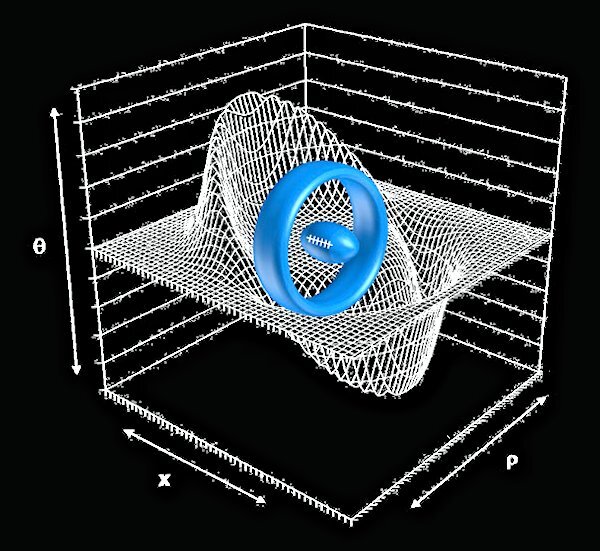
An Alcubierre warp drive bubble, showing spatial compression ahead of the bubble, and spatial expansion behind (Image: NASA)
The warp effect uses gravitational effects to compress the spacetime in front of a spacecraft, then expand the spacetime behind it. The bit of spacetime within the warp bubble is flat, so that the spacecraft would float at zero-g along the wave of compressed and expanded spacetime. The net effect is rather like surfing, where you are nearly stationary with respect to the wave, but are traveling with the speed of the wave. Whereas many of the theoretical studies consider a warp bubble moving at ten times the speed of light, there is no known limit to the potential speed.
Such a warp bubble could in principle be used to enable subluminal travel (travel slower than light) as well as superluminal travel (travel faster than light). This may seem a silly choice – why travel slow rather than fast? However, it is likely to turn out far easier to achieve a subluminal warp drive for a number of fundamental reasons. Besides, space travel at 90 percent of the speed of light is far superior to anything we currently have on the books.
This sounds too easy, and in many ways, it is. Thus far, all superluminal warp drives require negative energy and pressure to form and maintain the warp bubble. Matter consistent with such properties does not exist in classical physics. While in quantum mechanics there are certain possibilities for negative energy phenomena, they generally do not seem well suited to generate the required warp bubble.
An additional problem is that a great deal of negative energy is required to initiate a warp bubble. For Alcubierre's original model, it would take more negative energy than the total mass of the Universe to equip a small spacecraft to travel at ten times light speed. Fortunately, refinements to the model have resulted in the energy requirements reducing to the mass equivalent of a few hundred kilograms of matter with negative energy. Mind you, we don't know how to get that quantity either, but it feels a more likely prospect.
Matter with negative energy and negative pressure is usually called exotic matter, and we don't know of any. However, another possibility is to use dark energy to expand spacetime – after all, that is how we know dark energy exists, through observing the accelerated expansion of the Universe. Although nearly three-quarters of the mass-energy of the Universe is dark energy, it is spread thinly, at the equivalent of about ten hydrogen atoms for every liter of space. Given this, harnessing dark energy for warp drives might seem an overwhelming task.
That doesn't mean it's impossible however. To put this into perspective, consider magnetism. The interstellar magnetic field is about a nanoTesla, or about one-fifty thousandth of the Earth's field. If this is all we knew of, harnessing magnetism for any practical purpose would seem unlikely. However, a tiny rare earth magnet exhibits magnetic fields 100 million times stronger than the interstellar field. It isn't wise to recklessly eliminate possibilities.
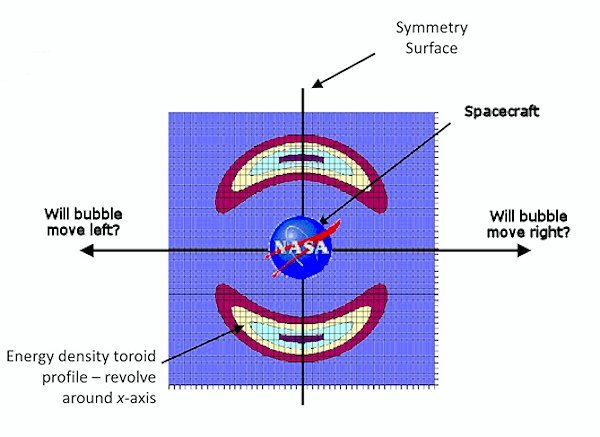
Schematic illustration of the warp bubble symmetry problem (Image: NASA)
All warp bubbles have unknown difficulties concerning turning them on and off. It isn't that models for this process can't be composed – rather the models are too complex to analyze. In addition, to date warp bubbles are symmetrical, so how do they decide which direction to move? A recasting of the relativistic theory of warp bubbles suggests a solution to this dilemma, but the theoretical analysis appears to be faulty. It isn't clear if the faults can be patched without losing the result.
Other problems with superluminal warp bubble drive include the apparent need to generate the front edge of the warp field, which is moving faster than light. In some cases it becomes impossible to control a superluminal warp drive from the spacecraft within the bubble, which would be embarrassing to all concerned as the ship continued to travel forever, or at least until it hit something. Speaking of hitting something, we presently have no idea what happens if a warp bubble hits an external object.
Many models of superluminal warp bubbles also have visible event horizons which are likely to generate high levels of Hawking radiation. Some researchers believe the spacecraft would be incinerated by this radiation, some believe it would not present a problem. The jury is still out, but it seems likely that such problems can be avoided.
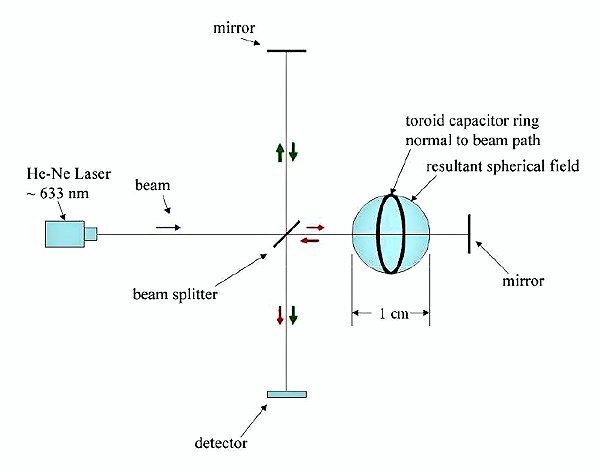
NASA's White-Juday Warp Field Interferometer can detect the warping of space in the 1 cm experimental volume of a part in ten million (Image: NASA)
Before creating a warp bubble, it would be nice to know something about how various sorts of physical inputs can actually warp space. This is the intent of NASA's new White-Juday Warp Field Interferometer (WFI). The WFI is a conventional interferometer, capable of measuring changes in the various path lengths of as little as a nanometer. In this case, however, the path lengths are not changed by moving the mirrors, but by warping spacetime in the small experimental volume. Length changes as small as one part in ten million will be detectable.
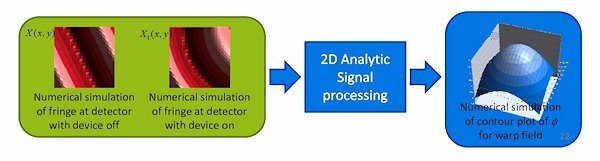
A positive signature of space warping in the WFI (Image: NASA)
The apparatus will first be tested to see if warping due to the electric field of an extremely high voltage ring electrode can be detected. If so, an optical signal similar to that seen on the left side of the figure above will result. Once the signal is analyzed, a plot of the amount of warping as a function of position within the charged ring will be generated.
The takeaway message is that, while practical warp drive is a long way off, serious efforts to learn more about the possibility are, on a small scale, being undertaken now. In 2022, a version of this article will probably be relatively certain whether an Alcubierre-style warp drive is a reasonable possibility or not.
Source: NASA Eagleworks

From an early age Brian wanted to become a scientist. He did, earning a Ph.D. in physics and embarking on an R&D career which has recently broken the 40th anniversary. What he didn't expect was that along the way he would become a patent agent, a rocket scientist, a gourmet cook, a biotech entrepreneur, an opera tenor and a science writer. All articles by Brian Dodson
Very nice article! Definitely enjoyed reading it, hope you continue writing for Gizmag.
Racqia Dvorak3rd October, 2012 @ 02:10 pm PDT
What an excellent article; most thorough and complete I've ever seen on Gizmag.
Todd Dunning3rd October, 2012 @ 05:30 pm PDT
This is why I love science. You can extrapolate to create a model and then work back again to try to realise what the model predicts. This is how we have managed to advance so quickly this past couple hundred years. Throw mysticism out as far as learning and understanding is concerned. I felt all warm and fuzzy inside reading about spacetime warp bubbles.
Scion3rd October, 2012 @ 06:49 pm PDT
It is fantastic NASA is taking steady steps towards interstellar travel. I hope they do more research about phased standing waves in order to stretch spacetime more efficiently without the need for negative energy.
3rd October, 2012 @ 07:02 pm PDT
Before we try to warp space we need to model the structure of space - space time in vaccum. With the discovery of Higgs boson we have made the first tentative move towards detecting the nature of vaccum. Now have to study the properties of Higgs and move on to physics beyond the Higgs boson which is the only way to reveal the nature of the exotic substance that forms the Higgs condensate that pervades all empty space.
Once we understand we can contemplate manipulating it eventually ending with something like a jet engine which propels empty space or vaccum. There you have our warp drive
Able Lawrence4th October, 2012 @ 03:44 am PDT
MHO is that physicists lose all connection with reality, mainly because quantum fysics presents such a mass of incomprehensible mathematics, from which supernatural phenomena are deduced.But I will be the first to congratulate NASA if the warp-drive works
jochair4th October, 2012 @ 06:18 am PDT
I can't wait to put one of these babies in my Mustang.
flylowguy4th October, 2012 @ 09:20 am PDT
Good piece, thanks
theotherwill4th October, 2012 @ 09:51 am PDT
This was a GREAT article. It really raised the bar for Gizmag. It was complete without being boring and introduced to reader to lots of paths for further exploration.
Well done!!!
Timothy Damien Rohde4th October, 2012 @ 09:54 am PDT
theoretical physics vs real world applications. funny how many theories fail at that point.
Artisteroi Rlsh Gadgeteer4th October, 2012 @ 09:55 am PDT
finally, a really good article
this is worth 1000 unreadable/unaffordable puzzle/watches, or antigravity pyramid lamps
wle4th October, 2012 @ 09:56 am PDT
Sounds a lot like the Soviet submarine torpedo (the Shkval), which used part of its fuel load to create a hi-pressure gas bubble directly in front of the missile (supercavitation). +400kph underwater speeds were previous thought to have been impossible...and these are only the published velocities.
Somewhere, someone will come up with a energy matter collector/storage system and that's what will be required in order to return from any such excursion...unless we've been down this road before and that's how we got to the planet :-)
Mirmillion4th October, 2012 @ 10:48 am PDT
",,,our descendants will someday see childhood's end."
I hope not. That was one of Arthur C. Clarke's annoying/depressing books.
Gregg Eshelman4th October, 2012 @ 11:40 am PDT
in the mustang indeed. I am more concerned with intelligent life on earth and that before death not after. pragmatics. nice article but it this not going to solve our ground transport anytime soon. this morning's report for the unfortunate many: 15 miles? 1 hour please! i had a revelat6ion this week, looking down upon a fully parked freeway. it was that this is how much parking it would take...and I was depressed all day, all night andslowly moved on and realized...we got here by seeking speed and convenience, gaining neither. If its 3p.m. and I'm on earth and I was spoze to be on.....that's what i see with pursuing Warped speed...warped priorities!
sorry for the rant and out of place at that
Walt Stawicki4th October, 2012 @ 12:10 pm PDT
ummm i think prior to a warp engine booting up particles are traveling in reverse then clicks into forward motion in a instant therefor producing traveling in front of the bubble effect. like dropping a stone in the water.
Dave Hargraves4th October, 2012 @ 12:24 pm PDT
The first ship to have one of these must be named The Roddenberry
Matthew Persico4th October, 2012 @ 07:34 pm PDT
Clearly if we can discover and harness that force that caused the expansion of the universe, then we'll have our warp drive. I had no idea that in the big bang space expanded at a rate mind-bogglingly faster than the speed of light.
So that clearly demonstrates it is possible in the realm of physics to have FTL travel. We really ought to be devoting a lot more money and research into this area, because it will allow us to travel to other planets within a short amount of time.
Just imagine what amazing things we could discover in other star systems and planets. Best of luck NASA, hope you guys solve this very difficult problem.
John Stone4th October, 2012 @ 11:57 pm PDT
The trickiest thing about travelling faster than the speed of light is that you won't see any obstacles approaching until after you've hit them. Hey who put that planet there? No need for a front windscreen, but you're gonna need a really good rear-view mirror!!
nutcase5th October, 2012 @ 04:28 am PDT
Nice piece of work, whether or not we have been visited by aliens has been a ongoing debate for many years, and were still at a loss as to explain what's is or isn't going on. Maybe in the future, we might be the star hopping aliens, using warp drive to explore the universe. Some planet we choose to observe out of curiosity may too come to a blank, as to what is buzzing through their skies.
Thomas Lewis5th October, 2012 @ 03:43 pm PDT
still don't think having the functional equivalent of a black hole anywhere close by is a good idea.
The proverbial cat in the box question-
experimental observations and the lid-
if the cat exists in the box before the lid is removed then a (that?) cat must exist outside the box. semi- logic iff P>Q>R R>Q Q>P is obeyed, R does not necessarily imply P.
in quantum mechanics-
The light bent by a black hole between the far side of the universe and here and whether or not it affects the speed of light or follows the gravitational and magnetic feilds like a laser does with magnetic ones (constant speed? vs bent space or a sea of holes?). Though a large distance might be full of anomalies , its proabably more detectable.
The basic equation being E=mC**2. (Kinetic,gravitational, or otherwise. aka- planet mecury orbit and einsteins' few (42?)
seconds difference vs newton). I'd think it'd be similar at a photon level (wave/particle reynolds numbers maybe?). The black hole being anti-mass (gravity is still positive? 0=infiti)? warping space or just the feilds associated with its mass warping space?
From there- how close to a black hole can you get without being caught by it- and slingshot close to the speed of light. When the speed of light is not constant what happens to the assumptions behind the equation.
where does a hole open up? or space get folded (bypassed?)- the cat (a cat?)
In terms of the Higgs-Boson particles existence its more tied to solving a unified feild theory -einsteins or not. The existence
of the anti partcle being a cat that is outside the box and needing a cat in the box to determine if the affects/effects are due
to the cat. The experimental assumption is predicated on deterministic math-the assumptions dictate its limits. The cat begs
the question does space really bend( the anti-partcile exist) or is it just the assumptions used to solve the math non-deterministically.
Theory is the cat is in the box- what is the cat- what does the cat do. quantum math? with what cat assumptions/postulates. assume there is a cat. not knowing what a cat is- its twenty questions (like looking for a sea of holes or a bend in space:
so is the speed of light a constant? are particles(pl.) like any other fluid?(waves and reynolds numbers) How big to measure what parameters of cats?
much like any theory-experiment-theory process (existential engineering- learn by doing- whether "its not possible" or not-the mindset gets it closer to reality (what a concept...)
Kwazai7th October, 2012 @ 07:09 am PDT
This is a really provocative article. Warp drive possible! I mean just the fact that the theoretical physics has been given credibility is staggering for the idea of actually travelling to distant star systems. It is possible, somewhere out there, that another lifeform figured this out and may have been travelling all over the universe for thousands or millions of years. As big as the universe is, they still may have never visited this blue marble, much less visited when there was anything interesting going on.
James Albert Hooper IV7th October, 2012 @ 10:06 am PDT
a beautifully written article. why not create a bubble with no higgs particles inside it. Meaning that inside and outside of the bubble are space and the walls of the bubble are higgs-less so therefore the ship in the center has mass but the space that it is in does not so therefore no mass = no speed limit.
squidfish7th October, 2012 @ 08:55 pm PDT
Enjoyed Mr. Dodson's article so much! Though far from scientific, leave it to the average joe ( uninformed ) to ask a dubious question or to wonder aloud stupidly such that science's eyes might somehow re-open to new avenues for further exploration.
A famous comedian once quipped..." A day without sunshine is like...night!"
When one flips a light switch...does the light rush in or does the dark rush out?
Can one have an up without a down (apparently yes... if gravity is present) which then further begs the query... does an Australian lover actually go up on their lover?
Thus ...I (stupidly) wonder aloud...If light follows dark or vice-versa, why not explore the possibility of attachment to the attractive or repulsive moment between the two? For in such an attachment, it matters not which one leads or follows since at the very least the hitchiker would have to be at the minimum travelling at light speed.
I call this "Hitching a Ride on the Crack of Dawn "...
Thumbs up and Cheers to Gizmag and Mr. Dodson!
prpldd8ch8th October, 2012 @ 02:33 pm PDT
The problem with physics based on multiple theory is that the end result will almost never work. People forget that the Big bang is just a theory, and every aspect of it is just a theory, the idea that all matter came from an exact point in space (smaller than an atom) is a ridiculous theory, that it all happened in an instant is a theory, that the matter moved many times faster than the speed of light is a theory and that it then slowed down but is now speeding up is all conjecture and theory and basing physic laws on any or all of that will result in failure.
. I love the idea of travelling faster than light, but it is also relative to the observer. And Doesn't Hawking radiation have to come from solid matter? Not a pressure wave of "nothing" I would also imply that if light cannot escape a black hole than neither can any type of radiation made up of particals, and that all that radiation is coming from outside the event horizon.
Lastly, you can see ahead of you while travelling faster than light, the movement viewed in front will be sped up like it is on fast forward, the rear view would simply be black.
Ronald Wade Cooper13th October, 2012 @ 05:37 pm PDT
Fantastic article. This is what being a science writer is all about. Thanks for making this subject understandable and interesting to the non-physicist!
Kaia Simpson David26th October, 2012 @ 05:22 pm PDT
They'll probably be lucky to move faster than an ion drive. Where's the proof of concept that this even works on Earth? Physics these days are too far removed from reality to apply to it. Hopefully this will prove that much simpler mechanics operate. What is the problem with simply accelerating past the speed of light? Someone said it couldn't be done? Why not try to prove him right or wrong by actually trying?
So much time lost for the lack of scientific guidance to prove Special Relativity right or wrong once and for all?
albalma21st March, 2013 @ 08:24 pm PDT
Needed; a few tons of un-ergy.
Brian Hall5th May, 2013 @ 06:28 pm PDT
Aren't there issues with FLT like causality violation? there's likely a cosmic censor for that that renders this a fundamentally flawed concept.
DonGateley8th May, 2013 @ 10:39 am PDT
Or Login with Facebook:
Just enter your friends and your email address into the form below
For multiple addresses, separate each with a comma
Privacy is safe with us because we have a strict privacy policy.


Super cool. Can't wait for the results!
James Tarquin Davis3rd October, 2012 @ 08:31 am PDT