For people who are unable to walk under their own power, exoskeletons offer what is perhaps the next-best thing. Essentially “wearable robots,” the devices not only let their users stand, but they also move their legs for them, allowing them to walk. While groups such as Berkeley Bionics, NASA, Rex Bionics, and ReWalk are all working on systems, Nashville’s Vanderbilt University has just announced the development of its own exoskeleton. It is claimed to offer some important advantages over its competitors.
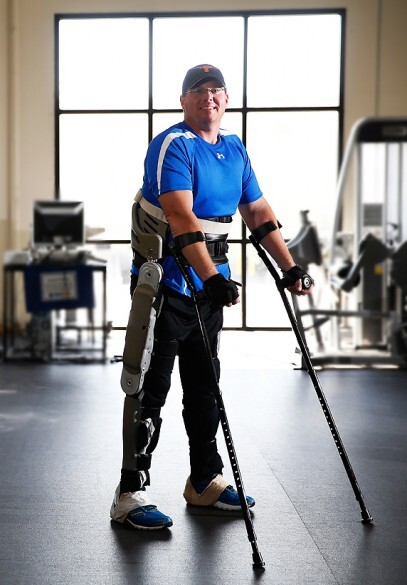
The Vanderbilt device attaches to the user’s torso, legs and feet. Computer-controlled electric motors in its hip and knee joints are activated by the wearer, bending their legs for them and moving them forward. As with other exoskeletons for the physically-challenged, the wearer still needs to use crutches or a walker in order to keep their balance.
As with a Segway, if the user leans forward, the machine will begin to walk them in that direction. Leaning backward and holding that position for a few seconds causes it to bring them to a seated position. If they subsequently sit forward for several seconds, it will bring them back up to a standing position.
According to the university, its exoskeleton is much sleeker and less obtrusive than other models – at a weight of 27 pounds (12.25 kg), it’s also said to be considerably lighter. This means that users could carry it packed and folded on the back of their wheelchair, then unpack it and strap it on (without any assistance) when they wished to use it. They could also wear it when seated in their wheelchair, if they anticipated going back and forth between the two.
Additionally, the amount of assistance provided by the motors automatically adapts to the amount of muscle control the user still has in their legs – this allows them to maintain a degree of physical fitness. Other products reportedly just provide “all the power all the time.”
It is also said to be the only exoskeleton that utilizes functional electrical stimulation. This is a rehabilitative technique in which paralyzed muscles are made to contract and relax via the application of small electrical pulses. It can reportedly build leg strength in people with incomplete paraplegia, while improving circulation, changing bone density and reducing muscle atrophy in complete paraplegics.

The exoskeleton was developed by a team led by Prof. Michael Goldfarb, who previously developed a bionic leg prosthesis that anticipates its user’s moves. Vanderbilt has licensed the exoskeleton technology to Parker Hannifin Corporation, which hopes to have a commercial version ready to go by 2014. A price estimate hasn’t been announced, although it is hoped to be significantly less expensive than other devices.
The prototype can be seen in use in the video below.
Source: Vanderbilt University