
DJ Hero Review
Green Wavelength's radical departure from conventional wind turbine design Green Wavelength unveils bumblebee inspired wind turbine
Subaru WRX STI TRAX Subaru WRX STI TRAX hits the backcountry
The Opera camper trailer has every conceivable luxury: electrically-adjustable beds, hot a... ‘Opera’ luxury camper trailer hits a high note
Zhong Lin Wang holds a prototype three-dimensional solar cell that could allow PV systems ... 3-D photovoltaic systems go where the sun don’t shine
Oasis of the Seas - world’s largest cruise liner Oasis of the Seas – world’s largest cruise liner sets sail this month
MORE TOP STORIES »
MILITARY

The electric cannon delivers shells over 200 miles at Mach 5

By Mike Hanlon

13:16 February 18, 2009 PST

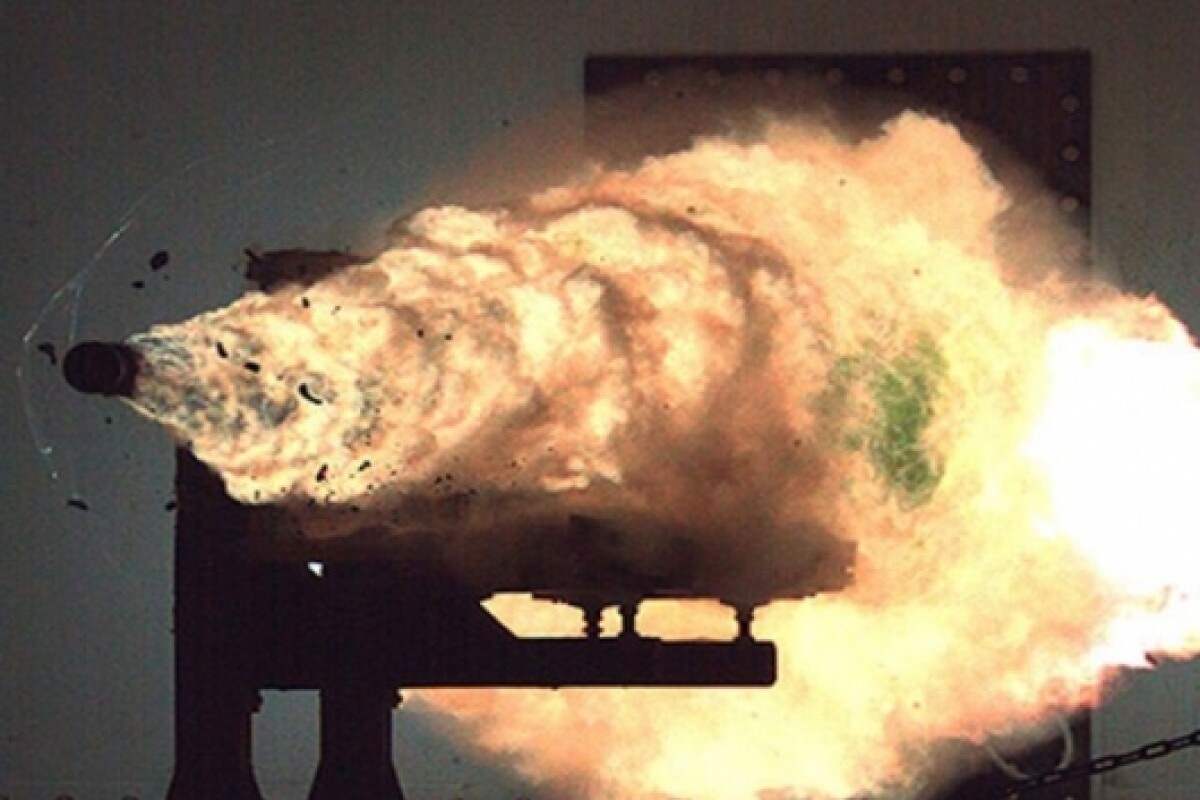
The first firing of the railgun in January 2008, was an historic and spectacular occasion

The first firing of the railgun in January 2008, was an historic and spectacular occasion

Image Gallery (3 images)

Think of the electromagnetic railgun as an electric cannon which uses electrical energy instead of chemical propellant to launch projectiles at hypervelocities. First conceived nearly a century ago, the concept was investigated by Germany during WWII, but has really only stepped out of science fiction and into reality in the last 12 months. With shells travelling at Mach 5 on impact, and accurate to within five metres at a 200 mile range, such weapons maximize the damage they do through kinetic energy, and hence don't need explosive payloads. Accordingly, they are ideal for naval warfare as they minimise the risk to warships which do not need to carry explosive warheads or propellants. Earlier this week, the US Office of Naval Research (ONR) awarded a USD 21 million 30-month contract to BAE Systems for the detailed design and delivery of an Innovative Naval Prototype (INP) Railgun. As previously warned, if the Daleks don't get here soon, they'll have a serious fight on their hands.

Under the contract, BAE Systems will develop advanced Railgun technologies including a composite launcher (barrel) that will be demonstrated in 2011. BAE Systems has partnered with IAP Research, and SAIC to develop the Railgun.

One of the greatest potential advantages for the Railgun program is the safety and logistics aspect.Safety on board ship is increased because no explosives are required to fire the projectile and no explosive rounds are stored in the ship’s magazine.

The technology uses high-power electromagnetic energy instead of explosive chemical propellants (energetics) to propel a projectile farther and faster than any preceding gun. At full capability, the rail gun will be able to fire a projectile more than 200 nautical miles at a muzzle velocity of mach seven and impacting its target at mach five. In contrast, the current Navy gun, MK 45 five-inch gun, has a range of about 13 miles.


User Comments (18)
 

Someone please explain to me why this rail gun is shooting out so much flame. Has the air ignited from the friction of the passing of the projectile?

thanks,

poidog

comment

poidog

- February 19, 2009 @ 04:02 am

The flames are most likely from the impact.

Rather than focusing on just the weaponry aspect, perhaps outlining some of the more peaceful aspect would be good. Could this be used for launching satellites, etc.?

comment

gknutson

- February 19, 2009 @ 05:02 am

The photo is taken at a very high frame rate, so the image you are seeing has captured the muzzle blast. When the armature leaves the bore of the launcher there can be a high level of electric energy remaining, causing the blast.

Using electromagnetic launchers for space applications is truly still an idea for science fiction. You have to realize that an enormous amount of energy is used to launch a projectile that is maybe 30kg. To launch a satellite into earth orbit would require a massive energy source. That said, you scale up a electromagnetic launcher, put it on the surface of the moon, and then you could potentially launch payloads to Mars (still science fiction of course). BUT, also note that the accelerations that the projectiles (and payloads of the future) are subjected to on launch are extremely large and could cause damage to the contents.

comment

robroy05

- February 19, 2009 @ 09:02 am

The MAP(magnetically accelerated projectile) idea for launching satellites is quite feasible and i believe a launch facility is being built, though i can't remember it off the top of my head.

However, pure magnetic acceleration to launch a satellite isn't very feasible. MAP designs to launch satellites use magnetic acceleration to build up centrifugal force inside a spiral track.

So, as far as a rail gun goes, orbital launch isn't something that will be explored soon.

comment

Racqia Dvorak

- February 19, 2009 @ 09:02 am

From popsci.com:

"The flames are from pieces of the projectile disintegrating; the 7-pound slug is jammed so firmly between the rails that when it's fired, pieces shear off and ignite in the air."

http://www.popsci.com/military-aviation-space/article/2008-02/navy-tests-32-megajoule-railgun

comment

loegaire

- February 19, 2009 @ 09:02 am

Peaceful aspect? HAH! Sorry to be cynical, but when have non-military applications ever come first?

Do I smell a new arms race? Yes, yes I do!

comment

wil9000

- February 19, 2009 @ 12:02 pm

Not peaceaful at all...

As for speed, load, etc - it's simple physics

E=0.5*m*v(squared),

so for E=12 MegaJoules,

m=13.4 kg this is the theoretical payload for the gun in the picture.

The actual payload would be considerably less.

SATELLITE LAUNCHING - I don't think this would ever be feasible. Maybe in the future.

Going from null speed to mach 7 over such a short distance means huge accelerations occur during the launch.

This would likely destroy any equipment.

Besides, a lot of heat would be generated while crossing the lower atmosphere.

Even if the satellite would resist the acceleration and temperature, the enormous electromagnectic fields inside the canon would likely fry any electronics inside the satellite.

Any ideas for a "peaceful" use for such a device?

comment

Rubin

- February 19, 2009 @ 02:02 pm

There is a few things going on behind that projectile. Rubin said a lot. There is so much energy that the air is...oxidizing, exploding. The materials: both the projectile and the weapons launcher are vaporizing (in part.) The object itself, as it travels, is part plasma; magnetized gas, superheated, and moving incredibly fast. Basically, its like getting hit by basketball sized mini sun moving at the speed of, well, the space shuttle...

comment

chards

- February 19, 2009 @ 06:02 pm

For launching satellites; A magnetic launch could work with rockets to get satellites into orbit cheap.

One of the biggest problems with rockets is the diminishing return as more and more of the fuel is used to lift more and more fuel as the payload gets heavier.....

With magnetic launch this issue can be avoided.

It would also allow the rocket to be launched at a lower percentage of potential thrust. This would increase safety.

Also, the magnetic launch apparatus could be connected to, but separate from the rocket and satellite. This would allow for launch without the strong electromagnetic fields produced interfering with rocket and satellite electronics.

As for the magnetic launch being a short launch; scrap off the side of a mountain. One that goes up to 14 thousand feet.....

It would probably cost as much as the crappy shuttle and all the peripherals they blew money on to keep it going.

comment

Dennis

- February 20, 2009 @ 05:02 pm

Dennis, the shuttle is not crappy, it happens to be one of the greatest achievements of our time.

And you would not combine a rocket with an electromagnetic launch. The whole concept of using EM launchers for space launch is to remove the rockets from the equation. And saying that the payload is connected to, but separate from the payload is like saying that the shuttle is separate from the main booster. But yes, you could feasibly design a EM shielding for the payload. The accelerations are the issue. That and the enormous amount of current required to produce enough of a Lorentz force to move a payload the size of a satellite.

And launch from a 14,000 ft mountain. Seriously? 400 miles = 2,112,000 ft. 28,000 miles = 147,840,000 ft. You really think launching from a mountain would help?

comment

robroy05

- February 23, 2009 @ 01:02 pm

Peaceful application? Hmm... Rig it to backfire and kill those developing it, perhaps?

comment

DanLightning

- February 23, 2009 @ 10:02 pm

The fire.

Rubin has it more or less.

Plasma, the rest is just buring air and projectile etc.

Peaceful applications?

If you want peace, prepare for war.

Spacecraft deployment?

If you could dig a big tunnel in Mt Kilmanjaro you could run the shuttle (or something) up it on rails.

Lower acceleration at an incline over a longer period.

Geologically stable.

The rest is politics unfortunately.

Cool gun man! They had an impact in the 1st gulf war which poked a small hole in an M1-A1 (nothing much does that) which they thought might have been a rail gun. (from the Russians)

comment

Craig Jennings

- March 2, 2009 @ 08:03 pm

Poidog: The muzzle flash you see is from the blast of the initial firing of a conventional charge, although a minor charge, to accelerate the projectile in the firing tube to a sufficient speed so as to overcome inertia and allow the electromagnetic forces to accelerate it to in excess of mach-7. Without this initial blast of acceleration, a substantial amount of the EME (electromagnetic energy) and barrel (rail length) would be used up just getting it from at rest to regular projectile velocities. I hope this helps with your question as to the source of the 'Muzzle Blast'. Let me know if I can answer any other questions IRT Rail Gun technology. I have been studying this for decades. John Kessler poppadock@hotmail.com.

comment

poppadock

- March 12, 2009 @ 12:03 pm

Robroy5,

The shuttle is not a great achievement of our time. It was a great achievement 30 years ago. Along with Rubik's Cube and the "word Processor".

The idea that rockets and electromagnetic launch are mutually exclusive is foolish. You use the best attributes of each to compliment each other.

Electromagnetic launch has all the power on he ground. So the facility can be built very heavy duty.

This is not possible when all the propulsion is on the launch vehicle.

If you cannot imagine a way to couple a EM launch apparatus to a rocket without them being a foot from one another, I am not sure what to say to that.....

And launching from a mountain is not about distance. It is about a having a long (many miles) EM launch facility to keep the G's down, and having a straight shot at a decent angle. While also cutting down on atmospheric density. Its a bit thinner up there.

As far as current needed, Really? Better to have rockets with the "explosive" power of the shuttle than to have a large generating plant on the ground? Really?

If you think this is wishful thinking, it is of course. There is only one institution that could make this happen and unfortunately it is NASA.

If left to its own devices NASA will never come up with anything better. Just the fact they have not been able to move past the shuttle shows their institutional Riga mortise.

comment

Dennis

- March 17, 2009 @ 06:03 pm

I ask you, who wouldn't want one? I'd love one... No more messy chemicals. No more smelly explosives. Simply marvellous. So much better for the environment. That is good for humanity isn't it? Sure it is....

I say that if we are going to obliterate each other we should strive to do it cleanly.

comment

Pieter

- April 21, 2009 @ 04:04 am

Robroy5,

Dennis is right. The Air Force looked at an EM launch system to place small satellites (~100kg) into orbit. The most likely design would mount the accelerator on the side of a mountain for the reasons that Dennis listed. You are correct that the design of the satellite would have to be carefully done to withstand the extreme g-loads necessary to launch within a reasonable length of accelerator. Of course, if you want to just launch bulk loads like, say, water, then the requirements get even easier.

Incidentally, the HAARP program looked to do the same thing with conventional but really really big cannons. There has also been some work on light gas cannons with multiple injection ports to sustain the acceleration.

You would still need a rocket in any case as the orbit would be quite elliptical. You would also need some sort of rocket motor to move the satellite into any different orbit and perform regular station keeping.

comment

Plasma Junkie

- June 1, 2009 @ 08:06 pm

How about launching nuclear waste OUT of orbit? No need to worry about damaging fragile contents, and packages could be as small as necessary?

comment

Christopher Jones

- July 26, 2009 @ 05:07 pm

Hey, maybe they could scale the whole thing down, and make an EM handgun...just a thought.

comment

windykites1

- October 19, 2009 @ 01:10 pm

RSS Feed for comments from this article RSS Feed for comments from all articles
Post a Comment

Login with your gizmag account:


Or Login with Facebook:


Connect
Gallery Images

Related Articles Email this article to a friend

Just enter your friends and your email address into the form below ...


Privacy is safe with us because we have a strict privacy policy.

Recent popular articles in Military
Recent Comments Featured Galleries