Paris Airshow 2013

Levytator – the curvy, energy-saving escalator

By

October 10, 2011

The Levytator uses curved modules to allow it to follow freeform curves

The Levytator uses curved modules to allow it to follow freeform curves

Image Gallery (6 images)

For over a century, escalators have followed a fairly straight path - with the exception of a few spiral and curved escalators found in cities including Reno and Osaka. Now a researcher at City University London has developed a new type of escalator called the Levytator that is capable of following freeform curves. This is achieved by replacing the traditional rectangular steps with curved modules that also allows the modules to be placed in a continuous loop. Not only does this open up the design possibilities for architects, it could also cut energy usage in half compared to conventional escalators.

Conventional escalators see redundant steps moving underneath those in use and require two separate escalators powered by two separate motors to carry passengers both up and down. Through the use of curved modules as steps, the Levytator, designed by Jack Levy, an Emeritus Professor of Mechanical Engineering at City University London, can be used in a continuous loop - following a curved path upwards, flattening and straightening out, before descending again. This means only one power source is required to carry passengers both up and down. Additionally, the weight of passengers traveling down can be used to offset the weight of passengers traveling up to further enhance energy savings.
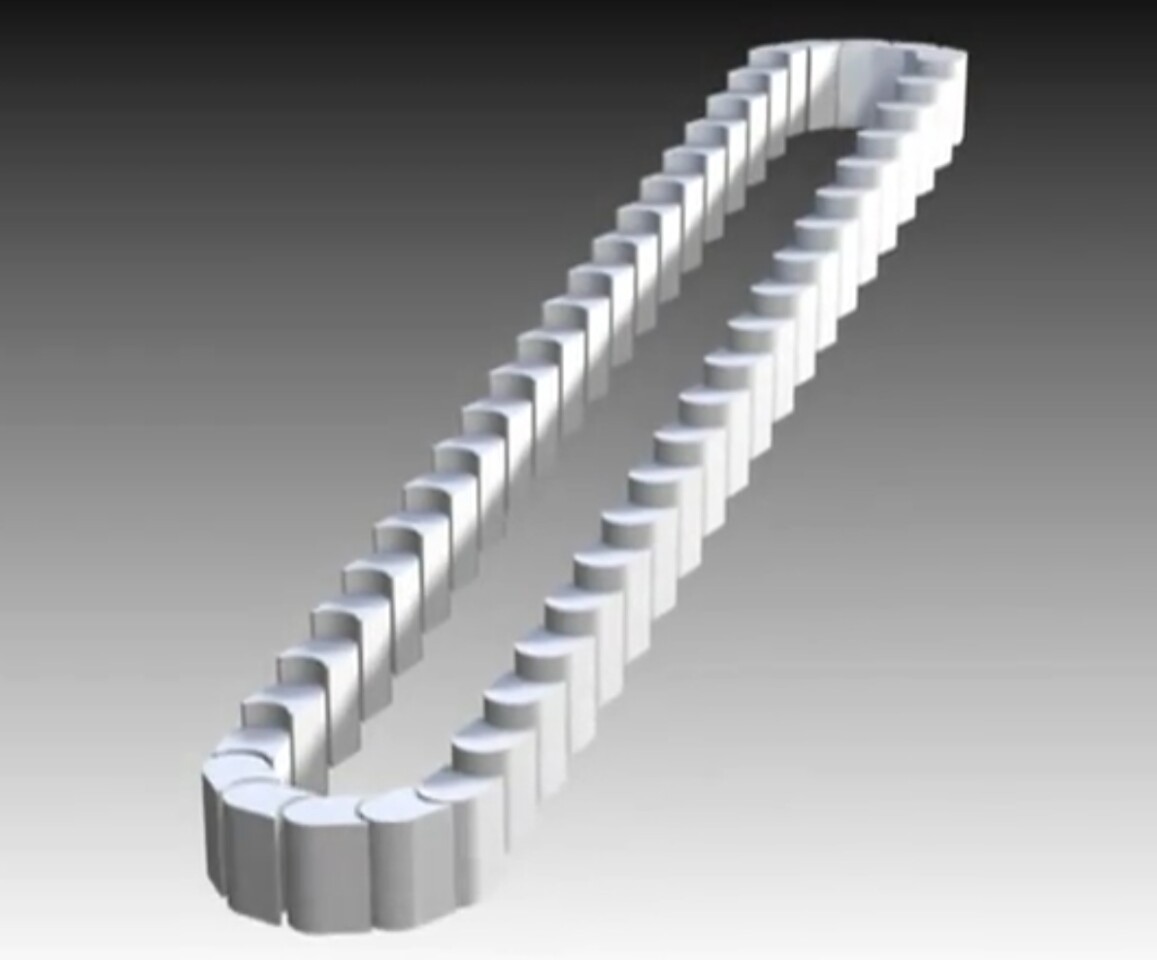
The Levytator allows curved modules to be placed in a continuous loop

As a result of mathematical modeling of the concept conducted with fellow University researcher, Elena Shcherbakova, Levy predicts that a fully-loaded Levytator with the maximum number of passengers traveling up and down would use around 80 percent of the power of two traditional escalators making the same trips. Meanwhile, a half-loaded Levytator with the down path full and the up path empty would use half the energy of the two equivalent escalators.

"The Levytator was primarily developed to give architects the ability to create escalators in any shape they want, but we've now shown that the design could significantly cut power consumption too. As utility bills rise and more organizations strive for green accreditation for their premises, we hope the Levytator can play an important role in cutting both energy use and the associated costs," says Levy.

But the advantages of the Levytator don't stop at aesthetics and energy savings. Because the curved modules are always "on top" and all the steps can be accessed from above, maintenance is much easier. Additionally, as no excavation is required for installation, the Levytator could be placed on top of an existing staircase.
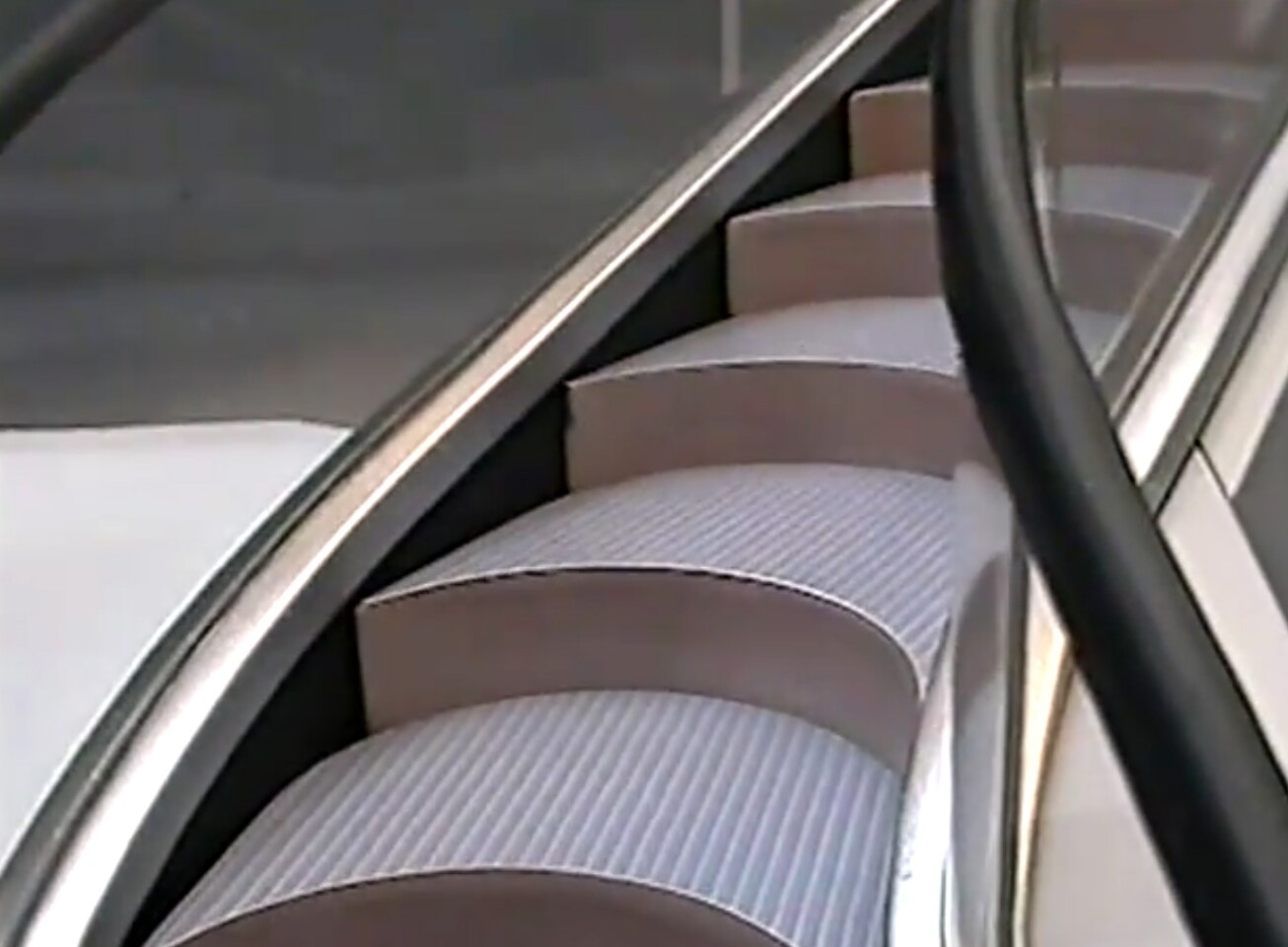
The curved modules used in the Levytator

"This could be particularly useful in the heritage sector, where the system could be placed on top of a grand staircase in a listed stately home, providing better access for elderly and disabled visitors, but not destroying the fabric of the building," points out Levy.

With such an ingeniously simple design and the obvious energy savings, it's hard to see Levytators not taking off. The only possible downside I can see is escalator walkers taking a dive after finding only thin air where they are used to finding a straight edged step. The technology has already been patented in the U.K., Europe, the U.S.A. and China. Revy has already built a scale model Levytator and City University London is currently in talks with investors, escalator manufacturers, architects and property developers worldwide, to build and install the first full-size Levytator.

Revy's functioning scale model Levytator can be seen in the following video.

About the Author
Darren Quick Darren's love of technology started in primary school with a Nintendo Game & Watch Donkey Kong (still functioning) and a Commodore VIC 20 computer (not still functioning). In high school he upgraded to a 286 PC, and he's been following Moore's law ever since. This love of technology continued through a number of university courses and crappy jobs until 2008, when his interests found a home at Gizmag.   All articles by Darren Quick
13 Comments

Don't think it will cut the power in half. Moving conveyor material around a turn will increase drag.

Also I think the single person upper entrance/exit would cause traffic problems in a high volume area

drakesword
10th October, 2011 @ 08:39 pm PDT

Where's the big innovation? You see this kind system at the baggage claim at virtually every airport in the world!

Laprivan of the Yellow Eyes
10th October, 2011 @ 11:02 pm PDT

The article says "Levy predicts that a fully-loaded Levytator with the maximum number of passengers traveling up and down would use around 80 percent of the power of two traditional escalators making the same trips. Meanwhile, a half-loaded Levytator with the down path full and the up path empty would use half the energy of the two equivalent escalators."

The energy halving would be when there is nobody going up but lots of people going down. Makes sense. With a bit of engineering, it should be possible to create a "regenerative energy harvesting function" when say at a sports event, all the people coming down the "stairs" would be charging batteries, or pumping water to a great height so that that can be used when the next time somebody goes up. Just like regenerative braking on electric vehicles harvests energy.

I don't ever recall see a baggage moving system which works in three dimensions. They're usually flat.

Joe Blake
11th October, 2011 @ 12:52 am PDT

I see exactly the same information, even the same video and pictures for at least a year, probably more. Just the information about possible power saving is new, but this is very logical as the same principe is used for centuries in mining elevators. So there is probably some bigger downside of this levytator when it is not yet replaced all existing escalators - i guess - price?

P.S.: why the steps are so tall? IMO they would need only about 1.5 to 2× of step height, so about 40cm, but on the picture it seems like 5× or so (1m). Saving the height so weight and dimensions needed would make it even more power saving and fitting in more places.

Tomáš Kapler
11th October, 2011 @ 02:27 am PDT

Conventional escalators can be set so all the paths move in one direction useful when filling a stadium or evacuating a burning building. On the other hand letting firemen ride to the burning floor cant be all bad.

Slowburn
11th October, 2011 @ 05:48 am PDT

@drakesword - made any calculations about it? They probably did, so they probably know what they're talking about. If you see the video at 0:50 there's way more ascending and descending movement than turning and there's no "single person entrance", because "The Levytator was primarily developed to give architects the ability to create escalators in ANY SHAPE they want"

@Laprivan of the Yellow Eyes - "I don't ever recall see a baggage moving system which works in three dimensions. They're usually flat", Joe Blake

@Tom Kapler - about the steps size? It's a model

How can you people keep talking about these innovations on this kind of website being such a short minded? Do something useful instead...

M.Digga
11th October, 2011 @ 07:00 am PDT

The crescent-shaped edges required will never meet any building code. There are always specific requirements for tread "depth".

Fixed spiral or winding staircases are only allowed in the US now with a 6-8" minimum depth at the narrowest edge of the tread - no more coming to a point, or even near that.

And yes, I am a builder.

Forrest

McDesign
11th October, 2011 @ 10:12 am PDT

Too many commenters have 'shot from the hip' before checking it out completely proving that it is too easy to say something critical and be wrong. Tread depth appears to be within minimum depth full width because the treads are not complete ellipses and the curves allowed are not extreme enough to require that much narrowing.

However it may be that this escalator needs to be narrow enough that most passengers can grasp both handrails, which could preclude the passing width common on American escalators.

Paul Gracey
11th October, 2011 @ 11:44 am PDT

Creating energy savings by any means possible is a part of the solution and deserves the consideration of even building codes if we are going to make a difference.

DanMar Dinsmore
11th October, 2011 @ 11:57 am PDT

Who was it who said "I like escalators.... when they break down they become stairs".

warren52nz
11th October, 2011 @ 12:54 pm PDT

Bla Bla Bla nobody sees the real problem.

The idea is good, but it is not enough to be usefull.

The real problem is the hand rail, you can´t bend the ruber hand rail sideways!!

Thats the only problem to be solved

jorgelansi
22nd October, 2011 @ 11:22 am PDT

Oh yes, you can! If you realy want to. I am sure it WAs solved... Cool!

Martin Pierre Pernicka
28th October, 2011 @ 07:47 am PDT

This is one of the best ideas concerning urban transport I've seen in the past 10 years.

I hope something similar can be done for elevators too.

Andreja Sinadinovic Vijatovic
19th March, 2013 @ 11:37 am PDT
Post a Comment

Login with your gizmag account:

Or Login with Facebook:


Related Articles

Just enter your friends and your email address into the form below

For multiple addresses, separate each with a comma


Privacy is safe with us because we have a strict privacy policy.

Looking for something? Search our 23,022 articles