Water
Vapur - the reusable, flexible water bottle
By Jeff Salton
21:47 February 3, 2010 PST

Personally, I’m not a fan of bottled water. Firstly, tap water in many parts of the world is safe, tastes fine, and it's free. Then there's the waste that bottled water causes – an enormous amount of energy is consumed in manufacture and most bottles end up in landfill. So when I see a product like the Vapur, I instantly warm to it. It’s a flexible, reusable water container that rolls up like a tube of toothpaste when it's empty to fit in your pocket, purse or backpack – then in the dishwasher, not in the trash. Read More
Has the human gekko's time finally come?
By Darren Quick
22:33 February 2, 2010 PST

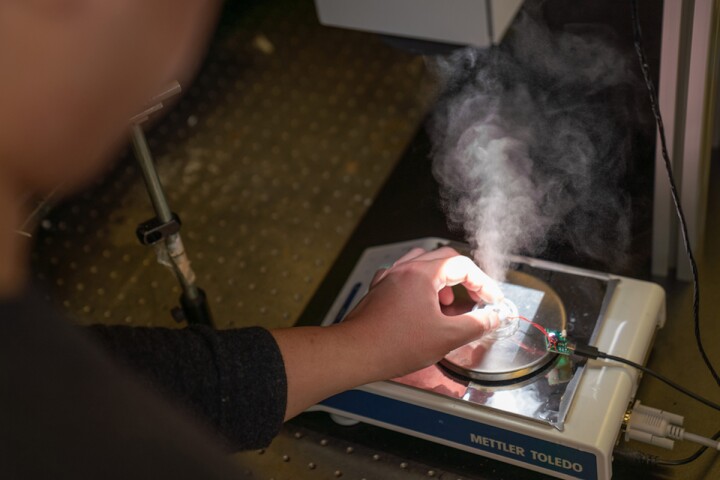
Researchers at Cornell University have created a palm-sized device that uses water tension as a switchable adhesive bond and can support many times its own weight. The device could usher in a whole new generation of superheroes by allowing shoes or gloves that stick and unstick to walls on command, or see the creation of Post-It notes that can bear loads. Read More
A first-ever human-powered Canada-to-Hawaii crossing?
By Ben Coxworth
17:13 January 27, 2010 PST

Back in January 2007, we brought you the story of Greg Kolodziejzyk, a Canadian adventurer who was planning to break the human-powered transatlantic record. What made Greg’s record attempt so interesting was that he was going to do it in a fully-enclosed pedal-powered sea kayak. The boat was still under construction at the time. Flash forward to January 2010, and Greg has had to call off the transatlantic attempt due to logistic problems. His new boat, however, is a marvel of marine engineering, and he’s planning on pedaling it from Canada to Hawaii. Read More
NEPTUNE Canada - world's largest cabled seafloor observatory goes live
By Ben Coxworth
20:00 January 26, 2010 PST

Deep-sea research is great and everything, but man, those submersibles can get pretty cramped. The other, bigger problem is that it requires going off and traveling on a ship, which is costly and can therefore only be done a few times a year. Fortunately, however, there’s now a way of obtaining real-time undersea data without leaving your office. NEPTUNE Canada, the world’s largest and most advanced cabled seafloor observatory, officially started going live to the Internet last December, giving anyone with an Internet connection free access to what will become an absolute mountain of data from the bottom of the sea. Read More
Personalize your showering experience – even remotely – with the Moen ioDIGITAL
By Jeff Salton
06:04 January 22, 2010 PST

Currently, your iPod might have your favorite songs personalized the way you like them and your laptop might be customized with your own homepage material. But what about your shower or bath? Do they know what you like? An easy-to-use interface for your bathroom is now available from Moen that gives you the ability to set and maintain water temperature, levels and flow with electronic precision – even remotely. The ioDIGITAL is available for three Moen products: the vertical spa, shower and Roman tub. Read More
Your very own self-sustained micro-ecosystem
By Ben Coxworth
00:13 January 22, 2010 PST

Have you ever wanted to create your own little planet? Do you like aquatic life, but think that aquariums are too much work? If your answer to either of those two questions is Yes, then you might quite enjoy owning a miniature closed aquatic ecosystem. All you need is a credit card, or a clear glass jar, some stuff from a pond, and an appreciation for things that exist on a small scale. The result will be a self-sustained miniature world that doesn’t need feeding, filtration, or anything other than light, from the outside world. Read More
DiCAPac has a dry idea for your electronics
By Jude Garvey
13:37 January 20, 2010 PST

Waterproof cases for cameras are not a particularly new idea but a new range of waterproof bags from Korean company Dicapac, may make you look twice. The covers are suitable for most portable electronic equipment, including your digital camera, camcorder, cell phone and MP3 player. They are transparent, flexible and some covers are waterproof up to 33ft (10 meters). Many also contain a UV coated optical lens – made from the same plastic material as aircraft windows – making them durable, scratch resistant and super clear. The good news? Unlike some other waterproof cases, they are surprisingly affordable. So you can stop worrying about water damage from splashing, rain or snow and focus on taking the perfect photograph. Read More
Mobile MaxPure solar filters bring pure water to refugees
By Jeff Salton
23:01 December 22, 2009 PST

Recently we reported on Marines and their deployment of GREENS solar-power for technological devices on the battlefield. World Water and Solar Technologies (WWST) has also placed solar-powered water purification units throughout the world including war-torn Darfur, Sudan. Working with the Humanitarian International Services Group (HISG), two high-volume Mobile Max Pure (MMP) water filters have been installed that use the sun for their power. Placed in a carefully selected location where it could do the most good, each unit can generate up to 3.5kW of solar electric power and provide 30,000 gallons of clean drinking water for the many thousands of displaced civilians. Read More
Silica nanoparticles make wool even more wonderful
By Darren Quick
21:54 December 22, 2009 PST

Already regarded as a “wonder fabric” for its lightness, softness, warmth even when wet, and other qualities, scientists from China say they have been able to improve on the natural properties of wool. They say their discovery could give wool a “brain,” placing it among other “smart” fabrics that shake off wrinkles, shrinkage and “breathe” to release perspiration. Read More
IBM forecasts the next 5 big ideas for the next 5 years
By Darren Quick
19:20 December 20, 2009 PST

Casting one’s eye into a crystal ball is a risky undertaking that can leave the forecaster as visionary or fool – particularly if they are short term predictions that can easily be checked. But that hasn’t deterred the soothsayers at IBM coming up with their fourth annual “Next 5 in 5” list of innovations that will impact our lives in the next five years. Based on market and societal trends as well as emerging technologies, the latest list focuses on innovations that have the potential to change how people live, work and play in our burgeoning cities. Read More
The world's first osmotic power plant from Statkraft
By Paul Ridden
15:06 November 26, 2009 PST

The principle of harnessing osmosis has the potential to produce enormous amounts of energy anywhere that salt water and fresh water meet. We looked at some of the approaches to turning this theory into reality earlier this year, including Statkraft's plans to build a prototype power plant. The company's plans are now coming to fruition with Her Royal Highness Crown Princess Mette-Marit of Norway officially opening the world's first osmotic power plant prototype on November 24. Read More
New maps suggests Red Planet was blue
By Jeff Salton
16:42 November 24, 2009 PST

Could it be that Mars - the dry, red planet - once had an ocean so huge it covered around one-third of its surface … and that rain created it? New research by scientists from Northern Illinois University (NIU) and the Lunar and Planetary Institute in Houston would indicate that could be the case. Using an innovative computer program to produce a highly detailed global map of the valley networks on Mars, their findings indicate the networks are more than twice as extensive (2.3 times longer in total length) as had been previously shown in the only other planet-wide map of the valleys. These valley networks roughly form a belt around the planet between the equator and mid-southern latitudes, which would indicate the presence of a long-gone ocean. Read More
Using aerospace principles to ride a wave of limitless energy
By Darren Quick
22:45 November 22, 2009 PST

The ocean is a potentially vast source of electric power, yet wave-energy systems are rare as they generally offer limited efficiency, must withstand battering storms, and need to be tethered to the sea floor. But by applying the principles that keep airplanes aloft, a team of aerospace engineers is creating a new wave energy system that is durable, extremely efficient, and can be placed anywhere on the ocean, regardless of depth. Read More
New inexpensive method to clean oil from water
By Darren Quick
19:46 November 17, 2009 PST

The rainbow effect caused by varying thicknesses of oil film on water’s surface might be pretty to look at but is indicative of polluted water. This “oil sheen” proves especially difficult to remove, even when the water is aerated with ozone or filtered through sand. But now a University of Utah engineer has developed an inexpensive new method to remove oil sheen by repeatedly pressurizing and depressurizing ozone gas, creating microscopic bubbles that attack the oil so it can be removed by sand filters. Read More
Eureka! NASA strikes water on lunar surface
By Darren Quick
19:16 November 17, 2009 PST

Scientists have long speculated about the source of significant quantities of hydrogen that have been observed at the moon's lunar poles, and just a few months ago NASA announced that water molecules were indeed present, but in relatively small amounts. Now the Lunar CRater Observing and Sensing Satellite (LCROSS) that was employed to shed some more light on the presence of water on the moon, looks like it has done just that with preliminary data indicating the mission successfully uncovered water in a permanently-shadowed crater. Read More
Long awaited satellite to monitor water cycle reaches orbit
By Darren Quick
22:43 November 5, 2009 PST

The 658kg (1,450 lb) Soil Moisture and Ocean Salinity (SMOS) satellite launched by the European Space Agency (ESA) this week is the first ever satellite designed both to map sea surface salinity and to monitor soil moisture on a global scale. The unique radiometer it carries will enable passive surveying of the water cycle between oceans, the atmosphere and land thereby playing a key role in the monitoring of global climate change. Read More
More robotic fish spawned to monitor water quality
By Darren Quick
23:32 November 4, 2009 PST

Although fish numbers are in decline in oceans all around the globe, the same can’t be said for their robotic brethren. Like the “Robotuna” from MIT and the robots developed by a team at the University of Essex, the latest robotic fish from Michigan State University also take inspiration from nature. The aim is to give researchers more precise data on aquatic conditions and provide a deeper understanding of critical water supplies and habitats... and hopefully help improve the outlook for fish of the biological variety. Read More
Oasis of the Seas – world’s largest cruise liner sets sail this month
By Paul Lester
18:59 November 2, 2009 PST

Last year we introduced “Project Genesis”, the world’s largest and most expensive ocean liner. After a total of six years in the making, owner Royal Caribbean has now taken delivery of this 16 deck, 225,282 ton floating city which features 2,700 staterooms and can carry 5,400 guests. Now officially called “Oasis of the Seas”, the ship sailed from Turku, Finland on Friday, October 30 en route to her home port of Fort Lauderdale, Florida, for a U.S. debut on Wednesday, November 11. Read More
Unfold and go - the Citibot kayak
By Mick Webb
04:53 October 13, 2009 PDT

For those who love getting out on the water, but lack the extra space required to store a recreational vessel, comes the Citbot Folding Kayak. Lightweight and easily assembled, the kayak can carry up to 95kg and folds down into a convenient backpack weighing just 11kg. Read More
Water found on the moon – what will it mean for the future?
By Jude Garvey
22:18 September 24, 2009 PDT

Newspapers and websites around the world are buzzing with the news that water and hydroxyl (hydrogen and oxygen) molecules have been found in the polar regions of the moon. NASA announced yesterday that instruments aboard three separate spacecraft revealed that water molecules were present, although in relatively small amounts. It was also discovered that hydroxyl also existed in the lunar soil. Although the amount of water found is small, it is exciting in terms of potential for the possibilities of establishing a lunar base and even for creating spacecraft fuel. Read More
An interesting take on the PWC – but will the idea float?
By Mick Webb
06:46 September 17, 2009 PDT

With personal watercraft design evolving at what some may say is “a rate of knots”, a rather interesting concept has come to our attention. The brainchild of Spanish designer Miguel Angel, this cross between a Jet Ski and a body board is designed with speed and maneuverability in mind – but does the idea have what it takes when the going gets tough and the water gets rough? Read More
Four crucial resources that may run out in your lifetime
By Loz Blain
06:14 August 27, 2009 PDT

We're living in lucky times. Living standards - in the Western world, at least - are the highest in history. It's an era of relative peace and plenty that would amaze our ancestors. But it's not going to continue forever; we're already stretching many of our natural resources to their limits, and the world's population will jump from 6.5 billion to around 9 billion over the next 50 years. Get ready for a painful correction - here are four interconnected resources that are headed for a catastrophic squeeze within our lifetime. Read More
Minx 18V speedboat claims Corvette performance at a Camry price
By Paul Lester
18:07 August 24, 2009 PDT

If your idea of a day out on the high seas is a gentle sail around the harbor, a few cold beers and perhaps a spot of fishing, then the Minx Model 18V Powerboat is not for you. We’ve already seen PWCs like the Samba hit 65mph but the Minx 18V, described as a ‘supercar for the water’, can reach speeds of up to 80mph (75mph without modification) and claims to be 15-20mph faster than any stock PWC or mainstream jet boat. Read More
Process to clean wastewater also produces electricity and desalinates water
By Darren Quick
00:05 August 17, 2009 PDT

Desalination plants generally employ one of two methods to produce clean water – reverse osmosis or electrodialysis. Unfortunately, both processes require large amounts of energy, but an international team of researchers has proven a process that cleans wastewater can also remove 90 percent of salt from brackish water or seawater while generating electricity. Read More
Lancia speedboat boasts 1120hp of exhiliration
By Jeff Salton
01:14 August 14, 2009 PDT

It’s touted as the biggest and most powerful Lancia ever built, boasting a 1120hp engine, fast, sleek lines, no regard for speed limits and superior Italian breeding through and through. It’s the soon-to-be-released Lancia di Lancia – or Motor Launch – and speedboat enthusiasts are entitled to get excited about it. Read More


dariusvons
- February 10, 2010 @ 00:56 UTC