
Self-balancing
-
 Inspired by the wheel-bodied battle droids from Star Wars, a scientist has created a robot that rolls along on one big wheel, using its legs to steer. Instead of smashing the Rebel Alliance, however, this bot may one day be making deliveries.
 -
 Should you ever have wondered who invented the self-balancing "hoverboard" … well, it was a man named Shane Chen. He has now incorporated that same technology into a design for a two-wheeled electric car, appropriately named the Shane.
 -
 While quadruped robots may surpass their wheeled counterparts at traversing rough terrain, they still aren't able to move along narrow ridges. That could change, though, as scientists have devised a method of allowing them to walk on a balance beam.
 -
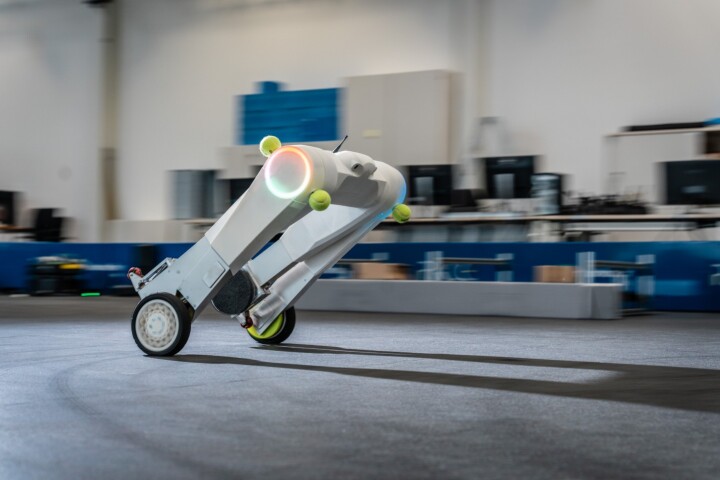 We've seen fast, nimble, self-balancing wheeled robots, plus we've also seen robots that can grasp and carry objects. The evoBOT could prove to be particularly useful, however, as it combines both traits in one clever machine.
 -
 It was just last year that we heard about the Ascento 2, a self-balancing, two-legged, wheeled, hopping robot. Well, as if it wasn't already impressive enough, its designers have now unveiled the even more capable Ascento Pro.
 -
 The ANYmal robot was already impressive back when it walked on four legs. It got more interesting when wheels were added, letting it both walk and roll. That wheeled version is now also able to stand up, and could soon be used for urban deliveries.
 -
 The urban e-micromobility mix includes lots of different ways to get around. Some roll on two wheels, others three, and there are microcars too. And then there are Onewheel skateboards. Now, Future Motion has announced new flagship and Pint models.
 -
 Pulling your stuff around in a cart is all very well and good, but … what if you want to keep your hands free? That's where the gita wheeled robot was designed to come in. There will soon be a smaller version available, known as the gitamini.
 -
 Beijing's Da Vinci Dynamics has launched its DC100, a high-performance electric streetbike with an impressive 250-mile NEDC range, and some wacky "robotic" tricks, including the alleged ability to self-balance and auto-follow you around.
 -
 Prior to its acquisition by Ninebot, Segway was mostly known for its self-balancing people mover that never quite captured the general public's imagination. With the S-Pod, Segway returns to its self-balancing roots with an electric chair-on-wheels.
 -
 At first glance the Mantour X from FlowDot looks like many other compact folding e-kickscooters. But when folded, it stays upright on its front wheel as you roll it smoothly along.
 -
 You might think that most new robots are designed to head off into factories or other workplaces, but the fact is that many of them are made to be used by robotics developers. That's the case with EVE r3, although its successor may find use in applications such as home care for the elderly.
Load More