
Royal Navy
-
 The Royal Navy is banking on state-of-the-art decoy launchers to protect its stealth ships. The £135 million (US$170 million) Ancilia Trainable Decoy Launcher project will counter the latest missile and drone threats.
 -
 In a newly declassified video, the $127 million DragonFire high-power laser weapon can be seen spectacularly blasting through mortar rounds and shooting down drones. It's the best look we've had yet of the top-secret battlefield game-changer.
 -
 Britain has fired its Dragonfire high-powered laser weapon at aerial targets for the first time. The test of the Laser Directed Energy Weapon (LDEW) on the Ministry of Defence's Hebrides Range was designed to demonstrate its power and accuracy.
 -
 The US, UK, and Australian governments have outlined a plan to provide the Royal Australian Navy with nuclear-powered attack submarines, which includes the development of a new AUKUS-class submarine that will include American and British technology.
 -
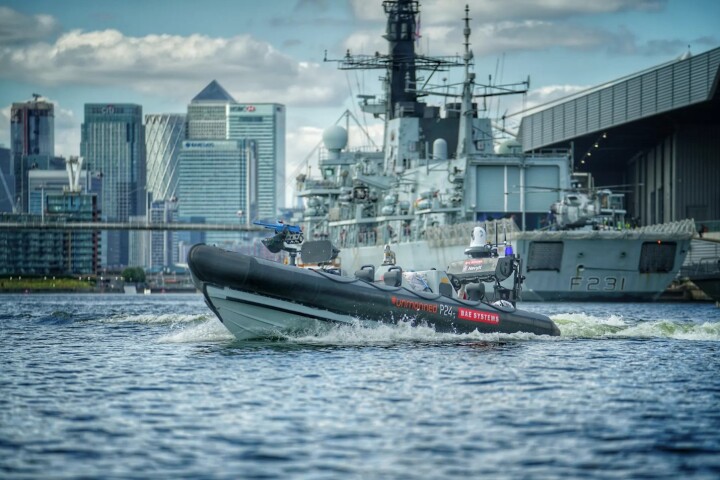 BAE Systems Autonomous Pacific 24 (AP24) Rigid Inflatable Boat (RIB) has taken a major step from development to deployment, the robotic naval vessel being awarded Lloyd's Register Unmanned Marine Systems Certification for its design and construction.
 -
 The Royal Navy has awarded a £15.4-million (US$18.9-million) contract to MSubs to build a cutting-edge robotic submarine, called Cetus, that will be the largest in Europe and will be capable of diving deeper than conventional submarines.
 -
 The first of the Royal Navy's Type 26 City Class frigates, HMS Glasgow, has begun a very slow launch, which will see it shifted onto a special barge before being slowly lowered into the water in an operation that will take days.
 -
 The Royal Navy's 700X Naval Air Squadron has completed intensive testing of heavy-lift drones at RNAS Culdrose in Cornwall, UK, to determine their fitness for resupplying aircraft carriers and other frontline naval operations.
 -
 Britain's supercarrier HMS Prince of Wales has become the first surface ship to be equipped with a state-of-the-art atomic clock as it departs for the Exercise Cold Response 2022 NATO joint exercises off the north coast of Norway.
 -
 Filling a gap in the UK Carrier Strike Group screen protecting the supercarrier HMS Queen Elizabeth, a Royal Navy Wildcat helicopter successfully fired new Martlet lightweight missiles for the first time during frontline operations.
 -
 The Royal Navy's latest supercarrier, HMS Prince of Wales, has launched jet-propelled drones from its flight deck for the first time as an experiment to see if autonomous aircraft can replace crewed fighters in simulated in-coming attack exercises.
 -
 A major shipbuilding program for the Royal Navy is now underway, with the first steel being cut for HMS Venturer, the lead ship of the Type 31 Inspiration class frigates, which will replace the navy's aging Type 23 frigates.
Load More