
Metamaterials
-
 Harvard engineers have created a strange new “metafluid” – a liquid that can be programmed to change properties, like its compressibility, transparency, viscosity and even whether it’s Newtonian or not.
 -
 A new type of 3D-printed lattice structure has surprised researchers with its strength and light weight. It uses two different lattice structures merged together to eliminate the weak points normally found in these complex shapes.
 -
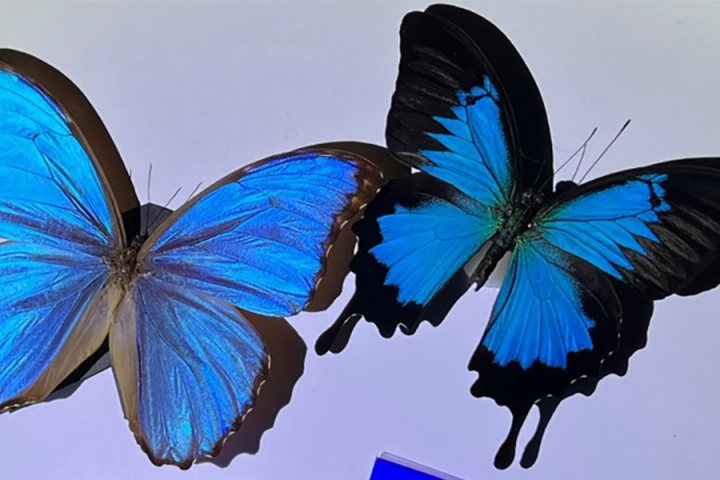 Lighter colors are cooler than darker ones, which can limit the practical palette choices for your clothes, car or house. A new material, inspired by butterfly wings, can produce vibrant colors while reflecting 100% of light to keep them cooler.
 -
 Engineers have developed a new system that can move objects without physical contact. The technique involves ultrasound waves acting on specialized surfaces to push or pull objects in set directions, which could help in manufacturing and robotics.
 -
 Researchers have developed a more precise design for "optical tweezers," using a metasurface lens studded with millions of tiny pillars which focus light to trap and manipulate individual atoms. It could pave the way for powerful quantum devices.
 -
 Although solar-powered devices are now fairly common, Swedish scientists have created something a little different. They've built tiny "metavehicles" that are mechanically propelled and guided via waves of light.
 -
 Though you can make objects smarter by adding sensors to them, a team of MIT engineers has managed to 3D print metamaterial structures with electrodes directly integrated into them to allow objects to sense user interaction.
 -
 Most conventional light microscopes have a resolution of 200 nanometers – this means that imaged objects which are any closer together won't be seen as separate items. A new high-tech microscope slide, however, boosts that figure to 40 nanometers.
 -
 Ultra wide-angle fisheye lenses are typically thick, bulbous contraptions, that can't easily be incorporated into devices such as smartphones. That could be about to change, though, as engineers have now created one that's completely flat.
 -
 ScienceImagine talking to someone across a crowd of thousands without using a phone, or sitting way up the back at a concert, but hearing everything perfectly. This is the promise of acoustic lenses, and researchers at the universities of Sussex and Bristol in the UK think they’ve something to shout about.
 -
 A team of researchers led by NASA and MIT has come up with radical new wing design that is not only much lighter than conventional wings, but also has the potential to automatically reconfigure itself to meet the flight conditions of the moment.
 -
 In our increasingly noisy world, it can be hard to find some quiet time. Now, a team of mechanical engineers at Boston University has developed a new device that is specially designed to block up to 94 percent of incoming sound waves, while still letting air pass through.
Load More