
MEMS
-
 Earlier this year, we introduced solid-state micro-speaker technology from California's xMEMS Labs that's designed to replace coil-based drivers in wearable audio products. Now the company is aiming for satisfying low end with the Cypress speaker.
 -
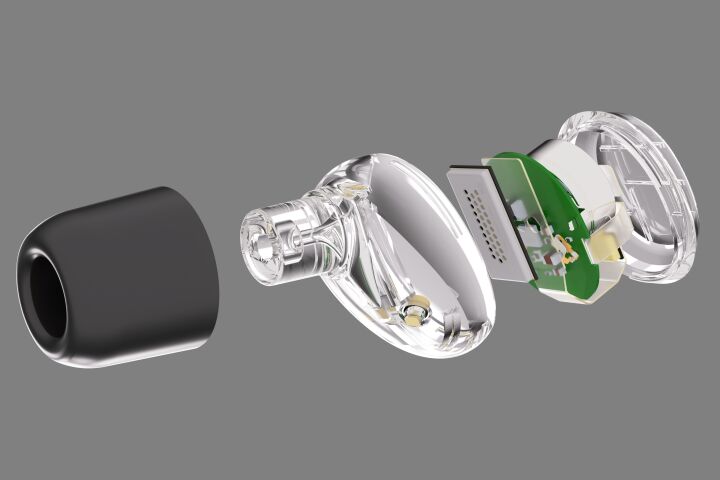 xMEMS Labs is aiming to replace century-old coil-based speaker technology with silicon-based microspeakers, and has launched three Solid-State Fidelity solutions for use in upcoming true-wireless earphones, in-ear monitors and digital hearing aids.
 -
 Although today's earbuds may seem small, they're limited in form and function by the fact that their speakers require membranes and magnets. A prototype microspeaker overcomes those limitations, potentially providing more uses for in-ear headphones.
 -
 A company spun off from the Fraunhofer Institute for Photonic Microsystems is looking commercialize a micro loudspeaker made from 100 percent silicon. After successful seed funding, Arioso Systems GmbH is now ready to take the technology to market.
 -
 Suppose that you had to build a tiny structure for use in a microelectronic device. Well, a new 3D printing technique would certainly make the process easier. It allows people to essentially draw minuscule metal items in mid-air.
 -
 Gravimeters measure tiny changes in the Earth's gravitational fields, and are useful in fields such as oil exploration. Now, using smartphone tech, scientists have made one that's smaller and cheaper than anything that has come before.
 -
 ScienceHow would you like to be able to know the chemical composition of something, just by taking a snapshot or video of it with your smartphone? You may eventually be able to, thanks to a compact hyperspectral imaging camera being developed at Tel Aviv University.
 -
 The latest in a growing line of wearable baby monitors is Monbaby, a large button-like device that can be attached to any item of clothing to monitor and provide analysis of your baby's sleeping patterns.
 -
 ScienceProfessor J.C. Chiao and his postdoc Dr. Smitha Rao of the University of Texas at Arlington have developed a MEMS-based nickel alloy windmill so small that 10 could be mounted on a single grain of rice. They are aimed at very-small-scale energy harvesting applications.
 -
 STMicroelectronics has announced a new MEMS-based module that integrates a three-axis magnetometer, a three-axis accelerometer, A/D converters, and control logic on a 2 mm x 2 mm x 1 mm surface mount chip, making it the smallest electronic compass available today.
 -
 Researchers at Tel Aviv University have developed a new micro-printing process that uses a non-toxic organic polymer rather than silicon to enable the production of biocompatible and energy-efficient microelectromechanical (MEMS) devices.
 -
 Lilliputian Systems, an MIT spinoff, has launched a USB battery charger powered by a miniaturized butane fuel cell, which will be able recharge most mobile phones about ten times, or a laptop battery once, from one container of butane.
Load More