
Laser
-
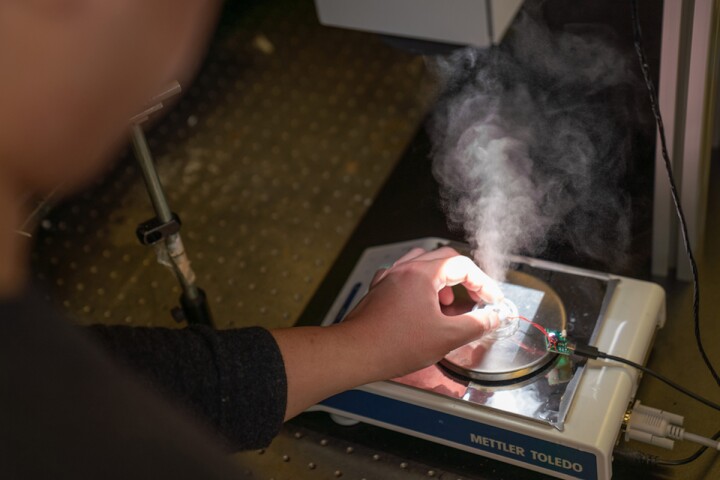 We all know that water evaporates when the temperature climbs, but researchers have just shown that there's another factor at play. The breakthrough could solve long-standing atmospheric mysteries and lead to future technological advances.
 -
 A smart projector with a novel five-channel dual-light optical engine and Dolby Vision? The Horizon Ultra went on sale late last year, and when I was recently given the opportunity to play catchup with the tech-packed home projector, I jumped at it.
 -
 Lawrence Livermore National Laboratory has published an extensive paper confirming the validity of its 2022 fusion experiment where multiple lasers focused on a sphere of deuterium and tritium to achieve the first fusion ignition in a laboratory.
 -
 In a move to make high-speed communications with deep space missions a practical reality, NASA is testing a giant hybrid dish antenna that is capable of handling both radio and laser signals across hundreds of millions of miles of space.
 -
 PFU America, which is part of the Ricoh Group, has added three laser projectors to its lineup, including its first short-throw model – a WUXGA box built around "advanced 3LCD projection technology" and capable of 4,500 lumens.
 -
 When using a handheld power drill, it can be difficult to ensure that the bit stays completely straight relative to the surface which is being drilled into. The Core is designed to help, by projecting a nifty laser sight onto that surface.
 -
 A plane wing that changes shape in flight to better handle the airflow crossing it could be on the horizon thanks to a materials science advance from researchers in Stockholm. The trick involves the melting and hole-punching power of lasers.
 -
 For two million years, a 10-feet-tall, 660-pound ape thrived in the forest, until it mysteriously vanished during the late middle Pleistocene. After 10 years of work, scientists at last reveal just what happened to our largest known distant relative.
 -
 Chinese projector company XGIMI has teased the first details of an upcoming long-throw projector that's built around its latest Dual Light Technology, and will also roll out with IMAX Enhanced certification.
 -
 Though projectors can certainly brighten up any room, the units themselves are not usually high on the list of considerations when it comes to interior design. LG is looking to change that with the compact CineBeam Qube 4K laser projector.
 -
 NASA has taken cat videos to a whole new level, with its Psyche Deep Space Optical Communications experiment beaming a 15-second high-definition clip of a playful tabby across 19 million miles (31 million km) of space to Earth.
 -
 Diamond is a promising material for data storage, and now scientists have demonstrated a new way to cram more data onto it, down to a single atom. The technique bypasses a physical limit by writing data to the same spots in different-colored light.
Load More