
Heating
-
 An energy supplier in Finland has announced the upcoming construction of an underground seasonal thermal energy storage facility about the size of two Madison Square Gardens that could meet the heating demands of a medium-sized city for up to a year.
 -
 A new industrial-scale “sand battery” has been announced for Finland, packing 1 MW of power and a capacity of up to 100 MWh of thermal energy for use during those cold polar winters. The new battery will be 10 times bigger than a prior pilot plant.
 -
 Fraunhofer scientists have used ultra-thin diamond membranes to drastically cool electronic components and boost electric vehicle charging speeds, taking advantages of diamond's outstanding thermal conductivity.
 -
 Scientists at MIT have directly captured signs of “second sound” in a superfluid for the first time. This bizarre phenomenon occurs when heat moves like sound waves through an unusual state of matter.
 -
 Just like any other organisms, crop-destroying soil microbes die if they get too hot. With that fact in mind, scientists have developed a new system in which soil-heating microwaves are used to kill such pests. It could one day replace pesticides.
 -
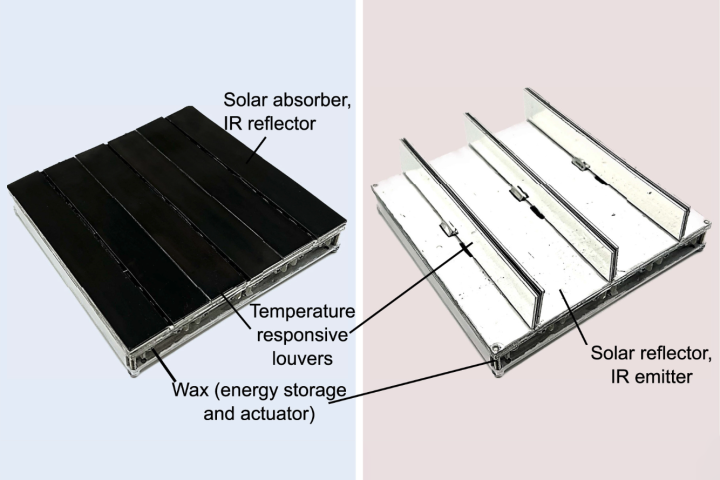 Using a temperature-driven "wax motor," researchers have created an adaptive roof tile system that helps keep a room at a comfortable 18 °C (65 °F). It delivers an extraordinary 3.1X reduction in cooling energy consumption, and 2.6X for heating.
 -
 Fourth Power says its ultra-high temperature "sun in a box" energy storage tech is more than 10X cheaper than lithium-ion batteries, and vastly more powerful and efficient than any other thermal battery. It's hoping to prove it with a 1-MWh prototype.
 -
 It’s a basic fact that temperatures drop at night, damaging crops, equipment and infrastructure. Scientists have created a new film that selectively absorbs and reflects different wavelengths of infrared light to efficiently keep objects warm.
 -
 Contrary to elementary school science class, it turns out that heat may not be necessary to make water evaporate. Scientists at MIT have made the surprising discovery that light alone can evaporate water, and is even more efficient at it than heat.
 -
 Researchers have created a low-cost fiber that contracts in response to heat, resuming its shape when the heat is removed. Compatible with existing textile-producing machinery, the shape-shifting fiber could have a myriad of uses.
 -
 Purifying polluted soil can be a difficult process, often requiring the soil to be dug up and transported to an offsite remediation facility. Now, however, scientists have developed an eco-friendly method of treating it where it lays – by zapping it.
 -
 The desert-dwelling Namaqua chameleon has a pretty neat trick – it changes skin color to stay cool when outdoor temperatures rise, and stay warm when they drop. An experimental new coating could one day do the same thing for our homes.
Load More