Articles tagged with "fraunhofer"

Page: 1 2

Bionic arm uses elephant’s trunk as a design model

Bionic arm uses elephant’s trunk as a design model

July 4, 2007 The more we learn about intelligent design, the more we understand the engenuity of nature, and the latest lesson in this regard has come during the development of a bionic robot arm by German researchers. The technology is expected to be used in therapy to restore the use of injured limbs, and low-cost, flexible prosthetic devices. Such devices could be commercially available within two years. (read more...)

Tags: bionic, fraunhofer , Robot
June 16, 2007  Lightweight wheels are a must-have for automotive enthusiasts as they significantly decrease unsprung weight and improve handling characteristics accordingly. Though fiber-composite materials are used in elite motorsport, and promise better

German researchers develop method for quality testing lightweight composite wheels

June 16, 2007 Lightweight wheels are a must-have for automotive enthusiasts as they significantly decrease unsprung weight and improve handling characteristics accordingly. Though fiber-composite materials are used in elite motorsport, and promise better long-term performance than their metal counterparts, they have been unable to make their way into the mainstream due to a lack of suitable testing methods. Standardized testing methods exist for conventional rims made of steel or aluminium, but there is doubt as to whether the testing methods for metal wheels can be applied to composite materials. Now German researchers have created a new method which can reliably simulate how an individual composite wheel will cope with the stresses of driving on public roads, including hitting the curb and potholes, and the meeting of quality standards, without destroying the wheel. (read more...)

Tags: fraunhofer
Vibration-compensated mini projectors

Vibration-compensated mini projectors

June 14, 2007 Miniature projectors embedded in our cell phones, handheld game consoles and other personal electronics appear very likely to play a major role in the future of information display. Projecting a large screen display on a wall appears the most effective way we can currently envisage having a large screen inside a small form factor. One of the problems will of course be that a handheld device projecting a large screen might not lead to a stable, vibration-free and easily readable display. Now German scientists from the Institute for Photonic Microsystems in Dresden have combined a compact laser projector system with inertia and yaw rate sensors to project vibration-compensated images. The sensor system detects the slightest motion and rotates the image to compensate for it, ensuring a steady picture, even in a moving vehicle. The system could be commercially available within two years. (read more...)

Tags: fraunhofer, Projectors
Video sunnies are on their way: MED's miniature eye-screens are now ready for mass-production

Video sunnies are on their way: MED's miniature eye-screens are now ready for mass-production

June 4, 2007 We've long been excited by the possibilities offered by wearable micro-screens. The ability to mount a miniature display in a set of glasses opens up a whole new portable video experience where any seat on the bus can be a personal movie theatre and you'll be able to enjoy your video in complete privacy. Now, with the anouncement of a volume manufacturing facility in Dresden, Germany, MicroEmissive Displays (MED) is ready to step beyond the prototype and bring commercial microscreens into the mass market. They'll start things off with mass production of the eyescreen ME3204, a 320 x 240 RGB display packed into a 6mm pixel array. It's tiny, bright and clear, with ultra-low power consumption, and the wearer sees the equivalent of a 30" screen at a 2 metre distance. (read more...)

Tags: Computer Human Interface, fraunhofer , Portable Video
Miniaturized color MEMS scanning mirror-based Laser Projector

Miniaturized color MEMS scanning mirror-based Laser Projector

May 31, 2007 The collective intelligence of the world’s technologists seems destined to give us the miniature projectors we’ve been promised for so long that will likely revolutionise personal infotainment in mobile devices, the automotive industry (driver assistance, Head-Up Display, etc), medical electronics (acquisition of biometrical data, positioning aid for X-Ray diagnosis and treatment etc), production technology (projection of reference points for drilling, pattern generator for tailoring of steel plates), and Metrology (structured lighting). Earlier this week we reported on the XXXX and now comes the news that a full color laser projection system based on a two dimensional micro scanning mirror technology will be shown at at the LASER 2007 show in Germany next month. The system contains an ultra compact projection head and a separate laser and signal processing unit. It allows the projection of arbitrary images and video sequences with a geometrical resolution of 640 x 480 pixels, 256 brightness levels per pixel and elementary color, and 50 hertz frame rate. (read more...)

Tags: fraunhofer, Projectors
3D laser structuring can burn microstructures into free form surfaces

3D laser structuring can burn microstructures into free form surfaces

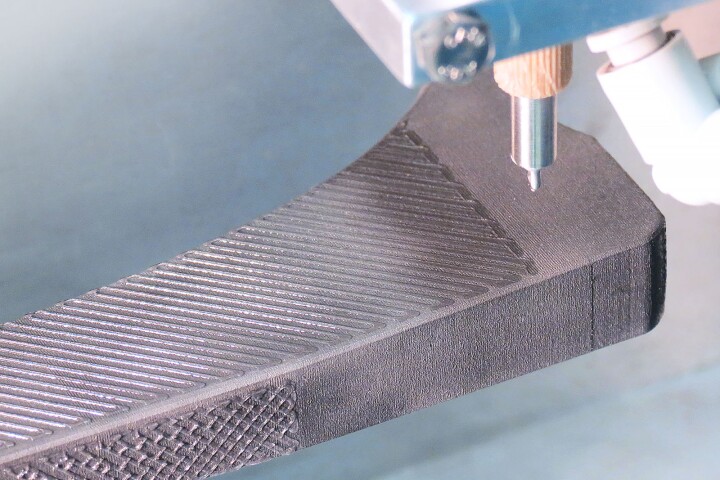
May 30, 2007 Micrometer-fine patterns in surfaces endow components with amazing properties: Plastic dashboards can be made to look like leather, sharkskin patterned ribs on an aircraft’s fuselage can significantly reduce air resistance and micro-recesses in human implants can dramatically improve connection with the bone. There are many reasons for applying microstructures but actually doing so is by no means easy. While lasers have been used for quite a long time to structure flat surfaces, the problems associated with using lasers on three-dimensional components of complex shape has ensured that etching techniques have had to be deployed, involving the use of large quantities of chemicals and costly processes. Now European researchers have developed a machine that can burn microstructures into free form surfaces. (read more...)

Tags: fraunhofer
micro-MIM - micro metal powder injection molding

micro-MIM - micro metal powder injection molding

May 9, 2007 Modern advanced production techniques are fast moving into the realms of the fantastic. We've regularly marveled at some of the modern advanced production techniques such a 3D printing and now there's a new one - micro metal powder injection molding (micro-MIM). Until now, the production of tiny metal parts using techniques such as etching or milling has been a very complex and time-consuming process, and not suitable for many types of metal. It has been possible for a long time to produce very small parts from stainless steel, but with micro-MIM, it is now possible to combine and shape different types of material such as this (pictured) biocompatible titanium stirrup, a replacement for the small bone in the human ear. (read more...)

Tags: 3D Printer, fraunhofer
3-D ultrasound from 2-D scanners for less than US$1000

3-D ultrasound from 2-D scanners for less than US$1000

May 7, 2007 Almost every doctor’s surgery in a developed country has a 2-D ultrasound scanner and for most parents it’s the first time they see their child-to-be. Apart from enabling us to see an unborn child in its mother’s womb, medical ultrasonography helps to detect gall stones, identify tumor-like lumps and it plays a particularly important role in the early detection of breast cancer. Three-dimensional sonography can provide especially informative images, for instance allowing the structure of tumors, their growth pattern and their blood supply to be clearly distinguished from healthy tissue. Although 3-D technology has been available since the 1990s, it remains prohibitively expensive. Physicians and clinics wishing to upgrade from 2-D to 3-D technology usually have to invest more than US$100,000 in new equipment. Now researchers have produced a system that enables conventional 2-D ultrasound scanners to be upgraded to provide 3-D images for less than US$1000. (read more...)

Tags: fraunhofer
The first commercially available Brain Computer Interface

The first commercially available Brain Computer Interface

The evolution of the Computer Human interface may seem to be rooted in the infernal keyboard and its recent travelling companion, the mouse, but much work is being done in the areas of virtual worlds, voice recognition, handwriting recognition and gesture recognition to give us a new paradigm of computing. It now appears we are on the edge of another brave new virtual world – the direct interface between the brain and the computer is here. One of the Holy Grail’s of research, there are many such projects going on around the world at present. Now the German g.tec (Guger Technologies) group has taken the technology out of the lab and into the real world with a complete BCI kit, and amazingly, there’s also a kit for a pocket PC - a super-low-weight biosignal recording system “g.MOBIlab” is used to measure the EEG and the data processing, analysis and pattern recognition are performed on a commercially available Pocket PC or in this case, your windows PC. The first BCI system will enable the composition and sending of messages, and control of a computer game. There’s also an invasive (implanted) option still being trialled in the laboratory – this is significantly more effective abnd the system can already accept and process input from both the embedded array and the cap array. Though the first work in the area is focussed on enabling paralysed humans to communicate far more freely, the potential to enhance one’s communications quite freely is clearly not that far away. There’s also the potential unlocked by putting such a device into the hands of thousands of eager and capable amateurs who will no doubt broaden the understanding of the human mind with their pursuits. The BCI system is nominated for the 2007 European ICT Grand Prize. (read more...)

Tags: bionic, Computer Human Interface , fraunhofer
The 2007 Lemelson-MIT Student Prize

The 2007 Lemelson-MIT Student Prize

February 15, 2007 If there’s an absolutely golden imprimatur for the person-most-likely-to-succeed, it’s the Lemelson-MIT Student Prize. Jerome H. Lemelson, one of the world's most prolific inventors, and his wife Dorothy founded the Lemelson-MIT Program funded via his own private philanthropic Lemelson Foundation, the Student Prize recognizes outstanding inventors, encourages sustainable new solutions to real-world problems, and enables and inspires young people to pursue creative lives and careers through invention. Given that MIT attracts the very brightest students to begin with, the winner is usually a stellar high achiever and this year’s winner is already that. 2007 winner Nathan Ball's inventions include the Atlas Rope Ascender (see separate story) and a needle-free injection technology that will enable greater efficiencies in mass inoculations, both capable of saving many lives and both with many commercial applications. Last year’s winner Carl Dietrich is the CEO and CTO of his own flying car company Terrafugia. We’ve also written about Saul Griffith, the 2004 winner. All the winners and their exploits in this article. (read more...)

Tags: bionic, fraunhofer , haptics
The Intellidrug tooth implant

The Intellidrug tooth implant

February 2, 2007 Man has been producing and administering drugs since the neolithic period. Initially these drugs were administered orally mixed with a liquid with the advent of pills making inhalation and the intramuscular or intravenous injection following. These days, the majority of the world’s drugs are administered via pills – pills offer an accurate dosage, but they are so convenient that it’s often possible to forget when you’ve taken them. Chronically ill patients get muddled when constantly having to swallow different numbers of tablets at different times, while those with dementia simply cannot cope. Now EU researchers are developing a better, more accurate and more convenient way – a dental prosthesis capable of releasing accurate dosages into the mucous membranes in the mouth. As it can administer accurate micro amounts over continuous periods, the prosthesis overcomes the peak concentrations that occur with taking pills and even offers the ability to monitor and maintain consistent blood levels of any drug. What makes the Intellidrug prosthesis unique is that, unlike existing drug prostheses and implants, it is small enough to fit into two artificial molars. Inside the patient’s mouth, it is readily accessible and can easily be maintained and refilled. (read more...)

Tags: bionic, Drugs , fraunhofer
The latest Autotram prototype

Dual-mode train-tram-bus systems gain momentum

December 2006 The concept of a dual-mode vehicle that will run on tram or train tracks and is also capable of driving on the road is gaining ground with the news that Japanese rail firm JR Hokkaido is poised to launch its dual-mode bus and rail vehicle we previewed two years ago. The company will begin conducting commercial tests in April 2007 and preliminary trials suggest the vehicle’s fuel cost is about a quarter of a diesel vehicle, and maintenance cost about one-eighth, while offering the flexibility to extend railed systems. Similarly, the European AutoTram concept is also gathering a following. The Autotram can be up to 36 meters long, can carry as many passengers as a streetcar while being as versatile as a bus. One of the key aspects of the Autotram is its flywheel energy storage system that facilitates a regenerative braking system and signficiantly cuts operating costs. The Bladerunner concept is another dual-mode transport system. (read more...)

Tags: fraunhofer
Smart technology for racing cyclists

Smart technology for racing cyclists

October 11, 2006 The future of sport is not just about training hard, it’s about monitoring the body and making intelligent decisions using the data available and a fine example of the high-tech understanding being developed in sport science is the work being done by Dr Martin Becker of the Fraunhofer Institute for Experimental Software Engineering IESE. Becker has developed a new intelligent training system which uses sensors, computers and actuators to help racing cyclists optimize their performance. Each bicycle is fitted with equipment that constantly registers the forces acting on the pedals. Further significant factors are the rider’s pulse and pedaling frequency, the speed and the gradient. All these readings are collected in a processor on the bicycle and radioed to a central processing unit where they are analyzed. The computer delivers individual training recommendations to each rider: He can view them on a display mounted on the handlebars or listen to them over headphones. (read more...)

Tags: fraunhofer, Racing
SX Pro automatically converts stereo into 5.1 Surround Sound

SX Pro automatically converts stereo into 5.1 Surround Sound

October 5, 2006 Best known for its development of the MP3, the Fraunhofer Institute for Integrated Circuits IIS is set to make another significant contribution to audio later today when it begins previewing a new technology to create 5.1 surround sound from existing stereo content at the Audio Engineering Society Convention in San Francisco. Fraunhofer IIS will demonstrate the high audio quality and high degree of creative control offered by the new SX Pro processing, which will be available for integration in software, consumer electronics, and professional hardware by the end of 2006. (read more...)

Tags: fraunhofer
First Bionic Arm fitted to a female patient

First Bionic Arm fitted to a female patient

September 15, 2006 The Rehabilitation Institute of Chicago (RIC), demonstrated its remarkable engineering and rehabilitation science know-how earlier this week by introducing Claudia Mitchell, the first woman to be successfully fitted with RIC’s Bionic Arm technology. The most advanced prosthesis of its kind, the RIC neuro-controlled Bionic Arm allows an amputee to move his or her prosthetic arm as if it is a real limb simply by thinking. The arm also empowers patients with more natural movement, greater range of motion and restores lost function. Using key learnings from the first successful Bionic Arm recipient, former power lineman and double amputee from Tennessee, Jesse Sullivan, RIC’s Bionic Arm initiative leader Dr. Kuiken and his team also have made significant advancements in the area of sensory feedback so that the patient can actually feel if they are touching hot or cold objects. We have excellent pictures and copies of Dr. Kuiken’s presentation to the media available in the image gallery. That's Claudia at top right in the main pic, the bionic arm bottom right, the nerve ending connections at top left and Dr. Kuiken and the first Bionic Man, Jesse Sullivan at bottom left. (read more...)

Tags: bionic, fraunhofer , Women
The Fraunhofer Multimedia Dome

The Fraunhofer Multimedia Dome

September 6, 2006 Making its first public appearance at the IFA international consumer electronics fair in Berlin, the Multimedia Dome is the first digital dome theatre to feature natural spatial sound: it envelops visitors in fascinating universe of video pictures and sound. The Multimedia Dome was developed at the Fraunhofer Institute for Computer Architecture and Software Technology FIRST and the Fraunhofer Institute for Digital Media Technology IDMT, the inventors of the MP3 format which has taken over the world in the last decade. (read more...)

Tags: Computer Human Interface, fraunhofer
MPEG Surround: quality multi-channel audio with backwards MP3 compatibility

MPEG Surround: quality multi-channel audio with backwards MP3 compatibility

May 19, 2006 We’re bullish about the prospects for MPEG Surround and see it as inevitable it will be adopted by the mass market. MP3 Surround enables high-quality surround sound at bit rates comparable to those currently used to encode stereo MP3 material. It is backwards compatible to stereo MP3; a legacy MP3 device plays back MP3 Surround as high quality stereo. Most importantly, it comprises a full set of tools enabling the representation, reproduction and rendering of multi-channel audio for a broad spectrum of applications, from digital broadcasting, to mobile entertainment, to Internet music distribution. It brings true surround sound to any media system at next to no overhead in transportation and storage, and preserves consumers' investment as existing home stereo equipment can stay in use. The Fraunhoffer Institute for Integrated Circuits IIS invented the MP3 and is working with Agere Systems, Coding Technologies and Philips, to demonstrate the full potential of the new Surround Sound system at AES (Audio Engineering Society) Pro Audio Expo which begins in Paris tomorrow. Wanna try for yourself? Go here to download a free evaluation version of the Fraunhofer IIS MP3 Surround player. (read more...)

Tags: fraunhofer, MP3
The four-wheel drive hybrid wheelchair

The four-wheel drive hybrid wheelchair

April 20, 2006 Technology is beginning to yield many new and wonderous devices to make life better, safer and more fun, but few can compare to the life-enhancement offered by a new wheelchair which offers mobility-impaired and aged people an unprecedented level of freedom. It is comfortable, all-terrain and safe - a four-wheel drive wheelchair with hybrid motor and electronic assistance system has the immense potential to enable the physically disabled live more independent lives, to enable Octagenarians to bushwalk, and paraplegics . The innovative system even checks pulse rate and blood values and calls for help in emergencies. (read more...)

Tags: fraunhofer, Hybrid
New real-world load monitoring system

New real-world load monitoring system

March 24, 2006 Just how far can you push weight reducation in a design before it breaks? What happens to a product after it leaves the factory? What stresses are placed on a mountain bike if the owner tackles a long set of concrete steps or a steep downhill slope or some steps on it? What is the magnitude and frequency of forces acting on the blade of a wind turbine? Computer simulation is one thing, but there’s no substitute for actually monitoring the loads a product will experience in usage, and German researchers have developed a new sensor system that does just that. (read more...)

Tags: fraunhofer
New data transmission record - 60 DVDs per second

New data transmission record - 60 DVDs per second

March 24, 2006 As the world’s internet traffic grows relentlessly, faster data transmission will logically become crucial. To enable telecommunications networks to cope with the phenomenal surge in data traffic as the internet population moves past a billion users, researchers are focusing on new systems to increase data transmission rates and it’s not surprising that the world data transmission record is continually under threat. Unlike records where human physical capabilities limit new records to incremental growth, when human ingenuity is the deciding factor, extraordinary gains are possible. German and Japanese scientists recently collaborated to achieve just such a quantum leap in obliterating the world record for data transmission. By transmitting a data signal at 2.56 terabits per second over a 160-kilometer link (equivalent to 2,560,000,000,000 bits per second or the contents of 60 DVDs) the researchers bettered the old record of 1.28 terabits per second held by a Japanese group. By comparison, the fastest high-speed links currently carry data at a maximum 40 Gbit/s, or around 50 times slower. (read more...)

Tags: fraunhofer
The Mental Typewriter

The Mental Typewriter

March 14, 2006 Scientists demonstrated a brain-computer interface that translates brain signals into computer control signals this week at CeBIT in Berlin. The initial project demonstrates how a paralysed patient could communicate by using a mental typewriter alone – without touching the keyboard. In the case of serious accident or illness, a patient’s limbs can be paralyzed, severely restricting communication with the outside world. The interface is already showing how it can help these patients to write texts and thus communicate with their environment. There’s also a PONG game (computer tennis) used to demonstrate how the interface can be used. Brain Pong involves two BBCI users playing a game of teletennis in which the “rackets” are controlled by imagining movements and predictably the general media has focussed the majority of its attention on computer gaming applications but BCCI could equally be used in safety technologies (e.g. in automobiles for monitoring cognitive driver stress), in controlling prostheses, wheelchairs, instruments and even machinery. (read more...)

Tags: fraunhofer
Bridge between worlds of simulation codes

Bridge between worlds of simulation codes

March 8, 2006 Simulation is vital to design and engineering: without repeated virtual testing, few high-end products would be what they are now. With an increasing need for high quality and reliable simulations multidisciplinary solutions become more and more important. Simulation technology is everywhere. Whether they are developing rocket engines, vehicle exhaust systems, bridges, heart valves or pressure valves, engineers always start by drawing up numerical equations. The equations for determining the various forces that combustion chambers, buildings or valves have to withstand and those that they need to control come from diverse physical disciplines. They may deal with the flow characteristics of gases or liquids on one hand, and mechanical forces on the other. Established numeric simulation codes exist for a majority of problems, but these can only partially represent reality: Coupling of different simulation codes, each specialized for a specific physical regime, is becoming more and more important for numerical simulations, both in industry and in research. The reason is that in many real-world applications the interaction of different physical phenomena must be taken into consideration in order to achieve high-quality predictions. The magic formula is known as 'code coupling'. (read more...)

Tags: fraunhofer
Shipping container with a mind of its own

Shipping container with a mind of its own

March 5, 2006 Radio frequency identification (RFID) of goods is currently revolutionising logistics. One practical application of the new technology is the Smart Box, a shipping container that can be located during transit and offers numerous other useful functions. One of the many applications for the new RFID tags is that of locating goods and containers in transit. German scientists have developed the “IFF Smart Box”, a container equipped with a scanning device that can check its contents by means of RFID. The data are forwarded to a small computer unit. A software combines them with the current geographical location determined by a GPS receiver. Various sensors can be integrated in the box, too, in order to measure parameters such as pressure, temperature or vibration. The information is transmitted to a database by mobile radio. (read more...)

Tags: fraunhofer
Soccer World Cup promises forefront of live sport services

Soccer World Cup promises forefront of live sport services

March 5, 2006 The FIFA World Cup has inspired more than a few brave plans for the employment of technology over the past few years, many of which never materialised. One that will be on show when the world descends on Germany in June and July is Servingo, a personalized portal designed to help the three million expected visitors to find their way around the twelve World Cup venues from Berlin to Munich. Every conceivable aspect of information related to the tournament is aggregated through the portal which was built at a cost of eight million euros with a view to helping World Cup visitors feel that they are "visiting friends". The portal is amazing, with a range of innovative features such as personally-tailored information systems and personal diary pages, but the highlight is the 3D reconstruction of scenes from the soccer match that enables the viewer to view a replay of key scenes from any point in the stadium – from the referee's perspective or the eyes of the goalkeeper. To make this possible, the team constructed 3D models of stadiums and compiled catalogs of players. An ingenious software program manages to generate the scenes from TV images. Sophisticated algorithms compare the 'visual template' of the virtual 3D players with the TV image and keep adjusting the virtual player's posture until it matches the video image. In this way, picture by picture, a scene from the match can be reproduced from any angle. (read more...)

Tags: fraunhofer
Artificial limbs that walk naturally

Artificial limbs that walk naturally

March 2, 2006 German scientists have developed a new type of prosthetic foot that imitates the natural walking motion so convincingly that you have to take a second look to realize its user is wearing a prosthesis. The foot is purely mechanical and entirely without elaborate electronics. (read more...)

Tags: bionic, fraunhofer

next page...

Page: 1 2


Editors Choice