Computers
Diamonds boost processing speeds in quantum computers
19:19 November 24, 2009 PST

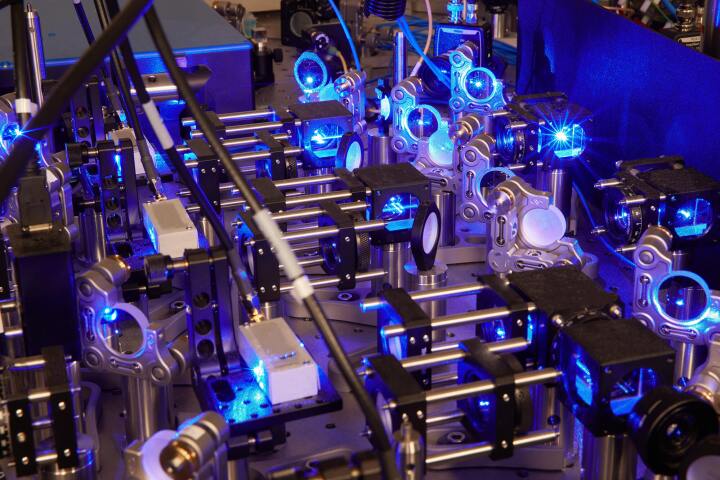
Scientists at UC Santa Barbara have made important advances in the field of spintronics by demonstrating the ability to electrically manipulate, at room temperatures, the quantum states of electrons trapped in the atomic structural defects of diamond crystals. Despite previous indications to the contrary, such quantum states can be manipulated very quickly, even at gigahertz frequencies, paving the way to significantly faster quantum computing. Read More
Bowers & Wilkins deliciously gorgeous MM-1 computer speakers
By Paul Ridden
13:27 November 19, 2009 PST

The makers of the award-winning Zeppelin ipod dock will shortly release some true hi-fi quality computer speakers which break away from reliance on the output capabilities of a system soundcard and connect via high speed USB instead. Boasting a frequency range of -6dB at 57Hz and 22kHz, outputting audio at 4 times 18W and incorporating music studio technology, the fully active MM-1 system could be just what audiophile deskbound digital music junkies have been waiting for. Read More
High-tech origami: Je Sung Park's recyclable paper laptop concept
By Jenna Meade
01:00 November 19, 2009 PST

In a world where concern for the environment is high on the agenda, it was only a matter of time before the laptop got a green makeover. Outstripping even the Bamboo notebook in eco-friendly credentials, designer Je Sung Park has pushed the concept to its limit and opened our eyes to the laptop of the future: a recyclable paper design. Read More
The GlideTV Navigator is a mouse, keyboard and AV remote that fits in the palm of your hand
By Darren Quick
03:54 October 14, 2009 PDT

TVs are no longer dumb receivers sitting in the corner of the lounge, displaying whatever trash the networks have decided to cram down our throats. Nowadays, a TV is just as likely to be hooked up to a home theater PC (HTPC) for playing games, accessing media content stored on a hard disk, or surfing the Internet. For more complex tasks like that, the humble remote starts to look a little underdone. That's where remote controls on steroids, such as the GlideTV Navigator, come in. It combines the functionality of a keyboard, mouse and AV remote control in one distinctive-looking unit that fits in the palm of your hand. Read More
10/GUI the human computer interface of the future for people with more than two fingers
By Darren Quick
03:43 October 14, 2009 PDT

Those old enough to remember the command line interfaces of yesteryear are only too aware of what a godsend the Graphical User Interfaces (GUI) of today are. However, the human computer interface (HCI) developed in the 1970s at Xerox PARC, combining a desktop metaphor GUI and mouse controller, has remained largely unchanged ever since. Now R. Clayton Miller proposes the next step in the evolution of HCI's with his 10/GUI concept that harnesses the power of multi-touch by removing the touch surface from the screen. Read More
Getac's resistive-type multi-touch technology works with or without gloves
By Darren Quick
02:34 October 9, 2009 PDT

Anyone who has tried to use a multi-touch touchscreen with anything other than their bare skin will know that it’s just not possible, no matter how hard you press. That’s because the capacitance technology used for the bulk of multi-touch devices doesn’t detect pressure, but measures the changes in electrical resistance caused by contact with a conductor – in this case, the human body. That might be annoying in cold climates, but is an even bigger problem in situations that require the wearing of protective gloves. Getac’s line of rugged Tablet PCs will be the first commercially-available rugged computers to solve this problem by offering a multi-touch screen that works with or without gloves. Read More
Frankencamera: Digital cameras get the open source treatment
By Darren Quick
02:15 September 4, 2009 PDT

Open-source started with the Netscape Navigator browser and has expanded to include operating systems for PCs (Linux) and mobile phones (Android). Now photo scientists at Stanford University are out to bring the advantages of open-source development to digital photography with the creation of an open-source digital camera giving programmers around the world the chance to create software that will teach cameras new tricks. Read More
ASUS EeeTop PC ET20/22 confirmed at last
By Paul Ridden
19:03 September 3, 2009 PDT

If you need computing power but space is at a premium and you don't want to opt for a laptop or netbook, then an all-in-one PC might just be the answer you are looking for. After months of eager anticipation, Taiwan's ASUS has finally confirmed the technical specifications for its solution for the space-conscious non-mobile computer user - the EeeTop 20/22 series. They'll be super fast full HD graphics on a touchscreen 20in or 22in screen, a built-in webcam, wireless keyboard and mouse and the option of a Blu-ray player and even more squeezed into one classy chassis. Read More
Nokia to join the netbook fray with the Booklet 3G
By Darren Quick
19:49 August 24, 2009 PDT

They’re known as netbooks, ultraportables, subnotebooks, mini-laptops or even kneetop computers in some circles. Now consumers have yet another moniker to contend with as Nokia announces its upcoming Nokia Booklet 3G. Featuring a glass 10.1-inch HD display and Intel Atom processor, the Booklet 3G is a Windows-based unit that promises the performance of a full-function PC alongside a rated 12-hour battery life. Read More
Avatar toys ‘come to life’ on home computers
By Jeff Salton
22:48 August 5, 2009 PDT

Toy-maker Mattel is releasing a range of action figures that incorporate augmented reality technology, based on characters from the Avatar movie hitting our screens around Christmas. The toys, to be launched in October, ‘come alive’ on your home computer when scanned on a webcam. Each action figure in the range has a unique 3-D web tag (i-TAG) which, when scanned, reveals special content onscreen. The animated 3-D models will show off “engaging, evading or defending moves”, says Mattel. And when two i-TAGs from the same Battle Pack are scanned together, the 3-D characters will interact on-screen. Read More
If Dali had a supercomputer: amazing supernova rendering
By Darren Quick
23:56 August 2, 2009 PDT

Capturing complex visualizations, such as the above Dali-esque rendering of a supernova, don’t just produce pretty pictures ideal for desktop wallpapers. They also allow scientists to see simulations of complex physical, chemical and biological phenomena. Unfortunately generating the quadrillions of data points required for visualizations of everything from supernovas to protein structures is quickly overwhelming current computing capabilities. So scientists at the U.S. Department of Energy’s (DOE) Argonne National Laboratory are exploring ways to speed up the process using a technique called software-based parallel volume rendering. Read More
Bacterial computers move towards feasibility
By Darren Quick
22:54 July 27, 2009 PDT

Last year we looked at how a research team had genetically engineered Escherichia coli, (E. coli), bacteria to solve a classic mathematical puzzle known as the burnt pancake problem. At the time the researchers indicated their intention to adapt 'bacterial computers' for other, related math problems, and it appears they’ve been true to their word by solving another classic mathematical problem, the Hamiltonian Path Problem. Read More
‘Beauty’ of sunspots revealed by supercomputers
By Jeff Salton
23:13 July 26, 2009 PDT

An international team of scientists led by the National Center for Atmospheric Research (NCAR) has created the first-ever comprehensive computer model of sunspots. It is hoped the use of the supercomputer modeling - the supercomputers undertake 76 trillion calculations per second - will help scientists unlock mysteries of the sun and its impacts on Earth. Read More
Self-destructing online messages could save your job, your relationship, your bacon
By Jeff Salton
23:40 July 23, 2009 PDT

If you’ve got nothing to hide there’s no need to read to any further. But if you’re worried about someone digging up something from your past – and we’re talking non-criminal here – which may influence or damage job prospects, relationships, your social or professional life, then good news is at hand. The University of Washington (UW) has developed Vanish – a prototype system that places a time limit on information uploaded to any web service through a web browser. Electronic communication sent using Vanish - such as e-mail, posts on social networking sites and chat messages - would have a brief lifetime and then self-destruct, becoming irretrievable from all websites, inboxes, outboxes, backup sites and home computers. The University says that not even the sender could retrieve them. Read More
Mimo Mini 710 USB Monitor - extra screen space on the go
By Mick Webb
17:20 July 6, 2009 PDT

The pivoting Mimo Mini is a low maintenance solution for some extra screen space on the go, and offers convenience by not requiring a separate power outlet like traditional monitors. The 7” high resolution 800 x 480 pixel display can be used for any number of programs, from a users IM client, to spreadsheets, email or video. Adding to the functionality of the units, they can be used in either landscape or portrait mode. Read More
Computing with the more mature in mind
By Paul Ridden
18:02 July 1, 2009 PDT

The Designed for Seniors Go Computer has been developed for and extensively tested by those born before computers started tightening their grip on our everyday lives, and who are still trying to ignore or simply don't trust the computer age. The computer hardware is behind the monitor to save space and avoid clutter, the keyboard has over-sized keys and bright colors and the system comes with an ergonomic trackball mouse. But it's the user interface which will prove most beneficial to the seniors it was designed to serve. Read More
Wetsuit not supplied: Stealth WPC-500F waterproof PC
By Paul Ridden
01:16 June 25, 2009 PDT

It's absolutely vital for all life on the planet yet it can kill a computer with relative ease. Water, moisture, fluid, liquid - whichever way you look at it computers and wet stuff are not on friendly terms. Stealth Computers begs to differ however, and has recently announced the release of a completely waterproof PC. Incorporating a whole host of tough tech, the rugged new unit promises reliability and performance whatever you throw at it and whatever conditions you might find yourself in. Read More
Reboot takes a hike with Ksplice update software
By Paul Best
23:19 May 25, 2009 PDT

Rebooting your PC after updating software is one of the more tedious aspects of working on computers. New award-winning software, called Ksplice, however, addresses this by enabling important updates, like security patches, without the need to restart – at this stage – Linux-based computers. Read More
Lenovo announces IdeaPad S12 netbook
By Darren Quick
06:37 May 25, 2009 PDT

We were starting to worry that it had been a couple of hours since we'd heard news of another netbook launch, but Lenovo has put our minds at ease by announcing the IdeaPad S12 - a Nvidia ION-based netbook with a 12.1-inch LED display and full-sized keyboard. Read More
Acer extends line of Aspire One netbooks
By Darren Quick
00:21 May 20, 2009 PDT

It seems too many netbooks are never enough, with Acer extending its line to include two new models - the 11.6-inch Acer Aspire One AO751h and the 10.1-inch Acer Aspire One AOD250. The 11.6-inch unit boasts an HD screen and full-sized keyboard, while the 10.1-inch model is thinner and lighter than its predecessor. Read More
Putting the squeeze on crystals could see an end to computer boot stages
By Darren Quick
01:36 May 15, 2009 PDT

Nobody likes staring at a screen while they wait for their computer to boot up. Sure, you can spend those few minutes making a cup of coffee or ferreting the dirt out from under your fingernails, but if you’re raring to go those few minutes can be a frustrating waste of time. This could soon be a thing of the past however, thanks to a clever materials science technique that may allow a new class of electronic devices that remember their last state, even after power is turned off. Read More
Golden-i Bluetooth headset with virtual PC display
By Darren Quick
23:04 May 11, 2009 PDT

Mobile phones and laptop computers have made traditional 9-to-5 workdays a thing of the past for many workers. That ability to work from any location, however, can be a double-edged sword. The flexibility to be freed from the office also means that work is increasingly encroaching on people’s recreation time, as they find they are never really off the clock. That situation looks set to worsen, or improve, depending on your perspective, with the introduction of the Golden-i from Kopin Corporation. The Golden-i is a Bluetooth headset that provides a 15-inch virtual display with a hands-free, natural-speech-recognition interface for wireless remote control over a range of devices including mobile phones, PCs, company networks and wireless systems. Read More
MSi gx laptops get turbo boost
By Darren Quick
04:53 May 7, 2009 PDT

If there’s one button that could possibly be more tempting than “do not press”, it's the one with “turbo” written on it. Perhaps recognizing this MSi has included a turbo button on its new GX623 and GX633 laptops that ramps up the speed of the CPU when the laptops are connected to mains power. If instead you’re looking for reduced power consumption and longer battery life, MSi’s ECO Engine can cycle through a range of power setting tweaks at the touch of a button. Read More
Lip-reading computers can recognize different languages
By Karen Sprey
00:51 April 28, 2009 PDT

Computerized lip-reading technology for deaf people - and surveillance cameras - has taken a step forward with scientists from the University of East Anglia successfully teaching computers to recognize different languages from the shapes and movements of people’s mouths. Read More
Greener computers talk in their sleep
By Darren Quick
23:48 April 27, 2009 PDT

Computers are often left running so they stay connected to a network or the Internet – be it to ensure remote access, availability for virus scans and backup, maintaining presence on instant messaging (IM) or voice-over-IP (VoIP) networks, or for file sharing and downloading. Although such tasks mean the PCs are relatively idle, they remain in awake mode and draw more power than they really need. Now computer scientists at UC San Diego and Microsoft Research have created a plug-and-play hardware prototype for personal computers that induces a new energy saving state known as "sleep talking", which provides much of the energy savings of sleep mode and some of the network-and-Internet-connected convenience of awake mode. Read More


Freedom Glen
- November 25, 2009 @ 02:47 UTC