
CERN
-
 Professor Peter Higgs has died aged 94. The theoretical physicist was best known for his prediction of a key elementary particle, the Higgs boson, which earned him the 2013 Nobel Prize in Physics soon after its discovery.
 -
 Shifting from giant accelerators 26 km (16 miles) across to brain surgery theaters, a particle detector first developed by physicists at CERN is being used by scientists in Germany to treat brain tumors with greater precision and safety.
 -
 Gravity's effect on antimatter has been a point of disagreement between physicists. New research may have settled the debate by finding that antimatter is affected by gravity in the same way as matter, ruling out the existence of repulsive 'antigravity.'
 -
 This month marks the 10th anniversary of the discovery of the Higgs boson. But what exactly is this particle, and why is it so important? What has it taught us in the last decade – and more importantly, what could it teach us in the next decade?
 -
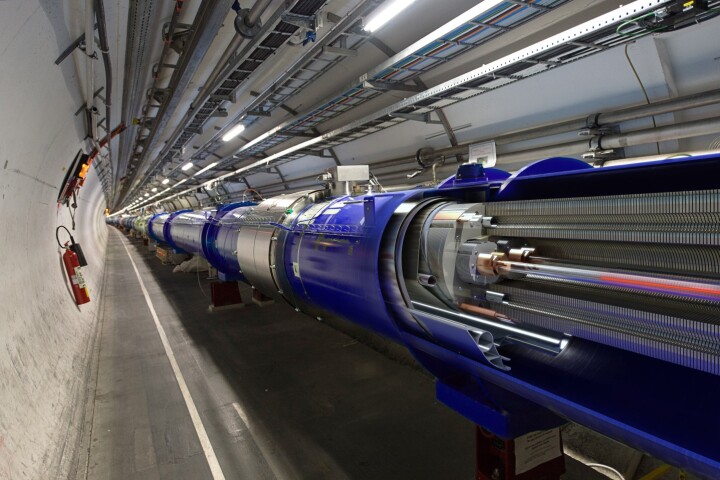
 The Large Hadron Collider (LHC), the largest and most powerful particle accelerator ever built, is ready to renter service after a three-year overhaul and refit. On April 22, two proton beams were sent around the the 27-kilometer-long ring.
 -
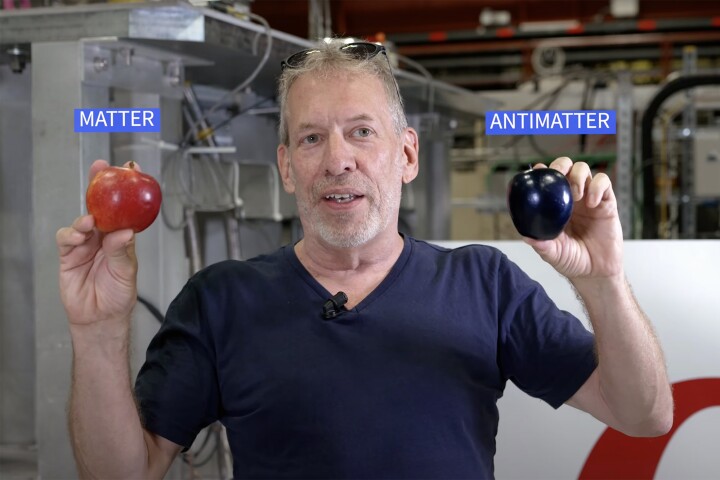
 Physicists at CERN have discovered that antimatter falls down. It sounds obvious, but scientists hadn’t yet been able to confirm that it responds to gravity in the same way as regular matter does. A new experiment provides the best answer so far.
 -
 CERN physicists have measured the life of the Higgs boson with greater accuracy than ever before. Since the legendary particle only lives for a tiny fraction a second, the scientists came up with a creative workaround to calculate the new figure.
 -
 Physicists have detected “ghost particles” in the Large Hadron Collider for the first time. An experiment called FASER picked up signals of neutrinos being produced in particle collisions, which can help scientists better understand key physics.
 -
 Normal matter has an “evil twin” that annihilates on contact, and despite decades of study antimatter remains very mysterious. So what actually is it? Where is it? Why is it important to understand? And why hasn’t it already destroyed the universe?
 -
 Antimatter is hard to study, not least because it annihilates any container you try to put it in. Now CERN physicists have developed a new antimatter trap that can cool samples in seconds, which could help unlock a fundamental mystery of the universe.
 -
 Physicists at CERN have discovered an exotic new particle that’s quite charming. Known as Tcc+, the particle belongs to a rare class called tetraquarks, and its unusual composition makes it the longest-lived exotic hadron found so far.
 -
 A subatomic particle has been found switching between matter and antimatter, in Large Hadron Collider data. It turns out an unfathomably tiny weight difference between two particles could have saved the universe from annihilation soon after it began.
Load More