
Cassini
-
 Researchers have just revealed that Mimas, one of Saturn's smallest moons, has an ocean of liquid water flowing under its entire surface. What is really making waves though, is how young the body of water is: just 5 to 15 million years old.
 -
 Saturn’s moon Enceladus continues to climb the list of best places to look for life beyond Earth. New NASA data has detected a molecule thought to be key to the origin of life, and suggests there’s more chemical energy for life to chow down on.
 -
 A new discovery has boosted the chances of life soon being found on another world. NASA has announced the detection of phosphorus, the rarest element that’s essential to life, in the oceans of Saturn’s moon Enceladus.
 -
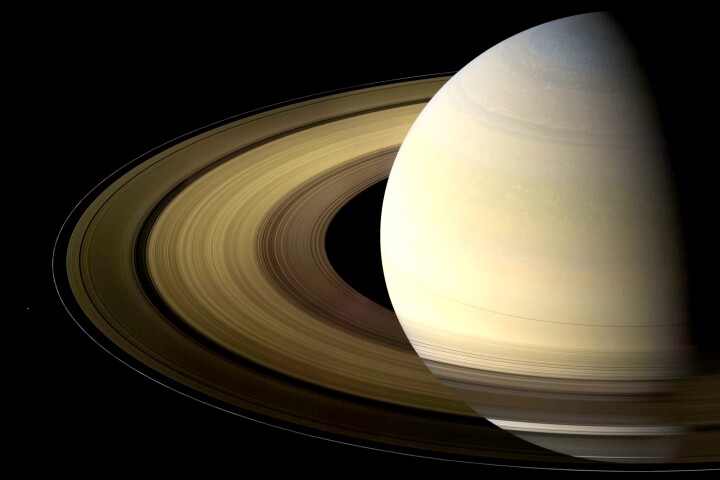 Saturn is renowned for its rings, easily visible through an ordinary telescope. Now, using observations collected over 40 years, scientists have discovered a never-before-seen interaction between the planet and its iconic rings.
 -
 Saturn is home to several solar system mysteries. Using data from Cassini, astronomers now suggest a simple answer to a few questions – a lost moon once orbited the planet before being torn to shreds.
 -
 Something is making methane on Saturn’s moon Enceladus. A new study has found that methane levels detected from the icy moon are far higher than can be explained by known geochemical processes – but they are consistent with microbes.
 -
Scientists have predicted the presence and movement of ocean currents in the vast subsurface ocean of Enceladus. The moon, which is sheathed in a 20 km thick shell of ice, is one of the most promising prospects in the search for ET.
-
 Home to oceans of liquid methane, Saturn’s moon Titan is one of the most fascinating bodies in the solar system. Now scientists have used radar to probe the depth of its largest sea, Kraken Mare, and estimated it to be at least 300 m deep.
 -
 Data captured by the Cassini spacecraft has been used to create a new infrared map of Saturn's moon Enceladus. The images highlight the icy world's dramatic "Tiger Stripe" vent formation, which leads to a subsurface ocean that could play host to life.
 -
 ESA engineers have determined why the space agency's Huygens probe suddenly began spinning the wrong way 15 years ago as it descended to the surface of Saturn's largest moon, Titan. The reversal could have implications for future space missions.
 -
 Enceladus’ unique "tiger stripe" fissures have long been something of a mystery. Why do these distinctive formations only exist at Enceladus’ south pole? Why they are so evenly spaced, and why they haven’t simply closed up or frozen over?
 -
 In some ways, the most Earth-like world in our solar system is Saturn’s largest moon, Titan. And now, astronomers from NASA JPL and Arizona State University have used years of Cassini data to construct the first global map of Titan.
Load More