
Battlefield
-
 Demonstrating that semi-autonomous weapons are the mainstay of the future and not an oddity, the US Navy and Lockheed Martin have completed a test of four Long-Range Anti-Ship Missiles (LRASM) simultaneously in flight with minimal human guidance.
 -
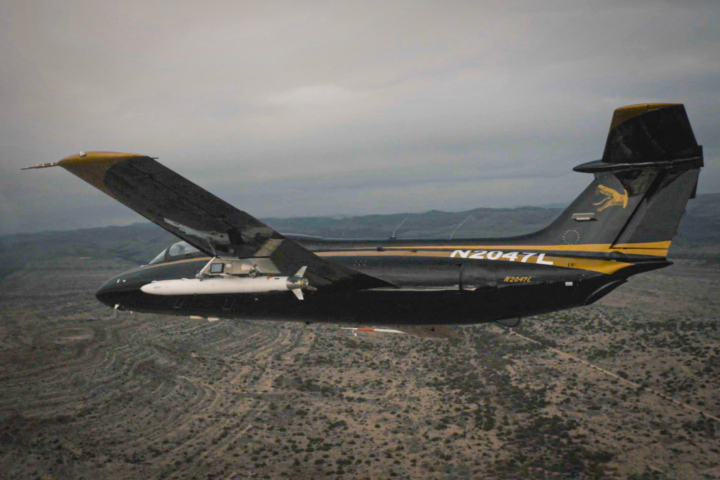 A supersonic drone that will be propelled by a revolutionary new engine has taken to the skies for the first time. When Venus Aerospace's aircraft does go supersonic on a later date, it will be powered by a Rotating Detonation Rocket Engine (RDRE).
 -
 The 2023 James Dyson Award global winners have been announced. The prizes have gone to three different student teams, each of which offers novel solutions to modern issues including global warming and providing care in war and disaster zones.
 -
 Drones are becoming a mainstay in modern warfare. Now, the Air Force Research Laboratory (AFRL) has countered the emerging threat of drone swarms, using the Tactical High-power Operational Responder (THOR) to take out multiple targets.
 -
 Collins Aerospace has come up with a new oxygen system for special forces soldiers making insanely high parachute jumps from up to 33,000 ft that automatically adjusts itself as they plummet at 126 mph for chute openings as low as 3,000 ft.
 -
 Northrop Grumman's Integrated Battle Command System (IBCS), which combines multiple current air and missile defense command and control systems into one, has been granted initial operational capability. This means it can begin active deployment.
 -
 DARPA is kicking off a new research program aiming to explore how molecular biology could be used to slow the speed of living systems, thereby extending the window for treatment after a traumatic injury and increasing the wounded's chances of survival.
 -
 After unveiling it in February, Milrem and ST Kinetics have conducted the first live fire tests of their weaponized UGV, the THeMIS ADDER. Armed with a heavy machine gun, the UGV aced the tests, paving the way for robots that may eventually support or even replace ground troops on the battlefield.
 -
 BAE Systems is aiming to bring augmented reality to the battlefield, as it develops a new system that would overlay virtual information on the real world. The company believes that in a timeframe of 20 years we could see the system condensed into a contact lens.
 -
 While armed drones like the Predator tend to attract most of the attention when it comes to military use of unmanned aerial vehicles (UAVs), the unmanned K-MAX helicopter recently demonstrated its ability to evacuate wounded fighters from a hypothetical battlefield.
 -
 BAE Systems has announced that it's taken an active damping suspension designed for F1 cars and adapted it for Sweden's Combat Vehicle 90 (CV90). Billed as a world's first for a tracked vehicle, the upgrade is claimed to improve battlefield speed and handling.
 -
 A team from Northwestern University has developed a new material capable of neutralizing nerve gases. The zirconium-based NU-1000 is not only useful not only disposing of stockpiles of such toxins, but also for use in gas masks and protective suits for soldiers and rescue workers.
Load More