


March 11, 2009 The driverless car of the future is getting closer every day, as more and more technologies come along that take critical jobs away from the driver and put them in the hands of lightning-fast, all-seeing computers. One of the latest and most ambitious of these systems has just been successfully demonstrated in the UK; the Sentience system is a kind of hyper-intelligent cruise control system designed specifically to minimize fuel consumption and emissions. It calculates the best route for you based on traffic, topography, curves, speed limits and a host of other information, and then actually takes over the throttle and brakes for you for the entire journey. It keeps you strictly within speed limits, slows down for corners, speed bumps and roundabouts, and it even knows when the lights ahead are about to turn red, so you don't waste petrol accelerating towards a stop point. Fuel savings in testing have been between 5% and 24% - a very significant figure - and Sentience is expected to be available on production cars, for a minimal cost, as soon as 2012. Incredible stuff.
Cruise control systems are getting smarter. Adaptive cruise control units can monitor the distance to the car in front of you on the freeway and maintain a safe gap - and they're becoming a fairly common factory option. Other systems are learning to read speed signs, in order to save drivers from draconian automatic speed enforcement systems.
Now, a UK research partnership has demonstrated a system which goes far beyond anything we've seen before. The ominously titled Sentience system runs from a mobile phone that's connected to the car's onboard ECU. It sucks in huge amounts of data as you travel, analyzing your planned route in terms of traffic, gradients, curves, speed limits and even probable speed limiting features such as junctions, crossings, schools, speed bumps, roundabouts and traffic lights. It then manages your acceleration and deceleration in such a way as to deliver maximum efficiency from a hybrid engine, resulting in demonstrated fuel savings of between 5% and 24%, depending on traffic and topology. Scale that out to a large number of vehicles and you're looking at huge benefits, fuel-wise and in terms of emissions.
The Sentience partnership
The Sentience system is the result of a multi-industry research partnership aimed at reducing CO2 emissions and fuel usage in hybrid vehicles. Ricardo and Jaguar-Land Rover brought their knowledge of car electronics and engine management to the table, TRL provided expertise on traffic, traffic signals and road usage patterns, Ordnance Survey contributed a massive breadth and depth of information about the UK road system, including curvature and topograpy information, and Orange Business Services chipped in with their knowledge of mobile phone software and handset connectivity.
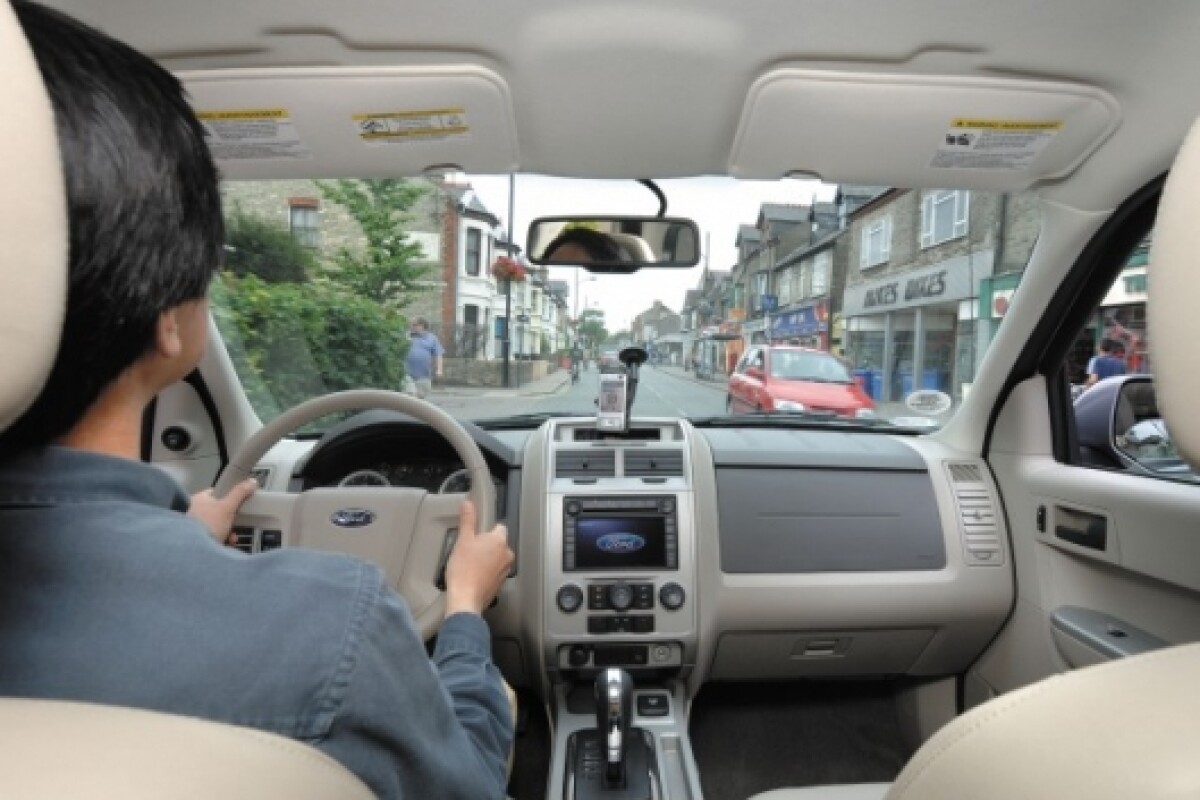
Between the five major partners, a system has emerged that acts like a kind of intelligent adaptive cruise control system that knows the roads you're taking, and how exactly to drive them for maximal energy efficiency and minimal emissions. The Sentience test vehicle was demonstrated earlier this month at a UK test track, with representatives of the media invited to drive a car equipped with the system, running through a Nokia N95 mobile phone.
How it works
Based on route information – which could eventually be integrated with a commercial navigation system – the Sentience vehicle will calculate and follow an optimal driving strategy. Its control system adjusts vehicle speed, acceleration and deceleration via its adaptive cruise control and regenerative braking. Using GPS and mapping data it takes into account the speed limits, traffic conditions, the road’s gradient and features including bends and even speed bumps, as well as less predictable road features including roundabouts, to determine the most efficient possible route.
It's also keyed in to traffic light timing, so it will automatically start decelerating if it knows the green light you're approaching is about to turn red. The driver simply keys in a destination, and steers the car without a foot on either pedal, letting the car make the decisions on acceleration and braking. Of course, you'd want to keep your foot close to the brakes to over-ride the system in case of an emergency situation.
The Sentience system also concentrates on getting the most out of hybrid drive systems, by optimizing the regenerative braking strategy for the batteries and increasing the availability of electric-only drive mode where possible.
Towards a driverless future
It's a clear step forward toward a future where your car will do the driving and you'll just be a passenger - and a demonstration of how a computer with detailed route and traffic signal information can make a huge difference to fuel consumption and emissions.
The Sentience system is expected to be made available in new cars as soon as 2012 - and the fuel savings will add up to around UKP500 per year if you spend around UKP50 a week on petrol. Scaled out to a large number of cars across the UK, the system could save between 1.2 and 2.9 million barrels of oil per year.
What are your thoughts?
Assuming it works as well in the real world as it has on the test track, would you sacrifice your total control and a few minutes of travel time if the Sentience system could guarantee you the minimum possible fuel consumption, the most fuel-efficient route and an absolute certainty that you won't be getting a speeding ticket? How do you feel about a future where a large number of cars run this sort of system? Let us know in the comments below.
Loz Blain