


The ancient lotus leaf has natural properties that scientists believe could prove beneficial in today's modern world. Already Gizmag has featured articles about the lotus leaf surface, including a self-cleaning cup and transparent coating for space suits. Recently, though, in an effort to improve the efficiency of modern engineering systems, such as power plants and some electronic equipment that must be cooled by removing heat through water evaporation and condensation, engineers at Duke University have been studying the lotus leaf. Using an ultra high-speed camera, a powerful microscope and an audio speaker, scientists were able to observe water as it condensed on the leaf's surface, and more importantly, how the water condensate disappeared.
The engineers say the secret lies in the strange surface of the plant's large leaves, and the subtle vibrations of nature. Research shows the leaves are covered with tiny irregular bumps spiked with even tinier hairs projecting upward. When a water droplet lands on this type of surface, it only touches the ends of the tiny hairs and suspended by air pockets below. Ultimately, it is repelled off the leaf.
In this case, however, "We faced a tricky problem – water droplets that fall on the leaf easily roll off, while condensate that grows from within the leaf's nooks and crannies is sticky and remains trapped," said Jonathan Boreyko, a third-year graduate student at Duke's Pratt School of Engineering, who works in the laboratory of assistant professor Chuan-Hua Chen.
"Scientists and engineers have long wondered how these sticky drops are eventually repelled from the leaf after their impalement into the tiny projections," Boreyko said. "After bringing lotus leaves into the lab and watching the condensation as it formed, we were able to see how the sticky drops became unsticky."
Cool music
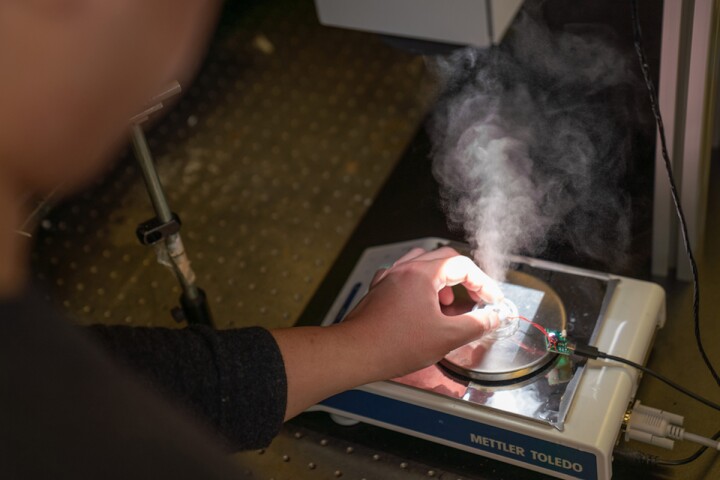
The key was videotaping the process while the lotus leaf rested on top of the woofer portion of a stereo speaker at low frequency and cooling the leaf to generate condensation. It turned out that after being gently vibrated for a fraction of a second, the sticky droplets gradually unstuck themselves and virtually leapt from the leaf.
"This solves a long-standing puzzle in the field," Chen said. "People have observed that condensation forms every night on the lotus leaf. When they come back in the morning the water is gone and the leaf is dry. The speaker reproduced in the lab what happens every day in nature, which is full of subtle vibrations, especially for the lotus, which has large leaves atop long and slender stems."
The results of these experiments have encouraged scientists and engineers to create similar man-made surfaces where the removal of condensation and the transfer of heat are necessary.
“We have revealed the physics behind anti-dew superhydrophobicity, a vital property for water-repellent materials to be deployed in the real world," Chen said. "These materials will be used in humid or cold environments where condensation will naturally occur. Our findings point to a new direction to develop water-repellent materials that would survive in demanding natural environments, and have strong implications for a variety of engineering applications including non-sticking textiles, self-cleaning optics and drag-reducing hulls."
The results of the team's experiments were published in the journal Physical Review Letters.