
More funds for Hawaii's Ocean Thermal Energy Conversion plant
By Ben Coxworth
November 26, 2010
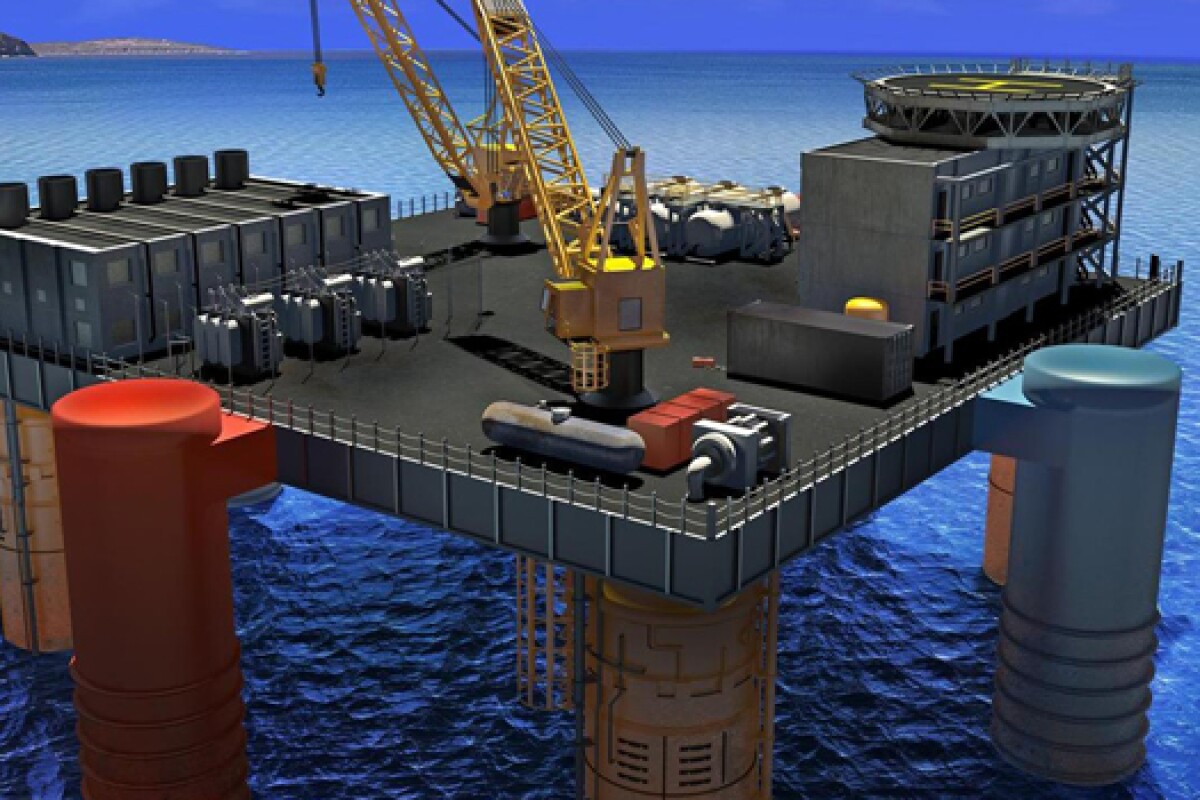
An artist's impression of Lockheed Martin's Hawaii OTEC pilot plant
Image Gallery (5 images)An Ocean Thermal Energy Conversion (OTEC) pilot plant off the coast of Hawaii’s Big Island is now a step closer to reality. The U.S. Naval Facilities Engineering Command (NFEC) has just awarded Lockheed Martin a US$4.4 million contract modification to develop critical system components and designs for the plant – this amount is in addition to the $8.1 million contract the NFEC issued in 2009, as well as two grants totaling $1 million that Lockheed Martin received from the U.S. Department of Energy in 2008 and this March. Hopefully, this means the streets of Kona may someday be lit by electricity obtained from the temperature difference between warm and cold sea water.
OTEC centers around a closed system, which the sea water heats and cools. Here’s how it works...
Warm, sun-heated water from the top layer of the ocean passes through a heat exchanger, which causes a “carrier liquid” with a low boiling point (such as ammonia) to turn to steam. This steam travels up a pipe to a turbine, where it generates electricity. The steam then condenses back to liquid and travels down to another heat exchanger, this one cooling the liquid with cold seawater from lower depths. From there, a pump brings it back up to the first heat exchanger, and the system continues on ad infinitum.
The system is reportedly completely non-polluting, and is capable of providing power to warm-climate seaside communities 24 hours a day.
Lockheed Martin’s involvement with the field of OTEC dates back to the 70s, when it built a prototype plant that ran for three months.
The Hawaii pilot plant is expected to have a 10 megawatt capacity, and be operational by 2012 or 2013. It is hoped that its success will lead to commercial-sized plants generating 100 MW or better, by 2015. According to Lockheed Martin, such a plant could meet the electrical needs of a small city.
All images courtesy Lockheed Martin

An experienced freelance writer, videographer and television producer, Ben's interest in all forms of innovation is particularly fanatical when it comes to human-powered transportation, film-making gear, environmentally-friendly technologies and anything that's designed to go underwater. He lives in Edmonton, Alberta, where he spends a lot of time going over the handlebars of his mountain bike, hanging out in off-leash parks, and wishing the Pacific Ocean wasn't so far away. All articles by Ben Coxworth
Kona is a good place for this type of technology; waters are calm most of the year. The sides of all the islands facing northwest would be fine for wave energy extraction since the majority of waves from storms comes from the northwest. The eastern sides usually have strong currents and underwater turbines could be used on those sides.
Adrian Akau29th November, 2010 @ 02:19 pm PST
A small OTEC barge was floated off the coast of Hawaii in the 80's, maybe as far back as the late 1970's. I'd heard it had been concluded the amount of energy to be extracted from ocean temperature differences was too low to be worth the bother.
Facebook User29th November, 2010 @ 02:29 pm PST
Once again, an article about a "promising" new energy source with no info about the most important factor--cost efficiency. You need some real reporters who can do more than republish a press release.
tsvieps29th November, 2010 @ 03:11 pm PST
Ocean floor temp is around 4C or 277K. Say surface temp is 27C (300k). That means that the maximum thermodynamic efficiency of the cycle is 1-277/300=7.6%. OK, your fuel is free but you're going to have to circulate a LOT of water to get meaningful amounts of power and I suspect your pumping and conversion losses will make this impractical or require truly massive installations.
Plasma Junkie29th November, 2010 @ 06:15 pm PST
Actually, at Kona you don't need something so elaborate. There's a live volcano nearby, so use a steam turbine based on geothermal power. They've been doing it for a long time in Iceland.
BigCat29th November, 2010 @ 11:43 pm PST
Plasma Junkie nailed the physics. There is no way around this. How about getting your reporters to ask follow up questions of the folks that issue you information if your reporters are not able to do some due diligence ahead of the first publication here.
tsvieps30th November, 2010 @ 12:22 am PST
tsvieps: the costs are given ... $4.4M $8.1M $1M = $13.5M
It'll produce: 10 MW x 24 x 365 = 87,600 MW hr/yr
At $0.10/kWhr or $100/MWhr, annual revenues are $8,760,000 or $8.76M/yr
That means a payback of less than 2 years ... pretty darn good!
Apparently Hawaii rates are much higher than $0.10/kWhr for even faster payback!!!
EGM30th November, 2010 @ 02:21 pm PST
tsvleps, the $4.4M is "to develop critical system components and designs for the plant." They are still at the design stage. This is on top of $10.1M already spent. LM is not known for low-cost gadgetry. It will be another $50M before anything ever produces a single kW and likely $250M before it reaches its design output of 10MW.
If you look at image one from the photo gallery, you will see we have no business investing tax-payer money in OTEC - the resource is in the wrong place.
CliffG31st December, 2010 @ 11:30 am PST
Or Login with Facebook:
Just enter your friends and your email address into the form below
For multiple addresses, separate each with a comma
Privacy is safe with us because we have a strict privacy policy.


really great info, it motivates me to do something extra ordinary
Nice post. I enjoy this post gorgeously with all of my friends.
Really nice.thanks.
Good information here. I really enjoy reading them every day. I've learned
a lot from them.
martina201027th November, 2010 @ 12:22 am PST