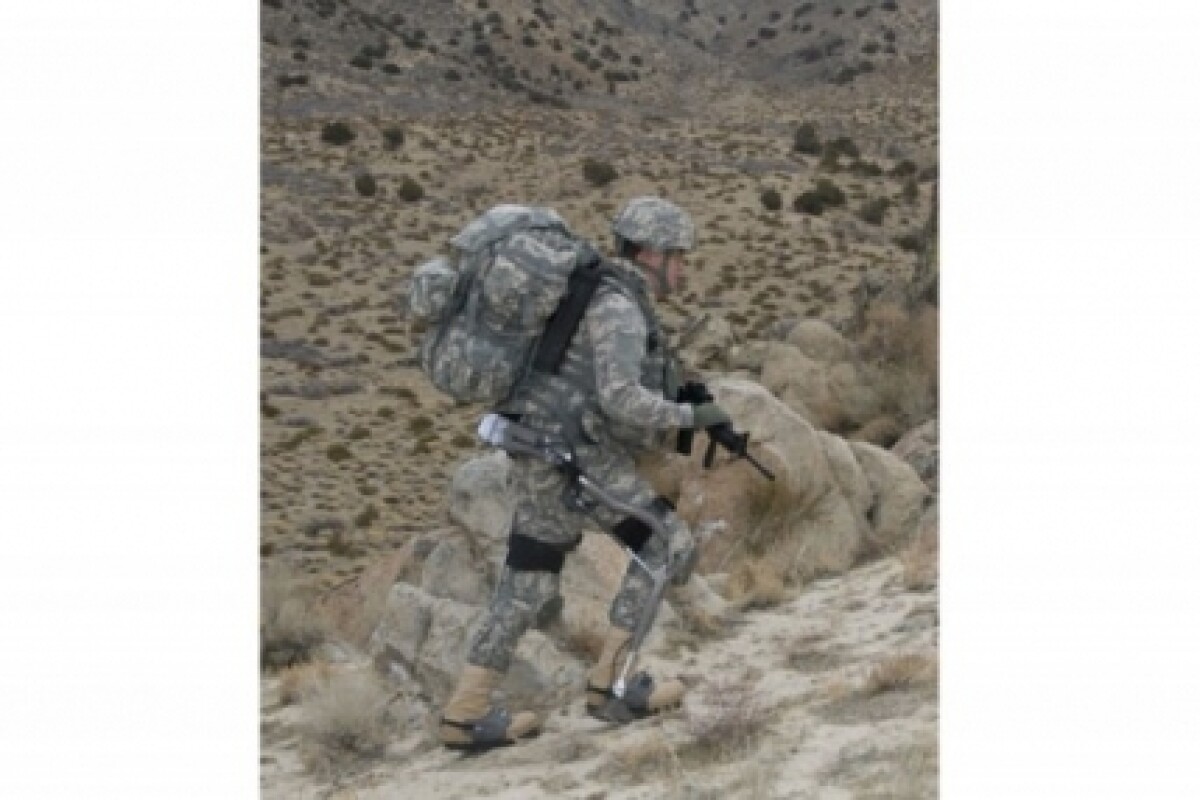



March 12, 2009 The use of an exoskeleton to improve the performance of humans in various situations including the military is a hot topic in the media and leads the imagination to all sorts of possibilities. It has the potential to deliver extraordinary strength and endurance to the wearer possibly changing the face of modern warfare. As part of the further development of exoskeleton technology for military scenarios, Lockheed Martin recently introduced the Human Universal Load Carrier (HULC™) exoskeleton at the Association of the United States’ Army Winter Symposium in Fort Lauderdale, FL.
Advances with exoskeleton technology
The field of robotics is being advanced in many sectors and the use of the exoskeleton to extend human capability is not new, but it's advancing fast. We've previously looked at Lower Extremity Exoskeleton - as the name implies it connects only to the legs of the wearer - which could find a use in the domestic sphere as Honda has recognized. Raytheon has a full-body project for the military in development and on a much larger scale there is Sakakibara-Kikai’s 3.4 meter Land Walker and tmsuk’s huge Enryu. There's even plans to merge exoskeletons with one person transport such as Toyota's i-unit and the radical Deus Ex Machina concept.
The HULC advantage
The HULC is a completely un-tethered, hydraulic-powered anthropomorphic exoskeleton that provides users with the ability to carry 200lb loads for extended periods of time and over all terrains says Lockheed Martin. An onboard micro-computer enables the exoskeleton to move in concert with the wearer eliminating the need for a joy stick or other controllers. The HULC is capable of performing deep squats, crawls and upper-body lifting and potentially move where the wearer wants to go. Lockheed Martin says the modularity allows for major components to be swapped out in the field and its power-saving design allows the user to operate on battery power for extended missions.
Soldiers are required to carry heavy combat loads in the field, increasing the stress on the body leading to potential injuries. The HULC exoskeleton transfers these loads to the ground through powered titanium legs without loss of mobility. Advanced technology systems will include ground soldier solutions such as wearable situational awareness equipment and mobility assistance systems. Additional development will focus on specific user needs and performance requirements and the company is also exploring exoskeleton designs to support industrial and industrial and medical applications.
Under a new exclusive licensing agreement between Lockheed Martin and Berkeley BionicsTM, the Exoskeleton will be enhanced further within the HULC system.
David Greig