

January 28, 2009 Following INTEL’s recent demonstrations of wireless power transmission and numerous wireless power products announced at the recent 2009 CES INTEL researchers have released details of an ambient RF energy harvesting technique they have developed to power a typical wall mounted house-hold weather station complete with LCD screen from energy collected via a TV antenna pointed at the local TV station antenna 4 km away. The technology is an extension of that used in off-the-shelf RFID tags where the tag reader supplies power to the otherwise unpowered ID tag.
As advanced as powering devices from nothing more than a distant TV broadcast tower may sound, the technology is very similar to a crystal radio set which have been in use for over 100 years. The most recent breakthrough that has enabled this demonstration to power more than a pair of high impedance head phones has been the falling power consumption of digital circuitry which has facilitated improved functionality per microwatt of scavenged energy.
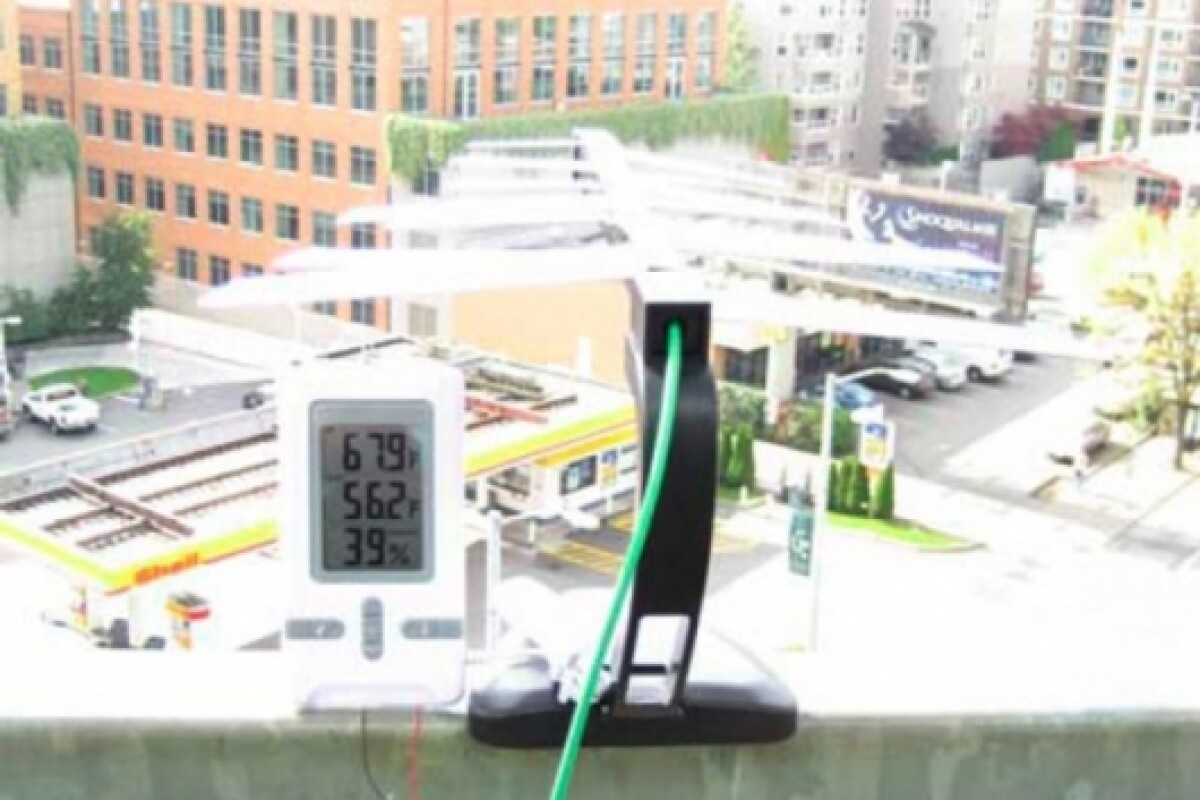
The Intel Researchers set up a TV antenna on a balcony with line of sight to the KING-TV tower 4.1 km away. The TV station broadcasts on channel 48 between 674 and 680 MHz with an effective radiation power (ERP) of 960 Kw. The TV antenna used was a UHF log periodic with 5 dBi gain connected to a 4 stage charge pump power harvesting circuit of the same design as that found in an RFID tag. Across an 8 KOhm load the team measured 0.7V, corresponding to 60 microwatts of power harvested. That was enough to drive a thermometer/hygrometer and its LCD display, which is normally powered, by a 1.5 volt AAA battery.
The technical paper by Alanson Sample and Joshua R. Smith (Intel and University of Washington) is available at TechOnline.
Paul Evans
January 28, 2009 Following INTEL’s recent demonstrations of wireless power transmission and numerous wireless power products announced at the recent 2009 CES INTEL researchers have released details of an ambient RF energy harvesting technique they have developed to power a typical wall mounted house-hold weather station complete with LCD screen from energy collected via a TV antenna pointed at the local TV station antenna 4 km away. The technology is an extension of that used in off-the-shelf RFID tags where the tag reader supplies power to the otherwise unpowered ID tag.
As advanced as powering devices from nothing more than a distant TV broadcast tower may sound, the technology is very similar to a crystal radio set which have been in use for over 100 years. The most recent breakthrough that has enabled this demonstration to power more than a pair of high impedance head phones has been the falling power consumption of digital circuitry which has facilitated improved functionality per microwatt of scavenged energy.
The Intel Researchers set up a TV antenna on a balcony with line of sight to the KING-TV tower 4.1 km away. The TV station broadcasts on channel 48 between 674 and 680 MHz with an effective radiation power (ERP) of 960 Kw. The TV antenna used was a UHF log periodic with 5 dBi gain connected to a 4 stage charge pump power harvesting circuit of the same design as that found in an RFID tag. Across an 8 KOhm load the team measured 0.7V, corresponding to 60 microwatts of power harvested. That was enough to drive a thermometer/hygrometer and its LCD display, which is normally powered, by a 1.5 volt AAA battery.
The technical paper by Alanson Sample and Joshua R. Smith (Intel and University of Washington) is available at TechOnline.
Paul Evans