The recent discovery at the Large Hadron Collider (LHC) of the European Organization for Nuclear Research (CERN) of a massive particle "consistent with" the predicted properties of the Higgs boson hit the news with the force of a hurricane. But the phrase "consistent with" suggests that the CERN observation may also be "consistent with" other types of particle. Is it or isn't it? We're going to attempt to clarify the situation for you.
Before we start, let's get rid of one widespread misconception being thrown about by the news media. The Higgs boson is often called the God particle (but never by scientists). The reason for that moniker is that Leon Lederman, Director Emeritus of Fermilab and Nobel Prize winner, wrote a popular book on the Higgs boson. He wanted to call the book "The Goddamn Particle" because of the difficulty and expense of finding the Higgs, but the publisher thought that sales might suffer. The publisher then suggested "The God Particle" as an alternative, to which Lederman eventually acceded. The name is thus a response to a bad joke, rather than an indication of spirituality or divine origin.
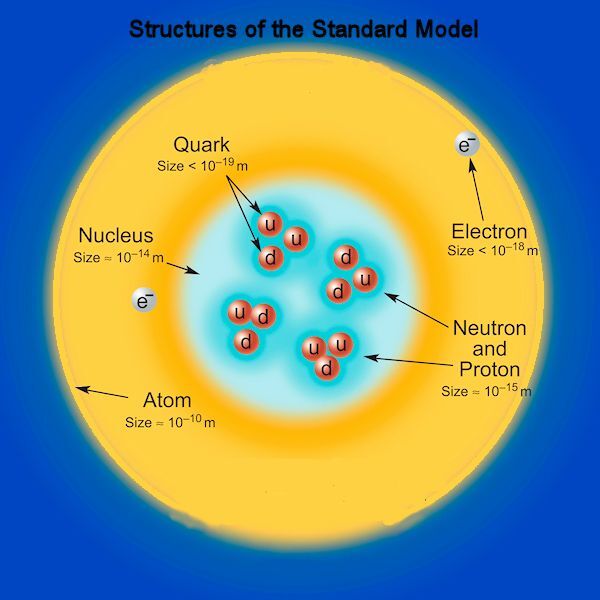
We're going to look at just what the ATLAS (A Toroidal LHC Apparatus) and CMS (Compact Muon Solenoid) experiments at CERN saw, why the data is "consistent with" detection of the Higgs boson, and what other particles may be "consistent with" the same data.
First, though, some background information. There are four known forces in nature, two of which (gravity and electromagnetism) you can experience directly. When you get up out of a chair you fight the force of gravity, and when you shuffle your feet on carpet and touch a doorknob, the small spark is driven by the electromagnetic force.
The others are the strong and weak nuclear forces. The strong force holds together the nuclei of atoms, as well as binding the quarks inside protons and neutrons. If it were slightly smaller in strength, there would be no stable atoms, save for hydrogen.
Finally, the weak nuclear force is a large part of what makes particle physics interesting. This is because only the weak force can change an up quark into a down quark, and vice versa. Quarks are the particles which make up protons and neutrons – a proton is the combination of two up quarks and a down quark, while a neutron consists of one up quark and two down quarks. In the decay of a neutron into a proton one quark changes from down to up, which requires that a weak interaction happens.
Without the weak force, the type of hydrogen fusion that powers the Sun would be impossible – when you fuse four hydrogen atoms to get a helium-4 nucleus, two of the hydrogen atoms must turn into neutrons. This will not occur without the weak force.
The Standard Model of particle physics is a theoretical description of three of the four forces which control our universe (gravity strongly resists treatment within the structure of the Standard Model). Developed in its current form when quarks were first observed, discoveries of the Standard Model-predicted top and bottom quarks, and the tau neutrino (possibly also the Higgs boson) have given physicists more confidence in the basic picture.
However, the Standard Model is not a complete theory of the underlying structure of the universe. Among other problems, it does not allow prediction of the masses of the various particles, and it contains neither gravity, dark energy nor dark matter (together making up about 96 percent of the universe!). It's the best we have at present, but further work is required to formulate better models, which is where the CERN experiments come in.
The Standard Model predicts that the Higgs boson is the last elementary particle waiting to be discovered. In this view, all particles gain mass through their interaction with the uniform Higgs field, which exists throughout the universe. (Why uniform? Otherwise mass would vary depending on which direction it was traveling through space.) This is the simplest, but not the only, approach to explain why particles, kings, and cabbages have mass. If you can find the Higgs boson, the Higgs field also exists. But if the new particle discovered at CERN is not the Higgs boson, this could be the first solid indication that the Standard Model is wrong.

What we know
What have the CERN experiments actually seen? Well, to start with, there is almost certainly a new particle with a mass of roughly 125 GeV. This mass can be estimated from the trajectories taken by the decay products. Weighing about 133 times the mass of a proton, the new particle is among the most massive particles so far detected. Only the top quark is heavier, at about 170 GeV. Among particles that can be isolated, the W and Z bosons (carriers of the weak nuclear force) are heaviest at 80-90 GeV.

In order to appreciate the CERN result, it's important to understand what's meant by the term "spin." Spin is a quantum mechanical property related to angular momentum that also obeys properties and rules that seem very strange compared to our experience of spinning objects. Fortunately, all we need to know here is that quantum mechanics predicts (and observation confirms) that spin comes in integer multiples of half of a fundamental magnitude. Thus, all particles have either half-integral spin (...-3/2, -1/2, 1/2, 3/2...) or integral spin (...-2, -1, 0, 1, 2...). Half-integral spin particles are called fermions, and integral spin particles are called bosons for reasons which need not concern us here.
CERN's new particle is observed to decay into a pair of photons (gamma rays). As photons have a spin of one, the particle from which they are emitted must have either spin-0 (1-1), or spin-2 (1+1). The experiments show the new particle has integral spin, so it is a boson. Spin-2 particles are rather unlikely to be made in a collider, so the new particle is probably (but not necessarily) a spin-0 particle.

The final bit of data we have characterizing the new particle is its decay modes – that is, what do we see the particle decaying into and with what probability? The new particle has been observed to decay via the following modes. The Higgs boson can also decay into the same modes.
- A bottom quark and an antibottom quark
- A tau lepton and an antitau lepton
- A pair of photons
- A W boson and an anti-W boson
- A Z boson and an anti-Z boson
While the theoretical Higgs boson and the new particle have the same decay modes, it appears that there are certain discrepancies between the new particle's decay probabilities and those predicted for the Higgs boson. The probabilities for the bottom quark and tau lepton decay modes is much smaller in observations of the new particle than those predicted for the Higgs boson, and the probability for the photon decay mode is about 50 percent larger than predicted for the Higgs boson.In summary, the data tells us that the new particle weighs about 125 GeV, has a spin of 0 or 2, and is not solidly in agreement with the decay modes predicted for the Standard Model Higgs. Not a lot of information. The CERN researchers describe the properties of the new particle as "consistent with" the Higgs boson. However, if the current distribution of decay mode probabilities survives the improved statistics resulting from the accumulation of more data, the Standard Model Higgs boson is in a bit of trouble, as is the Standard Model itself.
Other contenders
What else could the new particle be? There are other version of the Higgs interaction giving mass to particles. If the new particle does not decay into tau leptons, that would suggest that its interaction with tau leptons is rather weak, and also that it is not responsible for their mass. Perhaps the new particle is only the Higgs boson for bosons, but some other particle gives the fermions (electrons and leptons) their mass. This is in line with the original formulations of the Higgs field, which was to only explain how bosons got their mass. This answer would require an extension of the Standard Model, probably in the direction of supersymmetry. Supersymmetry relates elementary particles of one spin to other particles called superpartners that differ by half a unit of spin. Supersymmetry is only one possible theory that would extend the Standard Model, but it is particularly interesting in that it offers possible solutions to numerous problems. An explanation for dark matter (80 percent of the matter in the universe) is among the benefits.
In addition, mathematical physicists have proven that supersymmetry is the only approach to develop a consistent description of spacetime and the internal symmetries of the particle zoo. On the other hand, there is no clear experimental result pointing toward a supersymmetric model of the universe. Such a model would contain at least five "Higgs bosons," whose properties would differ from the Higgs boson of the Standard Model. The property that could help make this distinction is something known as "parity." All we really need to know here is that if the new particle has odd rather than even parity, it would be suggestive of the influence of supersymmetry.
Is it, or isn't it?
Back to the original question - is it or isn't it? If the new particle is found to have odd parity, or if the decay mode discrepancies survive as more data is acquired, the new particle is likely not the Higgs boson of the Standard Model. This would actually be very exciting, as it may be the first dent in the Standard Model taking us toward a new level of understanding of the universe. Or we may have indeed just discovered the Higgs, but there is still a need to search for new clues as to the extra levels of structure we know must exist. The answers (and the questions) will become clearer as more data is gathered in coming years. Either way, these are certainly interesting times for physics.
Source: CERN