

Software removes pedestrians from Google Street View
By Ben Coxworth
August 11, 2010
A pedestrian is removed from a Google Street View image using experimental new software
Image Gallery (3 images)Google Street View, while very useful, fascinating, and full of wonderful bloopers, does rub some privacy advocates the wrong way. Should people on public streets have a reasonable expectation of not ending up with their photo on the Internet? There’s a whole other article in that, but in any case... for all the folks who do have a problem with it, a computer science graduate student is working on a solution: software that digitally removes pedestrians from Street View images. One of the byproducts of the current version of the system is somewhat unsettling, however – areas where people were in images are sometimes marked by ghost-like shapes, or even by disembodied shoes and feet.
The as-yet-unnamed program was designed by Arturo Flores from the University of California, San Diego, as a proof-of-concept for CSE 190A, a project-based computer vision and machine learning class. While Street View does already blur faces, Flores feels that clothes, body shape, and height combined with geographical location can still be enough to make some pedestrians identifiable.
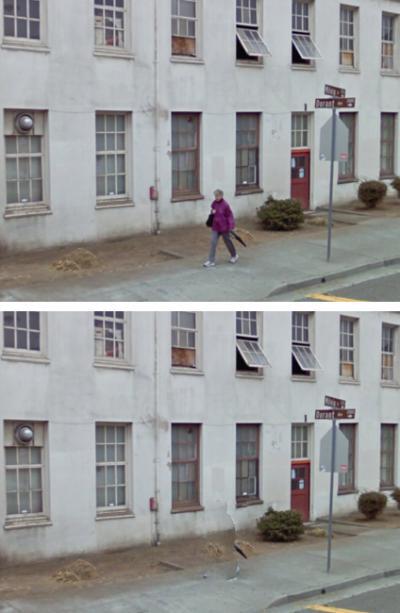
The system works by identifying human forms in each shot, erasing them, then filling the space in with background imagery obtained from the shots taken immediately before or after. It can be stymied, however, in cases where someone was walking in the same direction as the Street View camera car, at such a speed that they blocked the same bit of background for several shots in a row.
The system also only works in urban settings, where backgrounds are predominantly flat.
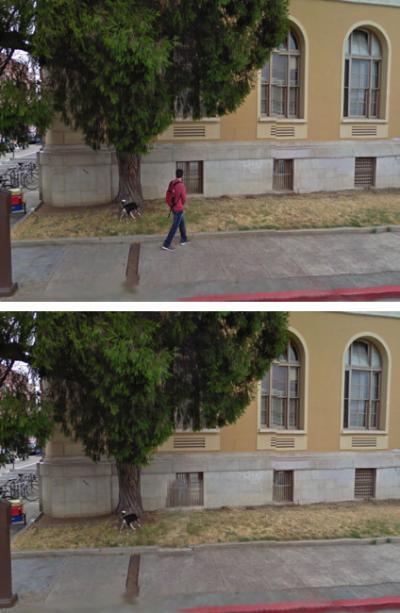
Flores used the Street View pedestrian locator, designed by computer science professor Bastian Leibe from Aachen University, as a jumping-off point when creating his system. He now plans on improving his pedestrian remover so it can identify and remove not only individual pedestrians, but whole groups of people.

An experienced freelance writer, videographer and television producer, Ben's interest in all forms of innovation is particularly fanatical when it comes to human-powered transportation, film-making gear, environmentally-friendly technologies and anything that's designed to go underwater. He lives in Edmonton, Alberta, where he spends a lot of time going over the handlebars of his mountain bike, hanging out in off-leash parks, and wishing the Pacific Ocean wasn't so far away. All articles by Ben Coxworth
That's going to be creepy when you view a downtown street in NYC and there's *NOBODY* there! Talk about Omega Man scenario!
Ed12th August, 2010 @ 02:08 pm PDT
I checked the new look Google in New York and pedestrians are still in the streets. Some street were clear and others still had people in them.
ukatama13th August, 2010 @ 02:58 am PDT
As low resolution as the photos are on GoogleMaps, there shouldn't be anyone worried about privacy. Nobody there is recognizable. Unreadable license plate numbers are already fogged out. Shouldn't bother with this.
JLR13th August, 2010 @ 10:52 am PDT
I think anything done for privacy rights is a step in the right direction. Anytime you do not have the persons permission to take their picture then post it for the whole world to see, we have lost rights so cudos to Arturo Flores! Now perhaps we can make a game of it similar to geo-tagging where we identify ghosts in pics!
Will, the tink14th August, 2010 @ 08:14 pm PDT
It's also possible to remove people, animals, or any thing moving with the current breed of HDR software that have a 'ghost' removal feature. And, of course, it's always been possible to do this manually using multiple exposures, as had been done DOF (days-of-film). But that can be VERY time consuming.
misterkenosborn15th February, 2012 @ 10:40 am PST
It's also possible to remove people, animals, or any thing moving with the current breed of HDR software that have a 'ghost' removal feature. And, of course, it's always been possible to do this manually using multiple exposures, as had been done DOF (days-of-film). But that can be VERY time consuming.
misterkenosborn15th February, 2012 @ 10:43 am PST
Or Login with Facebook:
Just enter your friends and your email address into the form below
For multiple addresses, separate each with a comma
Privacy is safe with us because we have a strict privacy policy.


So basically like Photoshop's content aware fill but automated? Cool.
Janek Nikicicz12th August, 2010 @ 01:54 pm PDT