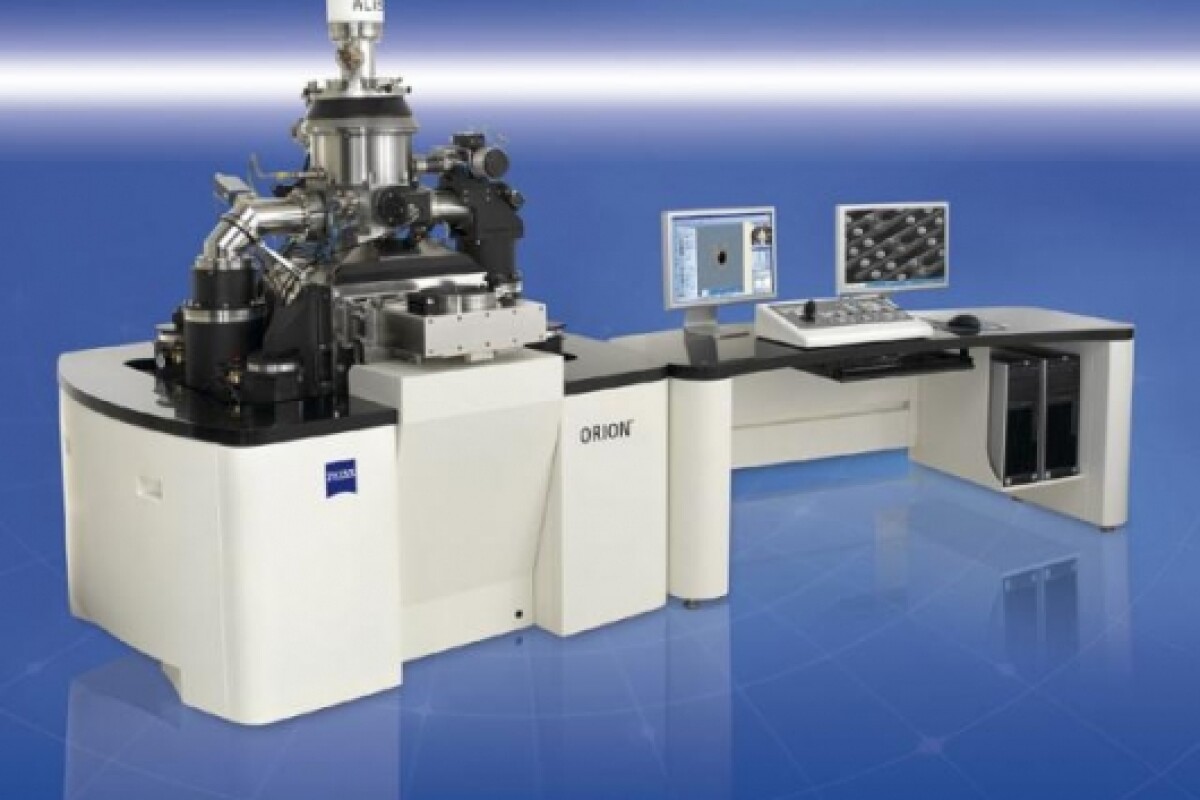


October 31, 2007 A revolutionary type of microscope that uses a beam of helium ions to provide significantly higher resolution images than commonly used electron microscopes promises a new era in sub-nanometer, ultra-high resolution scanning microscopy.
Dr Nicholas P. Economou and Bill Ward from Carl Zeiss SMT, Inc. have been awarded this year’s Wall Street Journal “Technology Innovation Award” in the category of “Materials and Other Base Technologies” for their work on the ORION helium ion microscope.
Unlike Scanning Electron Microscopes, which image and measure by focusing electrons into a beam, the ORION uses helium ions which can be focused into a smaller probe size. This provides a smaller sample interaction compared to electrons and allows for significantly greater image resolution, depth of focus and material contrast.
The ORION helium ion beam is said to be “the brightest illumination source ever created by man.” This is due to the fact that it originates from a region less than one angstrom, (0.1 nanometers), in size. The use of helium ions instead of electrons or other alternatives also provides other benefits, including a high secondary electron yield, and less sample damage. The images provide detailed information on the samples’ topographic, material, crystallographic, and electrical properties.
The ORION microscope was based on research conducted by ALIS Corporation - which was incorporated into Carl Zeiss SMT last year - and will enable scientific advancements in fields previously restricted by the limitations of the electron microscope, including semiconductor process control, life science applications and materials analysis. The ORION microscope has already been installed at the U.S. National Institute for Standards and Technology in Gaithersburg.