


August 21, 2007 Aerodynamics is now viewed by Formula 1 teams as the single most important piece of race car design the rules allow them to control. A good aerodynamic setup makes an F1 car slippery in a straight line, maximizes acceleration and top speed, and provides huge amounts of downforce to mash the car’s tyres into the tarmac and add extra grip in the corners. Massive money is spent on tweaking the wings and body shape for that elusive perfect flow of air. Toyota’s Head of Aerodynamics, Mark Gillan, explains further in the second part of Panasonic Toyota Racing’s ‘Inside a Formula 1 Car‘ series.
If you’ve ever stuck your hand out of a car window on the freeway, you’ll understand that as speed increases, the flow of air around the car becomes a significant force to push against. Imagine the strength of that force at a Formula One car’s top track speed of around 360kmh.
First and foremost, aerodynamics is the science of manipulating and making use of air flow. In Formula 1, ferociously high speeds mean the air is a formidable force and it can be used to the car’s advantage.
Put simply, the bigger the frontal area of an object, the more wind resistance it will encounter, so a bigger object will travel slower than a smaller object with the same amount of power to propel it.
As always in Formula 1, things are not that simple. Downforce complicates matters, because wind resistance can be used to improve a car’s performance, if the forces are transferred in the right way to provide extra grip around corners.
Mark Gillan explains: “Downforce is simply the force acting down on the ground. If you think of an aircraft, it has lift - a force acting upwards. On our car we have wings which work in the opposite direction to those on an aeroplane. On our car we have a force which acts down on the ground to keep the car fixed to the track as it is going around corners.”
Downforce is now such an important consideration in an F1 car’s cornering traction that a car that’s closely following another through a corner is severely disadvantaged by being in the leading car’s turbulent wake – although this is made up by the advantage the following car gains by slip-streaming the leader on high-speed straights.
Maximizing the positive effects of the air and minimizing the negative effects is the aerodynamicist’s challenge. The first attempts to harness aerodynamics in Formula 1 were relatively crude and dangerous, but the technology and knowledge has evolved into a fine art, which literally dictates who succeeds and who doesn’t in Formula 1.
“Aerodynamics in Formula 1 has been around a long time,” Mark says. “Way back in the late 1960s the first aerodynamic wings were sprouted and then, in the 1970s, understanding of aerodynamics on racing cars became more apparent. But it’s really in the last 10 years that Formula 1 aerodynamics has progressed beyond all recognition. It is really very impressive.
“Aerodynamics is now the most important item on the car which a team can actually change, because if you look at the tyres, everyone has the same tyres and the engine is homologated. So aerodynamics is the single biggest item we can change - the biggest performance item on the car.”
Thus, aerodynamics has become a key element of setup for each racetrack the Formula One cars visit. At tracks where high top speeds are more important, the aeros are adjusted for minimum drag, and at other tracks where corner speed is the key issue, the car is tuned for extra downforce and traction.
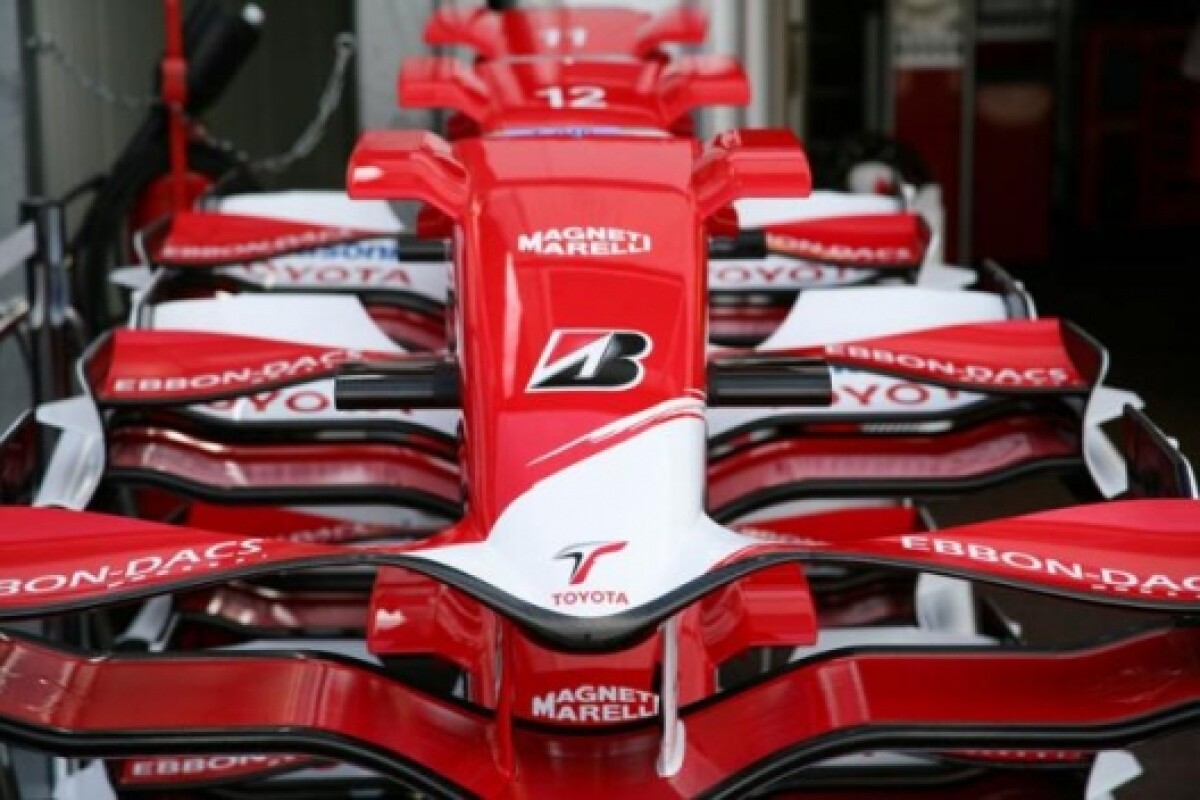
Although every part on the outside of Panasonic Toyota Racing’s TF107 car is designed with aerodynamics in mind, the most obvious aerodynamic elements are at the very front and rear of the car.
As the first part of the car to encounter air resistance, the front wing is a key to the aerodynamic puzzle. It channels the air around and over the car, ensuring it reaches the right areas to generate downforce but avoids places where it has a negative effect.
“The front wing is one of the more efficient areas on the car," explains Gillan. "It basically provides the downforce at the front of the car, to provide stability and increase grip. But it is also a mechanism for directing the air away from the tyres. The tyres are one of the main items which generate drag. From a legality point of view, we cannot cover the tyres so we have to find a way to move the air around and over them.
“To get the perfect set-up, we typically start at the front and work our way back because each item at the front, for example the front suspension, will have a knock on effect on the rest of the car.”
But that does not diminish the importance of aerodynamics at the other end of the TF107, as Mark adds: “The rear wing, like the front, generates downforce. It is the balance between downforce at the front and the downforce at the rear which provides stability.”
Because Formula 1 cars are incredibly sensitive to small changes in set-up, the TF107s are built to allow fine-tuning to maximize the useful effect of the wings. “If you look at the rear wing, you can see various hole positions,” Mark says. “What we can do is change the angle of the wing elements which generates less or more downforce as required.”
Of course, with aerodynamics being such a pivotal factor in determining performance on the track, Panasonic Toyota Racing leaves no stone unturned as it searches for small improvements it hopes can deliver success.
At its headquarters in Cologne, Germany, the team uses the latest technology to put designs to the test before they even make it on to a race track with a two-pronged approach. Powerful computers are able to simulate the effect of air flow over the car without it even needing to be built, while in the wind tunnel, an exact scale model of the TF107 is subjected to a wind flow which replicates driving at speed.
“Basically we spend roughly 8,000-9,000hours a year just to develop the car in the wind tunnel,” says Mark. “That is in addition to a similar amount of time in CFD, computational fluid dynamics, which is a computer programme which models the air flow over the car.”
The comprehensive data from these tests shows the team how the car behaves at racing speed, giving Mark and his colleagues the information they need to constantly improve the aerodynamics.