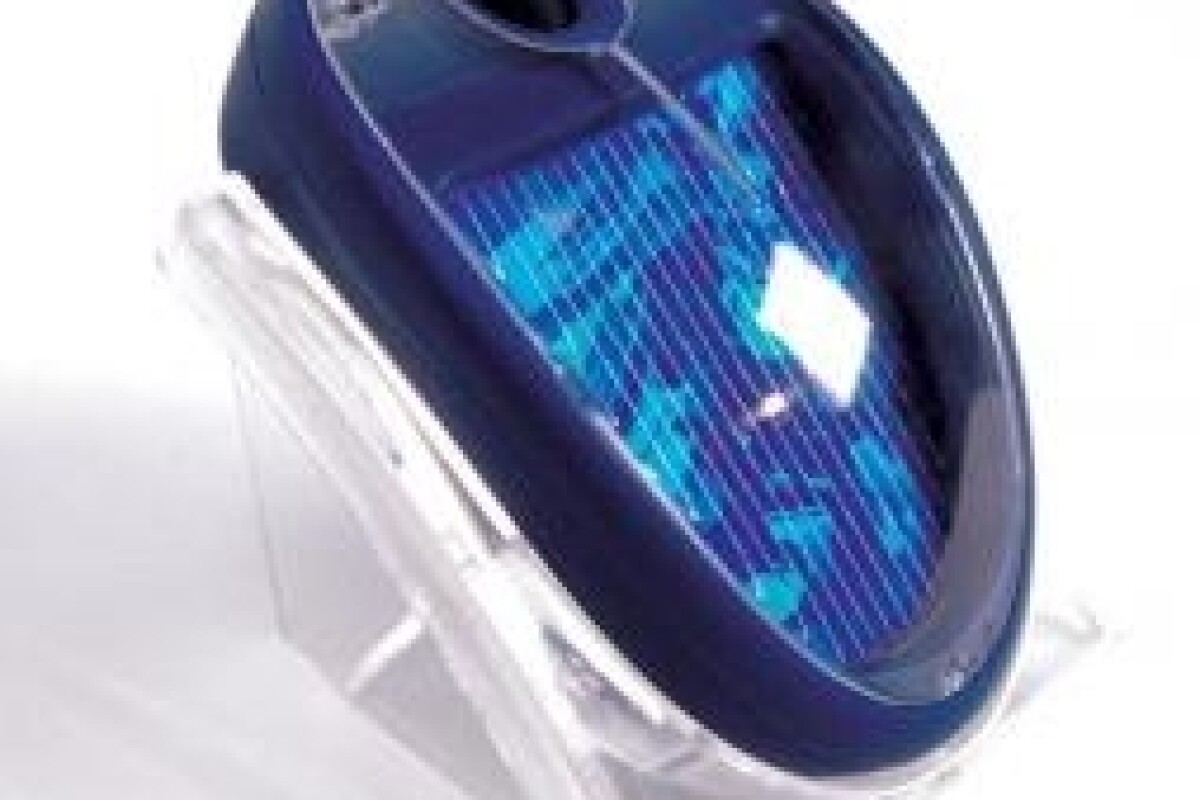



August 9, 2007 Anyone who has used a wireless mouse will know that although they don't use much power, it's enough to drain a battery quite regularly and it always decides to run out of power at the most inopportune times. Now comes news of the world's first exclusively photovoltaic-powered computer mouse currently undergoing trials in the Netherlands. The trial aims to demonstrate whether the mouse, known as 'Sole Mio', can be fully charged during busy daily activities. The initial first test series of 15 units are being tested in normal working environments to investigate whether users are willing to adapt their usage behaviour to suit the device.
High-profile participants including Minister Cramer of the Ministry for Housing have been recruited for the to see if factors such as working near a window, or periodically leaving the mouse in direct sunlight to enable the device to be 100% powered by solar energy can be accommodated.
The computer mouse was developed within the Syn-Energy programme of the Netherlands Organisation for Scientific Research (NWO in Dutch), in which the Universities of Twente and Utrecht, ECN and TU Delft cooperate closely.
Researchers estimate that several hundred million batteries could be saved annually on a global scale by adopting such devices, providing obvious environmental benefits. This scenario can only improve with the development of new types of cheap and energy-extensive PV cells, on which TU Delft and partners are also working.