

February 19, 2007 Patients who have gone blind are a step closer to perhaps one day regaining some of their sight with the news that the United States FDA has approved a study to evaluate an artificial retina. Researchers at the USC Doheny Eye Institute are developing the technology that hopefully will help patients with retinitis pigmentosa and macular degeneration regain some vision using an implanted artificial retina. The announcement by Mark Humayun, professor of ophthalmology at the Keck School of Medicine of USC and associate director of research at the Doheny Retina Institute, came at a press conference at the annual meeting of the American Association for the Advancement of Science in San Francisco.
The Food and Drug Administration recently approved an Investigational Device Exemption to conduct a clinical study of the new device – dubbed the Argus II Retinal Prosthesis System.
The implantable technology is a collaborative effort between USC and Second Sight Medical Products, which manufactures the implant.
The Argus II is the second generation of an electronic retinal implant designed for the treatment of blindness due to retinitis pigmentosa, a group of inherited eye diseases that affect the retina. RP causes the degeneration of photoreceptor cells in the retina, which capture and process light, helping individuals to see. As these cells degenerate, patients experience progressive vision loss. The Argus device is essentially designed to take the place of the photoreceptors.
“The first phase of our implant work began in 2002,” Humayun said. “We have successfully implanted six patients in the trial, and we have found that the devices are indeed electrically conducting and can be used by patients to detect light or even to distinguish between objects such as a cup or plate.”
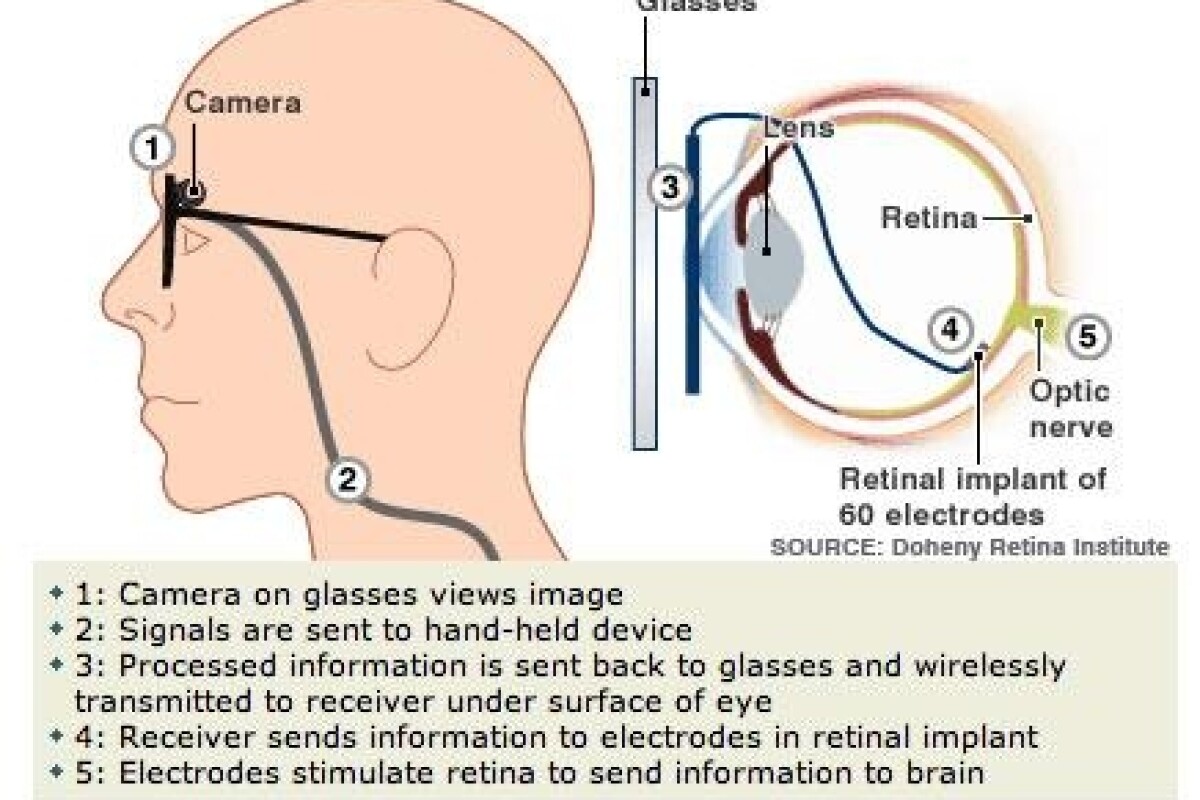
While the first generation of implants contained 16 electrodes laid out on an array, the Argus II is designed with 60 electrodes, which is intended to allow for higher-resolution images.
The new device is also approximately one quarter the size of the original, reducing surgery and recovery times.
The array is attached to the retina and used in conjunction with an external camera and video processing system to provide a rudimentary form of sight to implanted subjects.
The clinical trial of the first generation of implants continues at the Doheny Eye Institute at USC. All six previously blind patients in the first trial have been able to detect light, identify objects in their environment and even perceive motion after implantation with the first generation device.
The device ultimately may be used for the millions of people suffering from age-related macular degeneration, or AMD. In fact, Humayun said, there are 25 million people around the world, including 6 million in the United States, who have been blinded or are severely visually impaired due to diseases like RP and AMD.
By 2020, that figure is expected to double, creating a virtual vision-loss epidemic.
Both AMD and RP destroy vision by annihilating the retinal cells that allow light to be translated into recognizable images.
“Perhaps what we’re most excited about in this next study,” Humayun said, “is, similar to the first generation Second Sight device, we will be able to test the new device with patients at their homes, churches, schools and similar locations. The importance of this work is going to be reflected in how well this helps them regain some of their lost vision.”
The current study will include patients over 50 years of age who have RP or AMD and who have had previous functional vision.
This study is supported by the Department of Energy, the National Science Foundation, National Eye Institute/NIH, Research to Prevent Blindness, the W. M. Keck Foundation and the Albaugh Family Trust