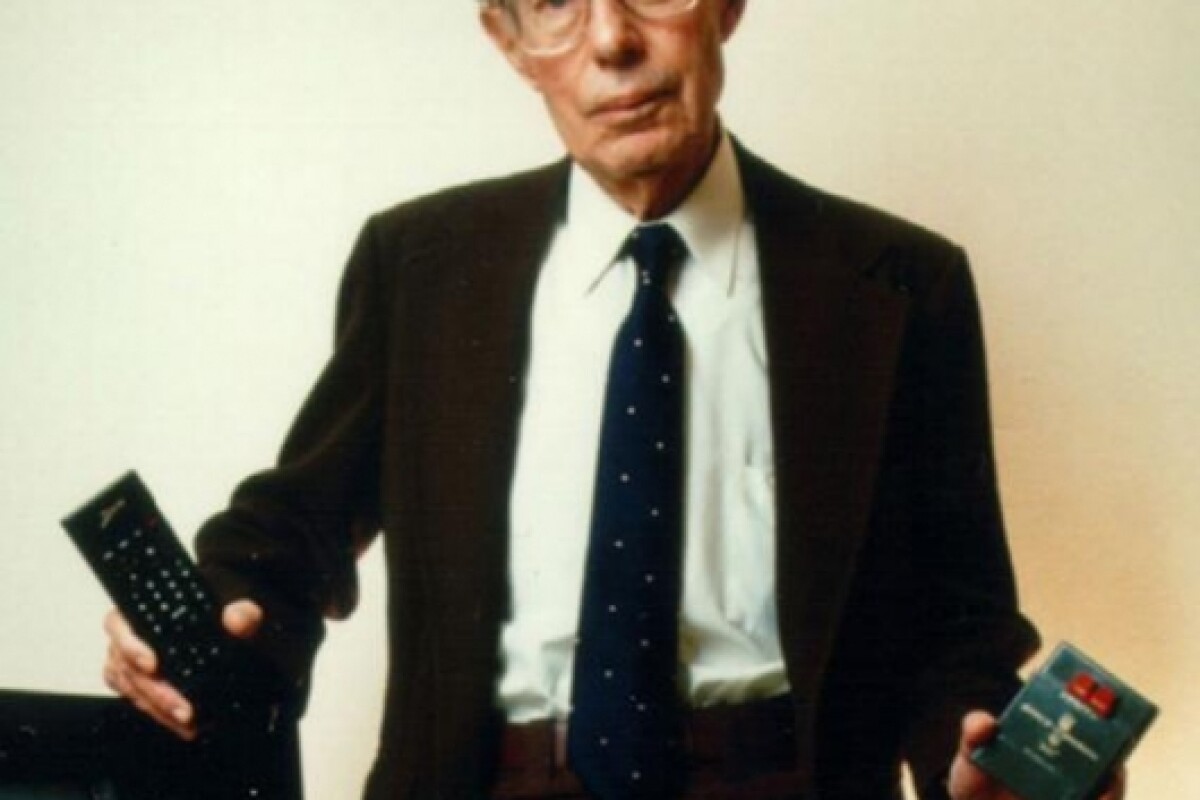



February 17, 2007 The man who invented the remote control for the television, Dr. Robert Adler, died this week, giving us a timely reminder of just how fast technology is progressing. Dr. Adler's "Space Command" ultrasonic remote control for TV sets was introduced by Zenith in 1956 and two years later saw him win the 1958 Outstanding Technical Achievement Award of the Institute of Radio Engineers (now the Institute of Electrical and Electronics Engineers or IEEE) for his "original work on ultrasonic remote controls" for television. Though he was best known as co-inventor of the wireless remote control for television , along with fellow Zenith engineer Eugene Polley), Adler was responsible for a large number of significant scientific contributions to the electronics industry, including landmark inventions in sophisticated specialized communications equipment.
A prolific inventor with a seemingly never-ending thirst for knowledge, his pioneering developments spanned from the Golden Age of Television into the High-Definition Era, earning him more than 180 U.S. patents. The U.S. Patent and Trademark Office published his most recent patent application, for advances in touch-screen technology, on Feb. 1.
Dr. Adler's six-decade career with Zenith Electronics Corporation began in 1941 when he joined Zenith's research division after receiving his Ph.D. degree in physics from the University of Vienna in 1937. He was named associate director in 1952, vice president in 1959, and vice president and director of research in 1963. He retired as research vice president in 1979, and served Zenith as a technical consultant until 1999, when Zenith merged with LG Electronics.
"Bob Adler was an unparalleled technical contributor, leader, adviser and teacher," said Jerry K. Pearlman, retired Zenith chairman and CEO, who knew Dr. Adler for 35 years. "His gifts and passions were many, his mentoring matchless and his ego totally nonexistent."
In the consumer electronics field, Dr. Adler has been widely recognized as the co-inventor (with fellow Zenith engineer Eugene Polley) of the wireless TV remote. Dr. Adler's "Space Command" ultrasonic remote control for TV sets was introduced by Zenith in 1956. He received the 1958 Outstanding Technical Achievement Award of the Institute of Radio Engineers (now the Institute of Electrical and Electronics Engineers or IEEE) for his "original work on ultrasonic remote controls" for television.
Among Dr. Adler's earlier work was the gated-beam tube which, at the time of its introduction, represented an entirely new concept in the field of vacuum tubes. The use of this tube greatly simplified the sound system in television receivers, markedly improving reception by screening out certain types of sound interference while lowering the cost of the sound channel.
Dr. Adler also was instrumental in originating and developing a synchronizing circuit which permitted demonstrably greater stability in fringe areas of the television reception. This invention was in wide use for many years and its principles are still employed today.
The electron beam parametric amplifier, developed in 1958 by Dr. Adler jointly with Glen Wade, then of Stanford University, was at the time the most sensitive practical amplifier for ultra high frequency (UHF) signals. It was used by radio astronomers in the United States and abroad, and by the U.S. Air Force for long-range missile detection.
Dr. Adler's original work in the field of acousto-optical interaction was instrumental in the 1966 public demonstration, by a team of Zenith engineers, of an experimental television display using ultrasonic deflection and modulation of a laser beam to produce a wall-size TV picture without a cathode ray tube.
During World War II, Dr. Adler worked on high-frequency magnetostrictive oscillators for use in Armed Forces communications equipment. His early work on electromechanical filters paved the way for the development of the highly compact filters widely used in aircraft receivers after the war. In the mid- 60s, he suggested the use of surface acoustic waves (SAWs) in intermediate frequency filters for color televisions sets, a technology that has since become universal, not only in television but as an essential building block of cellular telephone handsets.
Dr. Adler also pioneered the use of SAW technology for touch screens. Touch screens employing principles he originated are now in widespread use in airport kiosks and in museums such as the Holocaust Museum in Washington, the Rock and Roll Hall of Fame in Cleveland, the Milwaukee Art Museum, and the San Jose (Calif.) Technology Museum, among others. Since the early 1990s, as a consultant to Elo TouchSystems, Dr. Adler actively contributed to the commercialization and further innovation of his SAW touch screen invention.
In 1951, Dr. Adler became a Fellow of the IEEE, a professional honor which is conferred by the Institute's board of directors solely on the basis of "eminence and distinguished service." He was cited for his "developments of transmission and detection devices for frequency-modulated signals and of electromechanical filter systems."
Dr. Adler received the 1967 Inventor-of-the-Year Award from George Washington University's Patent, Trademark and Copyright Research Institute for his inventions in the field of electronic products, devices and systems used in aircraft communications, radar, TV receivers and FM broadcasting.
He received the Consumer Electronics Outstanding Achievement Award in 1970 from the IEEE. This award is made annually to an engineer who has contributed significantly toward the advancement of consumer electronics through engineering achievements.
Dr. Adler also received the IEEE 1974 Outstanding Technical Paper Award for his report on "An Optical Video Disc Player," representing early work in what was to become the digital video disc or DVD. His other IEEE awards include the Edison Medal in 1980 and the Sonics and Ultrasonics Achievement Award in 1981. The Edison Medal is the principal annual award of the IEEE and is presented for a career of meritorious achievement in electrical science, electrical engineering, or the electrical arts.
Together with Polley, he was honored in 1997 by the National Academy of Television Arts and Sciences with an Emmy award for Zenith's introduction of the first wireless TV remote controls 50 years ago. He was a charter inductee in the Consumer Electronics Hall of Fame in 2000. Dr. Adler was a member of the National Academy of Engineering, and a Fellow of the American Association for the Advancement of Science.
Born in Vienna, Austria on Dec. 4, 1913, Dr. Adler emigrated to the United States, settling in the Chicago area in 1941, when he joined Zenith. He lived on Chicago's North Shore for six decades, more than 50 years in Northfield, Ill., and in Northbrook, Ill., since 1998.
A lover of the arts, Dr. Adler was active in the Chicago cultural community for decades, including the Art Institute of Chicago, the Chicago Symphony Orchestra, Masters of Baroque, and community theater. A world traveler for both business and pleasure, he was fluent in German, English and French. He was an active participant in a Chicago-area French Club in the Chicago area for 35 years.
He was as passionate about hiking and skiing as he was about science and the arts. He was an avid downhill skier until age 89, and was still hiking in the past year. Dr. Adler died of heart failure on Feb. 15 in Boise, Idaho. He was 93. A memorial service is being planned for the Chicago area this spring. He is survived by his wife Ingrid (nee Koch) Adler.