
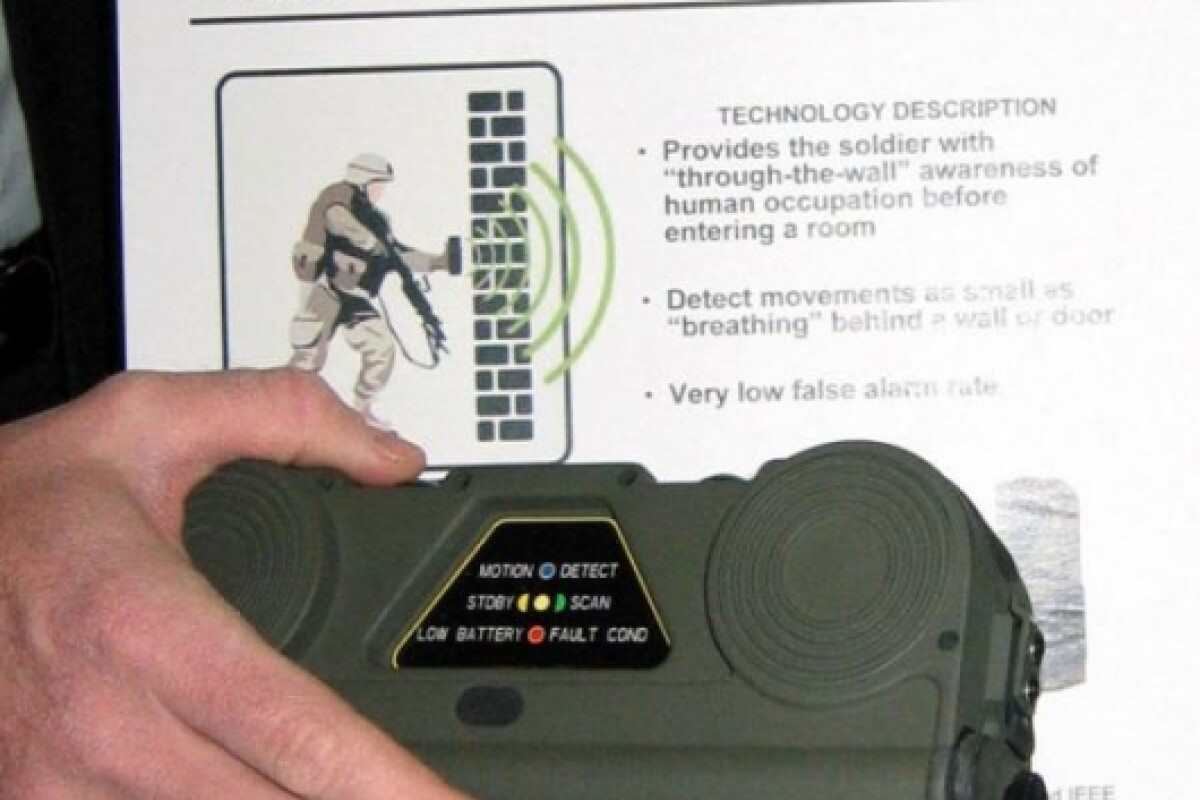



January 15, 2006 There was once a time when a concrete wall on the battlefield meant that a soldier was both safe from bullets and invisible to the enemy. Thanks to the coming XM25 Advanced Airburst Weapon System and DARPA’s latest invention, the “Radar Scope”, the concrete wall has now been rendered useless on both counts. The new "Radar Scope" offers warfighters the very same x-ray vision with which SuperMan captivated a generation of youngsters – it can see through walls. The Radar Scope is a light-weight, low-cost, through-wall personnel detector that uses stepped-frequency radar to detect subtle changes in Doppler signature of the returned signal. Put simply, it is a motion detector that can see through walls.
In a paper delivered by Dr. Edward Baranoski at last year’s DARPATech conference, the RadarScope’s abilities were outlined: “A warfighter searching a building will now be able to hold the Radar Scope up to a wall and detect in seconds whether someone is in the next room. It doesn’t matter if that someone plays possum; just as long as he is breathing, he will make a detectable movement.”
In the future, the Radar Scope could be extended to sensor arrays that yield 3D imagery of a room. Taking this further, future developments promise to image through multiple walls and even penetrate whole buildings using distributed sensors on or around buildings, carried by Soldiers, vehicles, even UAVs.
Baranoski’s DARPATech paper goes on to outline some of the future possibilities of a radar-based system: Imagine a commander being able to drive or fly down a city block and monitor buildings on both sides of the street, to find occupants inside, determine the layouts of the buildings, and locate weapon caches. We will be developing capabilities in advanced multistatic sensors and signal processing to create urban radar systems that will allow reconnaissance over whole city blocks.
Again, though, this is DARPA harder. RF signals will reflect and refract at every interface — floors, ceilings, stairways, furniture, doors, windows, wiring, and plumbing—you name it. Getting the energy inside is only the starting point. We have to get the energy back outside and interpret it to remove the distortion.
As Radar Scope shows, the most straightforward see-through radar task is motion detection. We would like to build approaches that can extend motion detection inside a building into methods that allow us to trace paths of motion. We can then build information on walkways, stairwells, and room boundaries. Even occupants’ RF shadows will have detectable signatures, allowing us to build information about background walls.
The Radar Scope, developed by DARPA, is expected to be fielded to troops in Iraq as soon as this spring. The Radar Scope will give warfighters the capability to sense through a foot of concrete and 50 feet beyond that into a room, Baranoski explained.
Weighing just a pound and a half, the Radar Scope will be about the size of a telephone handset and cost just about US$1,000, making it light enough for a soldier to carry and inexpensive enough to be fielded widely. The Radar Scope will be waterproof and rugged, and will run on AA batteries.
"It may not change how four-man stacks go into a room (during clearing operations)," Baranoski said. "But as they go into a building, it can help them prioritize what rooms they go into. It will give them an extra degree of knowledge so they know if someone is inside."
Even as the organization hurries to get the devices to combat forces, DARPA already is laying groundwork for bigger plans that build on this technology.
Proposals are expected this week for the new "Visi Building" technology that's more than a motion detector. It will actually "see" through multiple walls, penetrating entire buildings to show floor plans, locations of occupants and placement of materials such as weapons caches, Baranoski said.
"It will give (troops) a lot of opportunity to stake out buildings and really see inside," he said. "It will go a long way in extending their surveillance capabilities."
The device is expected to take several years to develop. Ultimately, servicemembers will be able to use it simply by driving or flying by the structure under surveillance, Baranoski said.