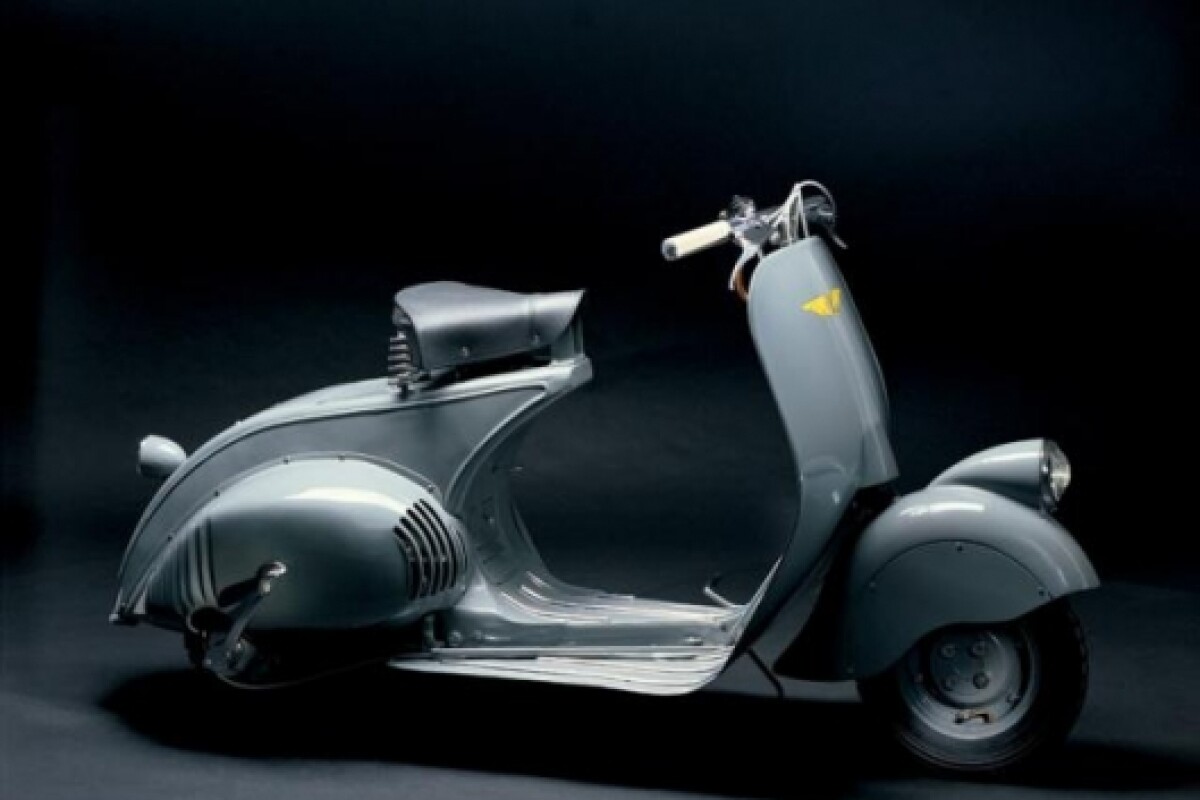



The scooter was invented in 1947 as a low cost alternative to the automobile in war-ravaged Europe – it was designed as transport for the masses and it caught on so quickly that it became one of the great transport phenomena to sweep the world in the 20th century. The Vespa (which means “wasp” in Italian) was the result of Enrico Piaggio’s determination to create a viable alternative to the automobile for the masses. As the war drew to a close, Enrico studied every possible solution to get production in his plants going again.
The origins
Piaggio was founded in Genoa in 1884 by twenty-year-old Rinaldo Piaggio.
The first activity of Rinaldo's factory was luxury ship fitting. But by the end of the century, Piaggio was also producing rail carriages, goods vans, luxury coaches and engines, trams and special truck bodies.World War I brought a new diversification that was to distinguish Piaggio activities for many decades. The company started producing aeroplanes and seaplanes. At the same time, new plants were springing up. In 1917 Piaggio bought a new plant in Pisa, and four years later it took over a small plant in Pontedera which first became the centre of aeronautical production (propellers, engines and complete aircraft) and then, after World War II, witnessed the birth of the iconic Vespa.
From aeronautics to individual mobility: the transformation of 1946
The war, a radical watershed for the entire Italian economy, was equally important for Piaggio. The Pontedera plant built the state-of-the-art four-engine P 108 equipped with a 1,500-bhp Piaggio engine in passenger and bomber versions. However Piaggio’s aeronautical plants in Tuscany (Pontedera and Pisa) were important military targets and on August 31, 1943 they were razed to the ground by Allied bombers, after the retreating Germans had already mined the pillars of the buildings and irrevocably damaged the plants.
To rebuild the Pontedera plants, Enrico Piaggio asked the Allies, who then occupied part of the grounds and of the buildings still standing, to arrange for the machinery transferred to Germany and Biella in northern Italy to be brought back. This was done rapidly and Armando and Enrico Piaggio then began the process of rebuilding. The hardest task went to Enrico, who was responsible for the destroyed plants of Pontedera and Pisa.
Enrico Piaggio’s decision to enter the light mobility business was based on economic assessments and sociological considerations. It took shape thanks to the successful co-operation of the aeronautical engineer and inventor Corradino D’Ascanio (1891-1981).
The origins of the scooter
A motor scooter was produced, based on a small motorcycle made for parachutists. The prototype, known as the MP 5, was nicknamed “Paperino” (the Italian name for Donald Duck) because of its strange shape, but Enrico Piaggio did not like it, and he asked Corradino D’Ascanio to redesign it.
But the aeronautical designer did not like motorcycles. He found them uncomfortable and bulky, with wheels that were difficult to change after a puncture. Worse still, the drive chain made them dirty. However, his aeronautical experience found the answer to every problem. To eliminate the chain he imagined a vehicle with a stress-bearing body and direct mesh; to make it easier to ride, he put the gear lever on the handlebar; to make tyre changing easier he designed not a fork, but a supporting arm similar to an aircraft carriage. Finally, he designed a body that would protect the driver so that he would not get dirty or dishevelled. Decades before the spread of ergonomic studies, the riding position of the Vespa was designed to let you sit comfortably and safely, not balanced dangerously as on a high-wheel motorcycle.
Corradino D’Ascanio only needed a few days to refine his idea and prepare the first drawings of the Vespa, first produced in Pontedera in April 1946. It got its name from Enrico Piaggio himself who, looking at the MP 6 prototype with its wide central part where the rider sat and the narrow “waist”, exclaimed, “It looks like a wasp!” And so the Vespa was born.
On April 23, 1946 Piaggio & C. S.p.A. filed a patent with the Central Patents Office for inventions, models and brand names at the Ministry of Industry and Commerce in Florence, for “a motor cycle with a rational complex of organs and elements with body combined with the mudguards and bonnet covering all the mechanical parts”. In a short space of time the Vespa was presented to the public, provoking contrasting reactions. However, Enrico Piaggio did not hesitate to start mass production of two thousand units of the first Vespa 98 cc. The new vehicle made its society debut at Rome’s elegant Golf Club, in the presence of U.S. General Stone who represented the Allied military government. Italians saw the Vespa for the first time in the pages of Motor (March 24, 1946) and on the black and white cover of La Moto on April 15, 1946.
From scepticism to “miracle”
Manufacturers and market experts were divided: on one side the people who saw the Vespa as the realisation of a brilliant idea, and on the other the sceptics, who were soon to change their minds. In the last months of 1947 production exploded and the following year the Vespa 125 appeared, a larger model that was soon firmly established as the successor to the first Vespa 98.
The Vespa “miracle” had become reality, and output grew constantly; in 1946, Piaggio put 2,484 scooters on the market. These became 10,535 the following year, and by 1948 production had reached 19,822. When in 1950 the first German licensee also started production, output topped 60,000 vehicles, and just three years later 171,200 vehicles left the plants.
Foreign markets also watched the birth of the scooter with interest, and both the public and the press expressed curiosity and admiration. The Times called it “a completely Italian product, such as we have not seen since the Roman chariot”. Enrico Piaggio continued tenaciously to encourage the spread of the Vespa abroad, creating an extensive service network all over Europe and the rest of the world. He maintained constant attention and growing interest around his product, with a number of initiatives that included the foundation and spread of the Vespa Clubs.
The Vespa became the Piaggio product par excellence, while Enrico personally tested prototypes and new models. His business prospects transcended national frontiers and by 1953, thanks to his untiring determination, there were more than ten thousand Piaggio service points throughout the world, including America and Asia. By then the Vespa Clubs counted over 50,000 members, all opposed to the “newborn” Innocenti Lambretta. No less than twenty thousand Vespa enthusiasts turned up at the Italian “Vespa Day” in 1951. Riding a Vespa was synonymous with freedom, with agile exploitation of space and with easier social relationships. The new scooter had become the symbol of a lifestyle that left its mark on its age: in the cinema, in literature and in advertising, the Vespa appeared endlessly among the most significant symbols of a changing society.
In 1950, just four years from its debut, the Vespa was manufactured in Germany by Hoffman-Werke of Lintorf; the following year licensees opened in Great Britain (Douglas of Bristol) and France (ACMA of Paris); production began in Spain in 1953 at Moto Vespa of Madrid, now Piaggio España, followed immediately by Jette, outside Brussels. Plants sprang up in Bombay and Brazil; the Vespa reached the USA, and its enormous popularity drew the attention of the Reader’s Digest, which wrote a long article about it. But that magical period was only the beginning. Soon the Vespa was produced in 13 countries and marketed in 114, including Australia, South Africa (where it was known as the “Bromponie”, or moor pony), Iran and China. And it was copied: on June 9, 1957, Izvestia reported the start of production in Kirov, in the USSR, of the Viatka 150 cc, an almost perfect clone of the Vespa.
Piaggio had begun very early on to extend its range into the light transport sector. In 1948, soon after the birth of the Vespa, production of the three-wheeler Ape van (the Italian for “bee”) derived from the scooter began, and the vehicle was an immediate success for its many possible uses. Numerous imaginative versions of the Vespa appeared, some from Piaggio itself, but mainly from enthusiasts - for example, the Vespa Sidecar, or the Vespa-Alpha of 1967, developed with Alpha-Wallis for Dick Smart, a screen secret agent, which could race on the road, fly, and even be used on or underwater. The French army had a few Vespa models built specially to carry arms and bazookas, and others that could be parachuted together with the troops. Even the Italian army asked Piaggio for a parachutable scooter.
1956: the Vespa crosses the one million mark
While the Lambretta was starting to enjoy some success, the Vespa was being copied and imitated in a thousand ways: but the uniqueness of the vehicle ensured Piaggio a very long period of success, so much so that in November 1953, the 500,000th unit left the line, followed by the one millionth in June 1956. In 1960 the Vespa passed the two million mark; in 1970 it reached four million, and over ten million in 1988, making it a unique phenomenon in the motorised two-wheeler sector it has sold over 16 million units to date.From 1946 to 1965, the year Enrico Piaggio died, 3,350,000 Vespas were manufactured in Italy alone: one for every fifty inhabitants.
The boom of the Vespa, and the different business prospects of the Piaggio brothers, with Enrico concentrating on light individual mobility in Tuscany and Armando on the aeronautical business in Liguria, led the company to split. On February 22, 1964, Enrico Piaggio acquired the share in Piaggio & C. S.p.A. held by his brother Armando, who then founded “Rinaldo Piaggio Industrie Meccaniche Aeronautiche” (I.A.M. Rinaldo Piaggio).
The Vespa 50 had appeared the previous year, 1963, following the introduction of a law in Italy making a numberplate obligatory on two-wheelers over 50 cc. The new scooter was exempt from this law and was an immediate success. In Italy sales of vehicles with numberplates decreased by 28 per cent in 1965 compared to the previous year. On the other hand, the Vespa, with its new “50” series, was a great success. The light Vespa was a successful addition to the Piaggio range and this displacement is still in production. To date almost 3,500,000 Vespa 50s have been built in different models and versions, the latest being the ET4 50 launched in autumn 2000. It is the first four stroke Vespa 50cc, and has a record range of over 500 km with a full tank.
The Vespa PX (125, 150 and 200cc) is the biggest sales success in the entire history of the Vespa. It is the “original vintage” - launched in 1977, it has sold over two million units, and as such is a favourite among those with a sense of nostalgia but also with the younger market.
Records, sports and long distance travel: around the world with the Vespa
The Vespa also has a racing career behind it. In Europe back in the Fifties, it took part, often successfully, in regular motor cycle races (speed and off-road), as well as unusual sporting ventures.
In 1952 the Frenchman Georges Monneret built an “amphibious Vespa” for the Paris-London race and successfully crossed the Channel on it. The previous year Piaggio itself had built a Vespa 125cc prototype for speed racing, and it set the world speed record for a flying kilometre at an average of 171.102 km/h.
The Vespa also scored a great success at the 1951 “International 6 Days” in Varese, winning 9 gold medals, the best of the Italian motorcycles. That same year saw the first of innumerable rallies with the Vespa: an expedition to the Congo, which was to be the first of a series of incredible journeys on a scooter that was intended primarily to solve the problems of urban and intercity traffic.
Giancarlo Tironi, an Italian University student, reached the Arctic Circle on a Vespa. The Argentine Carlos Velez crossed the Andes from Buenos Aires to Santiago del Chile. Year after year, the Vespa gained popularity among adventure holiday enthusiasts: Roberto Patrignani rode one from Milan to Tokyo; Soren Nielsen in Greenland; James P. Owen from the USA to Tierra del Fuego; Santiago Guillen and Antonio Veciana from Madrid to Athens; Wally Bergen on a grand tour of the Antilles; the Italians Valenti and Rivadulla in a tour of Spain; Miss Warral from London to Australia and back; the Australian Geoff Dean took one on a round-the-world tour.
Pierre Delliere, Sergeant in the French Air Force, reached Saigon in 51 days from Paris, going through Afghanistan. The Swiss Giuseppe Morandi travelled 6,000 km, much of it in the desert, on a Vespa he had bought in 1948. Ennio Carrega went from Genoa to Lapland and back in 12 days. Two Danish journalists Elizabeth and Erik Thrane, a brother and sister, reached Bombay on a Vespa. And it is impossible to count the many European scooter riders who have reached the North Cape on their Vespas.
Few know that in 1980 two Vespa PX 200s ridden by M. Simonot and B. Tcherniawsky reached the finishing line of the second Paris-Dakar rally. Four-time Le Mans 24 Hours winner Henri Pescarolo helped the French team put together by Jean-François Piot.
The Vespa continues to travel: in 1992 Giorgio Bettinelli, writer and journalist, left Rome on a Vespa and reached Saigon in March 1993. In 1994-95 he rode a Vespa 36,000 km from Alaska to Tierra del Fuego. In 1995-96 he travelled from Melbourne to Cape Town - over 52,000 km in 12 months. In 1997 he started out from Chile, reaching Tasmania after three years and 150,000 km on his Vespa across the Americas, Siberia, Europe, Africa, Asia and Oceania. All in all, Bettinelli has travelled 254,000 km on a Vespa.
Vespa, the cinema and the USA
Stylish and unmistakably Vespa, exceptionally comfortable to ride with low-environmental-impact engines and disk brakes, the new-generation ET models are now also sold in numerous "Vespa Boutiques" in the US (over 60 from California to Florida and from Hawaii to New York, with the latest two boutiques in SoHo and Queens).
Having returned to the US in 2000 after exiting the market in 1985 because of new emissions legislation that targeted two stroke engines, the Vespa was an immediate success all over again, and has achieved a market share of 20 per cent of the small (40,000 units a year) but growing scooter sector. 6,000 Vespas were sold in the first year, 2001, and over 7,000 in 2002.
But the Vespa isn't just a market phenomenon. It forms part of social history. In the "Dolce Vita" years the Vespa became a synonym for scooter, foreign reporters described Italy as "the country of the Vespa" and the Vespa's role in social history, not just in Italy but abroad, can be seen from its presence in hundreds of films. And it's a story that continues to be told today.
Audrey Hepburn and Gregory Peck in "Roman Holiday " were only the first of a long series of international actors and actresses to be seen on the world's most famous scooter in a filmography that goes from “Quadrophenia” to “American Graffiti”, from “The Talented Mr. Ripley” to “102 Dalmatians”, not to mention “Dear Diary ”.
In photo shoots, films and on the set, the Vespa has been a "travel companion" for names like Raquel Welch, Ursula Andress, Geraldine Chaplin, Joan Collins, Jayne Mansfield, Virna Lisi, Milla Jovovich, Marcello Mastroianni, Charlton Heston, John Wayne, Henry Fonda, Gary Cooper, Anthony Perkins, Jean-Paul Belmondo, Nanni Moretti, Sting, Antonio Banderas, Matt Damon, Gérard Depardieu, Jude Law, Eddie Murphy and Owen Wilson.