
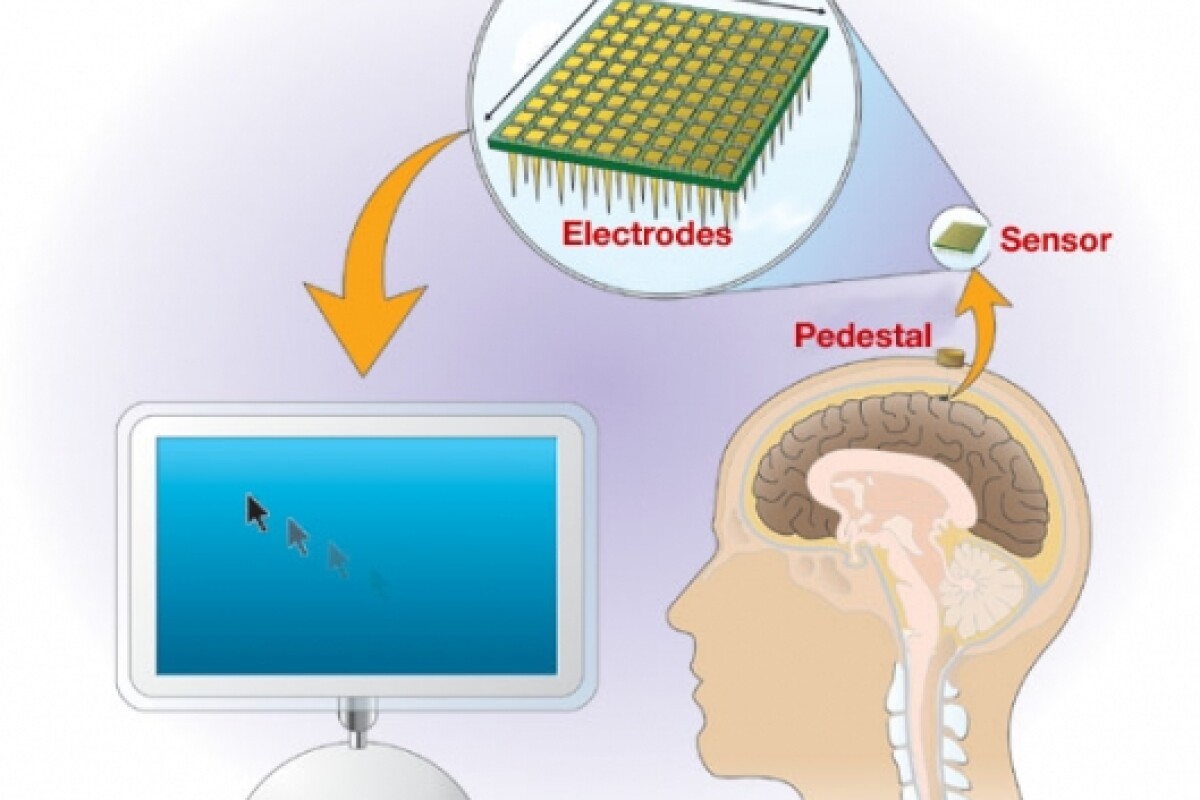



December 7, 2004 An implantable, brain-computer interface the size of an aspirin has been clinically tested on humans by American company Cyberkinetics. The 'BrainGate' device can provide paralysed or motor-impaired patients a mode of communication through the translation of thought into direct computer control. The technology driving this breakthrough in the Brain-Machine-Interface field has a myriad of potential applications, including the development of human augmentation for military and commercial purposes.
"The goal of the BrainGate program is to develop a fast, reliable and unobtrusive connection between the brain of a severely disabled person and a personal computer" stated Tim Surgenor, President and CEO of Cyberkinetics. "We [hope] to provide paralysed individuals with a gateway through which they can access the broad capabilities of computers, control devices in the surrounding environment, and even move their own limbs."
Researchers at the University of Pittsburgh have already demonstrated that a monkey can feed itself with a robotic arm simply by using signals from its brain, an advance that could enhance prosthetics for people, especially those with spinal cord injuries. Now, using the BrainGate system in the current human trials, a 25 year old quadriplegic has successfully been able to switch on lights, adjust the volume on a TV, change channels and read e-mail using only his brain. Crucially, the patient was able to do these tasks while carrying on a conversation and moving his head at the same time.
John Donoghue, the chair of the Department of Neuroscience at Brown University, led the original research project and went on to co-found Cyberkinetics, where he is currently chief scientific officer overseeing the clinical trial. "The development of the BrainGate program is the culmination of 10 years of research in my academic laboratory at Brown University. We have not only demonstrated in preclinical studies that BrainGate can remain safely implanted in the [monkey] brain for at least two years, but we have shown that it can safely be removed as well."
About the BrainGate device
The BrainGate Neural Interface Device is a proprietary brain-computer interface that consists of an internal neural signal sensor and external processors that convert neural signals into an output signal under the users own control. The sensor consists of a tiny chip smaller than a baby aspirin, with one hundred electrode sensors each thinner than a hair that detect brain cell electrical activity.
The BrainGate technology platform was designed to take advantage of the fact that many patients with motor impairment have an intact brain that can produce movement commands. This may allow the BrainGate system to create an output signal directly from the brain, bypassing the route through the nerves to the muscles that cannot be used in paralysed people.
The chip is implanted on the surface of the brain in the motor cortex area that controls movement. In the pilot version of the device, a cable connects the sensor to an external signal processor in a cart that contains computers. The computers translate brain activity and create the communication output using custom decoding software. Importantly, the entire BrainGate system was specifically designed for clinical use in humans and thus, its manufacture, assembly and testing are intended to meet human safety requirements. Five quadriplegics patients in all are enrolled in the pilot study, which was approved by the U.S. Food and Drug Administration (FDA).
The Future of Neural-Interfaces
Cyberkinetics has a vision, CEO Tim Surgenor explained to Gizmag, but it is not promising "miracle cures", or that quadriplegic people will be able to walk again - yet. Their primary goal is to help restore many activities of daily living that are impossible for paralysed people and to provide a platform for the development of a wide range of other assistive devices.
"Today quadriplegic people are satisfied if they get a rudimentary connection to the outside world. What we're trying to give them is a connection that is as good and fast as using their hands. We're going to teach them to think about moving the cursor using the part of the brain that usually controls the arms to push keys and create, if you will, a mental device that can input information into a computer. That is the first application, a kind of prosthetic, if you will. Then it is possible to use the computer to control a robot arm or their own arm, but that would be down the road."
Existing technology stimulates muscle groups that can make an arm move. The problem Surgenor and his team faced was in creating an input or control signal. With the right control signal they found they could stimulate the right muscle groups to make arm movement.
"Another application would be for somebody to handle a tricycle or exercise machine to help patients who have a lot of trouble with their skeletal muscles. But walking, I have to say, would be very complex. There's a lot of issues with balance and that's not going to be an easy thing to do, but it is a goal."
Cyberkinetics hopes to refine the BrainGate in the next two years to develop a wireless device that is completely implantable and doesn't have a plug, making it safer and less visible. And once the basics of brain mapping are worked out there is potential for a wide variety of further applications, Surgenor explains.
"If you could detect or predict the onset of epilepsy, that would be a huge therapeutic application for people who have seizures, which leads to the idea of a 'pacemaker for the brain'. So eventually people may have this technology in their brains and if something starts to go wrong it will take a therapeutic action. That could be available by 2007 to 2008."
Surgenor also sees a time not too far off where normal humans are interfacing with BrainGate technology to enhance their relationship with the digital world - if they're willing to be implanted.
"If we can figure out how to make this device cheaper, there might be applications for people to control machines, write software or perform intensive actions. But that's a good distance away. Right now the only way to get that level of detail from these signals is to actually have surgery to place this on the surface of the brain. It's not possible to do this with a non-invasive approach. For example, you can have an EEG and if you concentrate really hard you can think about and move a cursor on a screen, but if someone makes a loud noise or you get interrupted, you lose that ability. What we're trying to make here is a direct connection. The [BrainGate] is going to be right there and you won't have to think about it."
DARPA
The Brown University group was partially funded by the Defence Advanced Research Projects Agency (DARPA), the central research and development organisation for the US Department of Defence (DoD). DARPA has been interested in Brain-Machine-Interfaces (BMI) for a number of years for military applications like wiring fighter pilots directly to their planes to allow autonomous flight from the safety of the ground. Future developments are also envisaged in which humans could 'download' memory implants for skill enhancement, allowing actions to be performed that have not been learned directly.
Surgenor discounts the near term possibility of this type of 'memory enhancement', however, saying several critical factors would have to be overcome.
"I don't know about memory but I do think that it will be possible to augment sense. Instantaneous sensation will be possible. In order to do memory we'd have to figure out how the brain actually stores that information, which is not well understood at this point.
"You can learn to interpret an electrical stimulation pattern in your ear and turn that into sound. So that's a sensation. Some companies are interested in connecting television cameras to the retina of the eye, and there's other groups - academics, not companies - that are interested in putting a connector directly to the part of the brain that processes vision. Those are the cortical applications envisaged at the moment - vision and hearing."
For more information visit: