


I recently had the opportunity to visit the headquarters of OQO and received a sneak peak not only of their upcoming Model 1 ultra personal computer (uPC), but of their working environment and their marketing plan. The office itself is interesting, an eclective mix of and old and new. The interior of the building looks like the sandblasted shell of a factory built at the turn of the last century, but has been updated with bits of postmodern/industrial looking art here and there. The main striking difference from the offices that most people work in was the lack of walls. Not even cubicle partitions separate the workspaces of OQO's staff. That's not to say that there aren't plenty of doors, they've attached legs and wheels and turned all the doors into desks.
The creative minds that envisioned this unique workspace have come together to push the envelope and build the smallest functional PC that can possibly be built with today's technology. From the looks of the advanced sample that I had a chance to test out, I'd say they've done just that.
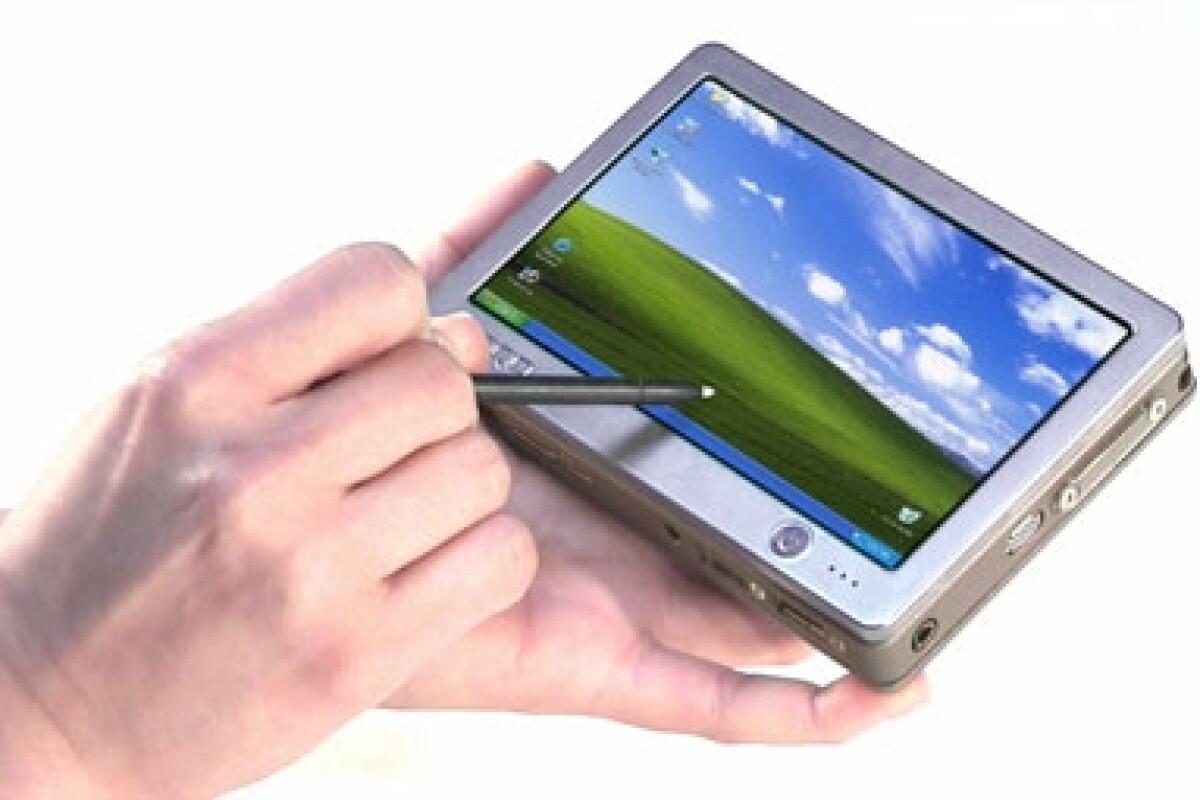
The OQO uPC Model 1 is basically a PDA sized notebook PC. The technical wizards at OQO have managed to squeeze nearly all the features and performance of an ultra light tablet/notebook PC into a package that measures 4.9 x 3.4 x 0.9 inches in size. The only major difference between OQO's UPC and a a notebook like a Sharp Actius MM20 is the screen, which is 5in. and 800x480 pixels on the uPC. Other notable differences are the keyboard and the lack of a PC-Card slot. It's got everything else that you'd expect in a full sized PC and a couple of extra features that take advantage of its size. Since the device is designed to be held in your hands while being used, the clever engineers at OQO have included a thumb wheel to scroll through lists and window contents, as well as a magnetic pen that allows you to write on the screen in the way that you'd use a tablet PC. The device is equipped with an array of I/O ports as well as both WiFi (802.11b) and Bluetooth networking. To make things even easier, OQO has created a "docking cable" which has connectors on it every few inches for video, USB, Firewire, Ethernet, audio, and power.
Awesome Technical Achievement, but is it worth the bother?
There's no doubt that the hardware is impressive, but after using the device myself I'm left wondering about the wisdom of running the desktop version of Windows XP on a device that feels like a PDA. Aside from the fact that Microsoft's desktop OS eats up a lot of CPU power, the applications that run on XP aren't optimized for use on a handheld device. As a high-end gadget user I'm more attracted to a super PDA like Samsung's Nexio XP30 or Bsquared's Power Handheld devices. Both of these devices run Windows CE .Net version 4.1, which is an OS designed to be used in handheld devices, so there's a more natural fit for the applications that run on the CE .Net platform. If you're a business user that uses your PC for Outlook and Office applications, then it might be better to choose a device with a PDA OS, especially considering that the newest crop of high end PDAs have 3G networking and phone capabilities built into them.
With that said, OQO says that they're targeting business users to buy their uPC. Businesses that have custom applications that run only on PCs could be served well by this new class of device that's substantially easier to handle and carry around than a notebook PC. After hearing their pitch, I tend to agree... with parts of it. While I think that the device will be a star at running vertical applications, OQO's other business target users are corporate executives who leave their notebooks in their docking stations and don't carry them around. Apparently the fact that an executive has a device that's mobile, but doesn't move it, is extremely troubling to the IT staffs of many fortune 500 companies. To solve this problem they want to swap out the notebooks PCs these executives are using with OQO uPCs in the hopes that the executives will carry them around more if they're smaller.
Personally I don't see the point, and I think that anyone that had a relatively powerful notebook replaced with a much less powerful uPC would ask for their old PC back pretty quickly. Time will tell if executives accept these devices as their only PC, or if they use them as a really high end, high status PDAs. Either way, as long as the IT guys don't send back the ones the execs aren't using, OQO benefits.
The only really important feature that I can see that's missing in this device is the lack of 3G networking. I spent a lot of time discussing this with the company and got two answers on this issue.
1) "We're working diligently on successfully launching the device in September, and we don't want to discuss future plans or anything that isn't already in the current design." A fair statement considering that they first announced the device in 2002 and are a bit late in shipping it as a product.
And 2) "We've got built in WiFi and Bluetooth in the device now which is more than most notebook PCs, so we're ahead of the game even without 3G networking."
Again, to be fair, I'm not sure what the company could easily do short of adding a PC-Card Slot that would solve this problem. So on this issue we agreed to disagree. OQO thinks that WiFi networking is pervasive today to allow you to use their device just about everywhere. I think they've created their own networking problem by making their device so small. With a regular notebook it's not really an issue setting yourself up at Starbucks, since you've got to unpack the thing and sit down to use it anyway. With the uPC you just slip the thing out of your pocket and start using it. This easy access is what causes networking problems, since the places you're likely to whip out your uPC aren't likely to have WiFi access.
Granted, if you have a GSM phone that's Bluetooth compatible you could use your phone as a modem for your uPC. With such and impressive design team, and incredible first product we'll just have to hope that they'll have a high speed WLAN solution in the future, even if they won't talk about it today.
Competition
There's really three types of competitors that are vying for mind share in the small portable space. The first are other uPC manufacturers. In the uPC space there is only one other company of note, Paul Allen's Vulcan Ventures. This investment company headed by a Microsoft co-founder got so frustrated with the lack of availability of a handheld PC that they decided to build their own. The result is the FlipStart PC. While sharing similar specs with the OQO Model 1, the FlipStart PC differs in a few key areas, not the least of which is that no one that I know of has actually seen one of the devices. It wasn't all that long ago that OQO itself was in the running to be inducted into the vaporware hall of fame, so I don't want to be too hard on the FlipStart, but I can't consider it a viable competitor until it's actually seen and used by someone outside their company.
The second class of competitors are ultra portable notebook manufacturers. Small lightweight notebooks are twice as heavy and have 4 times the footprint of the OQO uPC, but they've got the advantage of having faster processors, larger screens and full sized keyboards. In situations where flexibility is more important than portability it's more productive to use a small notebook. I think that this is where OQO is going to find they have the most competition, with lots of customers being impressed with their product, but "compromising" and buying the notebook anyway.
The last class of competitors are the uber-PDA manufactures. The Windows CE .Net devices like the Nexio and Power Handhelds mentioned above are meant to used full time with 3G networking and make better calendar and e-mail devices. If you need a device that keeps you connected to the office and allows you to occasionally use Microsoft Office applications, these devices are better suited to the task.
So is it worth the wait?
Possibly, but it's hard to imagine the Model 1 succeeding in all of the niches that OQO has identified. While it looks like it might be ideal for custom vertical applications, I don't see it winning big with executives as a notebook replacement. This is especially true since OQO decided to stick with Transmeta's aging Crusoe 5800 processor instead of launching with their new higher performance Efficeon processor. Additionally a device designed to be carried in your jacket pocket and used anywhere needs network access that works anywhere.
Ironically the Model 1's diminutive PDA-like size leads you to expect that it will work like a 3G-PDA instead of like the ultra small notebook PC that it really is. It's just too much of a compromise coming from the full featured desktop PC that these executives' notebooks already have replaced.
But even with all that said, if none of these issues are show stoppers on your personal evaluation list, there's not much that could be done to stop you from running out and buying one of these things the moment that its available. Even if you think it's not practical you can't deny that it's just plain old cool!
OQO is planning on a limited release in June (to corporate customers) and a general release in September. If you'd like to be one of the lucky ones to participate in a corporate pilot, OQO has a signup form on their website for just that purpose (http://www.oqo.com/enterprise/corpsales/).
Dave Weinstein is Gizmo's Editor-at-Large in the United States. If you'd like to comment on this article or have products that you'd like Dave to look into, feel free to e-mail him at daveknows@gizmo.com.au.