



Every year between November and January, endangered North Atlantic right whales are thought to use an area off the coast of Maine known as the Outer Fall as a breeding ground. They are “thought to” because the ocean conditions at that time of year can make it difficult to locate them. Two autonomous marine robots called gliders have now been used as a real time whale-detection system for researchers and to warn boats in the area to slow down to avoid striking the marine mammals.
Employed as part of an oceanographic research project led by Mark Baumgartner and Dave Fratantoni from the Woods Hole Oceanographic Institution, the two torpedo-shaped ocean-going robots are about six foot (1.8 m) long and come equipped with an iridium satellite antenna, underwater microphone, digital acoustic monitoring (DMON) instrument and specialized software that allows them to detect, classify and tally calls from four species of baleen whales – sei, fin, humpback, and right.
Used by oceanographers for around a decade, the gliders are able to move up, down and laterally through the water in a sawtooth pattern by changing their buoyancy and using their short wings to provide lift. They are also battery-powered, making them very quiet.
The two gliders were deployed on November 12 and surveyed the area for two weeks, surfacing every two hours to get a GPS position and transmit data to shore via satellite. The scientific team arrived on November 28 with the gliders continuing their survey operations for another week, alerting the scientists to the presence of whales in the research area in real time.
“We found our first right whale on the first day that we were surveying in decent weather conditions because the gliders were up there doing the leg work for us, to tell us where the animals were in real time,” says Baumgartner.
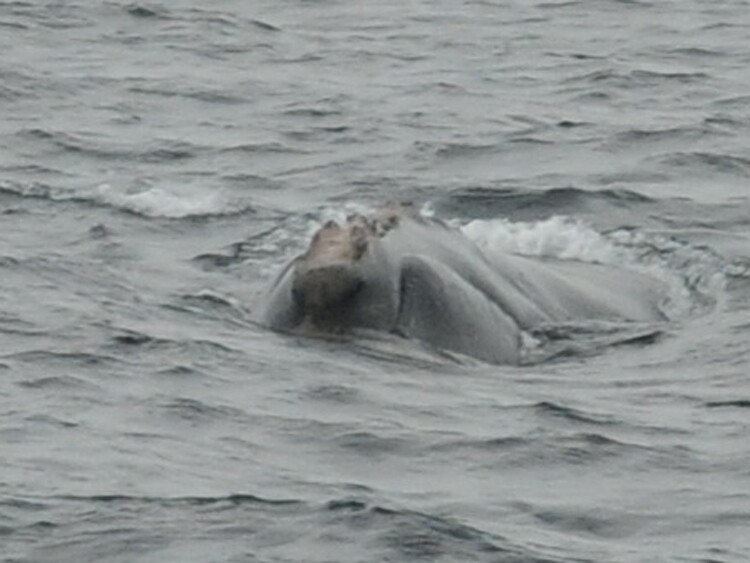
The researchers say the autonomous marine robots provide conservation managers and researchers with a more cost-effective and less labor-intensive alternative to current whale detection methods that rely on ship- or plane-based human observers.
“We’ve been doing visual based surveys for a long time – either from a plane or a boat. They have a lot of value, but they are limited, especially at certain times of the year,” says Sofie Van Parijs, leader of the Passive Acoustic Research Group at NOAA’s Northeast Fisheries Science Center (NEFSC). “These gliders provide a great complement to this system. Knowing where right whales are helps you manage interactions between an endangered species and the human activities that impact those species.”
The scientists reported their sightings to the National Oceanic and Atmospheric Administration (NOAA), with the NOAA Fisheries Service then putting in place a “dynamic management area,” asking mariners to voluntarily slow down so as to avoid striking the whales.