Prototype GHOST military watercraft claims a world's first
By Ben Coxworth
16:50 January 17, 2012

GHOST is a prototype military boat, that is claimed to be the world's first super-cavitating watercraft
Image Gallery (5 images)If you combined a stealth jet fighter and an attack helicopter and stuck them in the water, what would you get? Well, according to the folks at New Hampshire's Juliet Marine Systems (JMS), you'd get the GHOST marine platform. Privately developed for possible use by the U.S. Navy, the boat would reportedly be invisible to enemy ships' radar, while also being faster and more economical than existing military vessels. The company's big claim, however, is that GHOST is the world's first super-cavitating watercraft.
Supercavitation, in a nutshell, involves surrounding an object with a bubble of gas, so it can pass through the water with very little friction. In the case of GHOST, the objects in question are its two submerged buoyant tubular foils. Although the company isn't clear on how the process works, presumably the foils would have to be designed in such a way that when GHOST's gas turbines thrust it forward, water is deflected outward at the front of each foil, creating an envelope that closes behind it.
Whatever the case, JMS states that "GHOST is a combination aircraft/boat that has been designed to fly through an artificial underwater gaseous environment that creates 900 times less hull friction than water." Judging by that statement, it's hard to say if GHOST actually does create 900 times less friction, or if that's simply what they're aiming for.
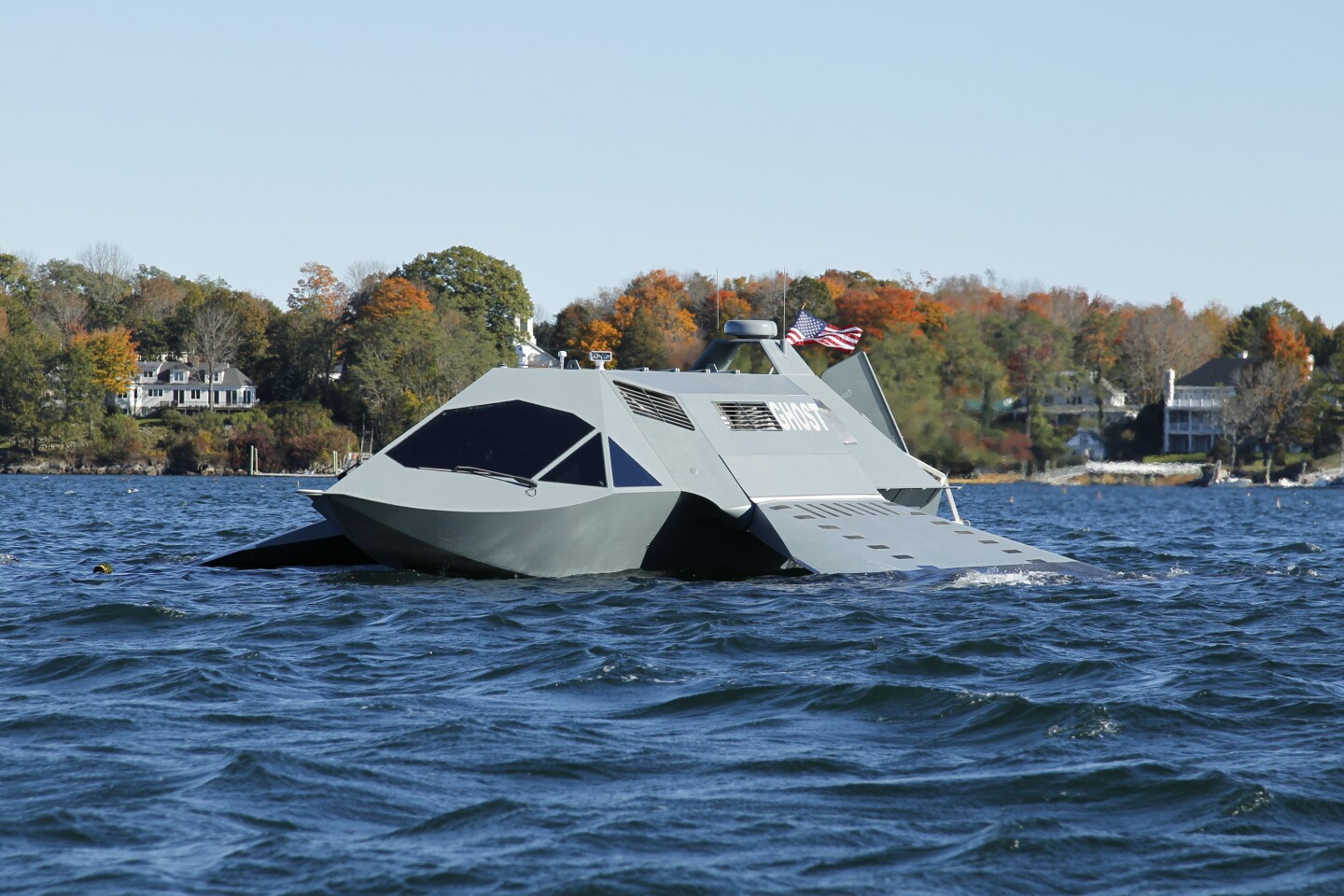
The three-crew-member watercraft is intended primarily to patrol the perimeter of naval fleets, ready to spring into action against attacking small enemy boats. It is also being marketed as a means of protecting commercial vessels against pirate attacks. It can reportedly carry "thousands of pounds of weapons, including Mark 48 torpedoes" in an internal weapons bay, and could incorporate multiple weapons systems, capable of firing on several targets simultaneously.
It could also serve as a quiet, stealthy means of transporting troops to enemy beaches, or as a fast and efficient way of ferrying people and supplies to and from locations such as offshore oil platforms.
While there's presently no word on whether or not GHOST has any takers, JMS claims to be already working with a large international defense company on a 150-foot version of the craft, and on creating an unmanned underwater vehicle that utilizes its super-cavitating technology.
Source: Danger Room

With the potential US military cut-backs
it doesn't stand a GHOST of a chance !!!
Awesome technology !!!
Charles Gaines. You saw something like this in a Jame Bond movie.
... and what you saw in the James Bond movie was another American prototype.
As for supercavitation, I guess it works similarly as the Russian Shkval supercavitating torpedo:
http://en.wikipedia.org/wiki/Shkval
In this case, the exhaust of its turbopumps is fed from the point of the torpedo, creating a bubble that surrounds it, and allows it to "fly" through water at 400kts.
@Charles Gaines : maybe Street Fighter the movie ? As far as I can remember it looked pretty much the same.
Looks a lot like US NAVY's stealth ship Sea Shadow from '84.
http://en.wikipedia.org/wiki/Sea_Shadow_%28IX-529%29
My understanding is that supercavitation is very loud through sonar.
It looks like the little mining ship you pilot in Descent :p
My first reaction was a creepy sort of deja-vu.. like the last thing you would see before an attack.
..And Alan, as a musician with some experience in acoustical engineering, I'd be curious as to why it would be so loud to sonar .. my guess is the air pocket acts as a resonance chamber.. correct?
Looks like Darth Vader from the front! Lets try it out on some Iranian speedboats in the Strait!
My first thought is if the military doesn't go for it, the drug cartels would be standing in line.
First, I think the sonar 'footprint' would deal mostly with HOW you 'distributed' the air around the hull/cylinder... "bubbles" ARE loud, but a 'smooth sheet of air' might be much less disruptive. I might also suggest that the cylinders be attached at the end of the 'wings' with VERTICLE connection rather than the current wingtip design. That would put a LOT of the water disruption with the surface on TOP of the cylinder instead of beside it -- where it will 'reflect' into the water more.
Second, I wonder how 'rough' the seas can be fore SAFE operation? If it is operating as an escort vehicle to a Fleet, what happens when the seas get very rough --- as the OFTEN do in open water?!
Third, Just HOW fast will it run? Will it be able to out-run an Apache Helicopter? (or 'similar' attack helicopter from 'opposing forces'...) And what will the Range be on a single load of fuel? If "rhtgind" is right, and drug cartels buy some of these, can WE Stop it from being used by others?
FINAL Question is...would it be COST-EFFECTIVE??! Would we be spending MILLIONS for a piece of equipment with limited improvements of other choices? Would it put the US far-enough "ahead of others" to justify this expense in a time of Economic 'crunch'?
Nice to see that US taxpayers are still paying for attack craft to invade countries and grab the goodies for our corporations. Small wonder that US taxpayers (the poor people who actually pay taxes anyway) get to foot the bill for a larger war budget than existed during World War II and that is larger than all the rest of the countries in the world combined spend.
How big a stick does our government really need and why does it have to be gold plated? And then of course the stick is increasingly being used to whack in every sense of the word, US citizens as well as foreign nationals.
Did I miss it? Didn't see any mention of how fast it moves.
Can it maintain the bubble while turning or does it only make use of supercavitation in a straight line?
That's the fundamental problem with supercavitation, it enables a vessel to move really fast in a straight line but as soon as you turn out of the low pressure zone at high speed you essentially run into a brick wall.
If it can't tune the envelope or maintain the bubble while turning the boat will be fast but have a gigantic turning radius.
Why even be attached to the water? Put wings on it and fly or go ahead and develop that huge Russian ground effects thingamajig.
To Calson: Private company.
Not government funded, PRIVATE.
First, it looks familiar because it looks like two or three different attack spacecraft from a couple of the recent (if the last 10 or 15 years can be considered recent) Sci-Fi movies and/or Television shows. Minus, of course, the vertical fin/rudder, whatever. On a more practical note, I wonder if the turning question could be answered by employing a sort of "Ball Joint", based on the same principle to allow radical directionality, such as those found on a certain brand of vacuum cleaner? As any of you who've read any of my comments may've deduced, I'm a firm believer in what might be best termed as "Cross-Platform Applicability". In other words, what works in one application, may, with suitable allowances, work in another, seemingly unrelated, discipline. ("Wheels within wheels are, after all, still "Wheels".)
Looks really familiar? well i certainly hope so. It only looks like the boat featured in the greatest movie of all time, Thunder in Paradise staring Terry "Hulk" Hogan.
http://t1.gstatic.com/images?q=tbn:ANd9GcTi6OYb2up7JJZxqF2sow20gV-Q-4ZIizOOsmA12BNfg2HumpbRJKi-Cg6P
It may be loud on sonar, but if you are travelling faster than a torpedo it wouldn't matter, and with stealth you would have to get a manual lock on the target to fire other projectiles at it.
The article has two different physical phenomena mixed up. Cavitation is the word for water flashing into water vapor where the local static pressure is lower than the vapor pressure of the water. It depends on the depth, the water temperature and the pressure distribution on the body going through the water. Propellers typically cavitate near their tips under high loading and/or high speed conditions.
Forming a gas bubble around a submerged body is called *ventilation*. This sometimes occurs accidentally on surface-piercing hydrofoils when air is drawn down onto the submerged portion of the top of the foil by the low pressure there.
This vehicle might very well be fast enough to operate supercavitating, but it would certainly not be the first vehicle to do so. It's possible, then that they meant to say "ventilated" or "air-lubricated." That wouldn't be a first either, though, as experimental craft have used that principle before.
To the commenter who wondered about this boat in rough seas...
I'm assuming by the size that it's meant to work in coastline areas, so the ride won't get too 'Perfect Storm'-ey, and those problems could be solved anyway by making it completely airtight and tough enough to survive anything the sea throws at it (both pretty standard in western navies I believe. Nothing more embarrassing than losing multibillion$ warship in a storm).
Wouldn't this thing go even faster if the cavitation occured on the bottom of hydroplane fins connected to the bottom of the catermaran pontoons?
I hope it can submerge and fly and that it can get just big enough to launch missiles.
Or Login with Facebook:
Related Articles
Just enter your friends and your email address into the form below
For multiple addresses, separate each with a comma
Privacy is safe with us because we have a strict privacy policy.
Explore Gizmag


I could swear I've seen this thing before. Looks really familiar anyway.