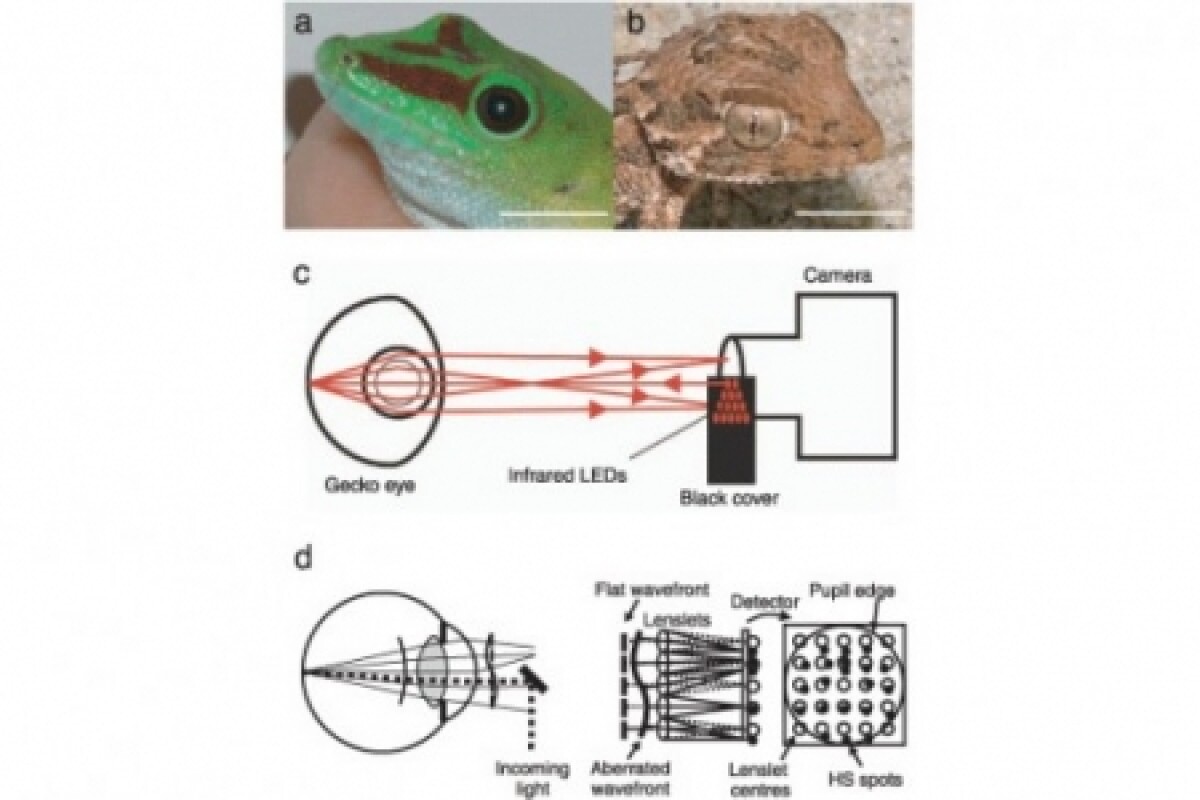



May 12, 2009 There’s a lot more to the Gecko than a cute little acrobatic creature that has sticky feet and can walk up walls. The helmet gecko - a nocturnal lizard - is among a few living creatures that can see colors at night. The trick to this unique characteristic is a series of distinct concentric zones of different refractive powers, according to a recent study published by the Association for Research in Vision and Ophthalmology. The research team hopes these studies may provide insight into creating better cameras and contact lenses.
The nocturnal gecko's multi-focal optical system
Studies on the sticky feet of the Gecko have led to the development of a SpiderMan-like suit that one day may enable humans to scale walls. This amazing little creature may now hold the key to the development of better multi-focal lenses and cameras.
In a peer-reviewed study published online by the Association for Research in Vision and Ophthalmology, researchers calculated the nocturnal helmet gecko's cone vision was more than 350 times more sensitive than a human's at the human color vision threshold, principally because the gecko has a multi-focal optical system comprised of large cones. Lina Roth, the team project leader from the Department of Cell and Organism Biology at Lund University in Sweden, says that geckos and other lizards differ from most other vertebrates in that they have only cones in their retina. Having a multi-focal optical system is an advantage for the nocturnal geckos as light from different ranges of wavelengths can focus simultaneously on the retina.
In addition, the gecko's eyes also allow it to focus on objects at different distances, such that the multi-focal eye generates a sharp image for at least two different depths. Roth says that geckos that are active during the day are mono-focal and do not possess the distinct concentric zones of their nocturnal counterparts.
In the article, the scientists state that previous studies of animals with relatively large eyes, such as owls and cats, have included surgery and fixation of the head. As part of this study, however, Roth and her team have developed a new method, using a modification to the Hartmann-Shack wavefront sensor, to gather the optical data from live animals without causing a great deal of intrusion.
David Greig