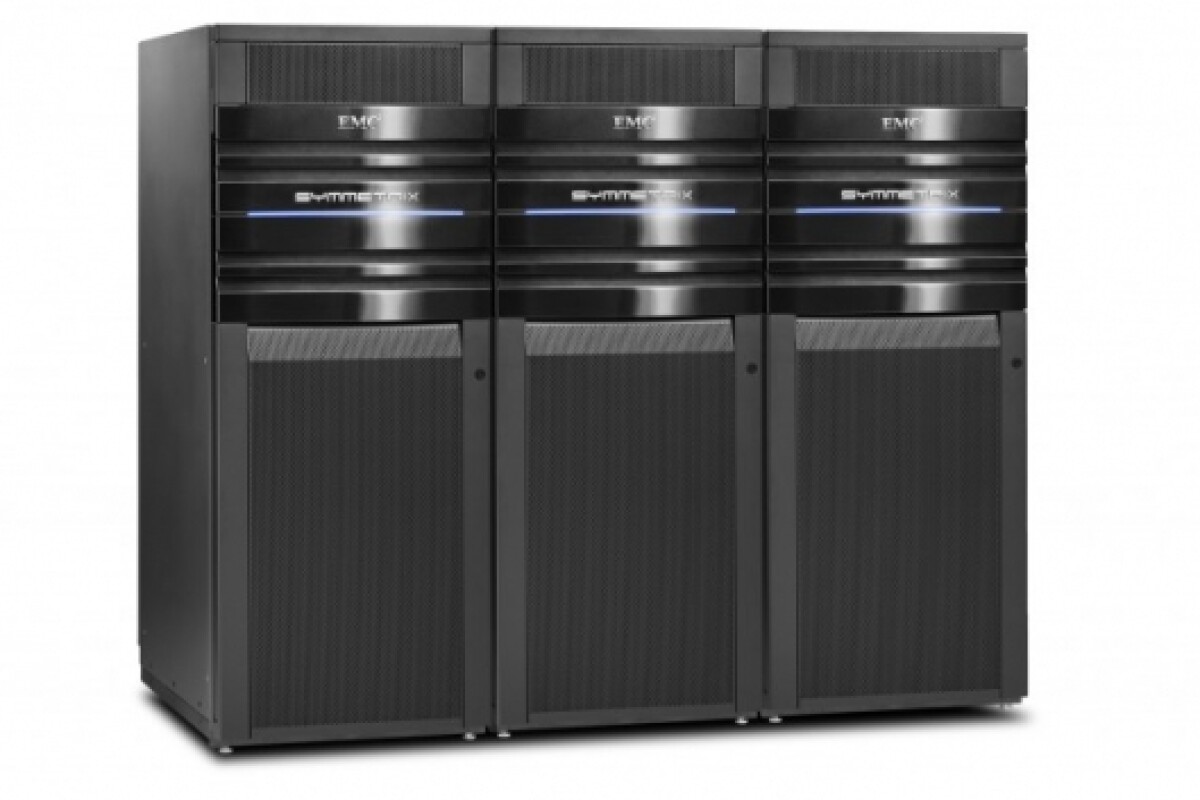



May 25, 2009 If you want speed, torque, and raw two-wheeled muscle, buy yourself a Yamaha V-Max motorcycle. If you are looking for performance and scalable power for your virtualized data center, check out EMC’s Symmetrix V-Max. Yamaha’s version may offer a claimed 197 horsepower, but EMC says their V-Max Engine churns out enough power to support hundreds of petabytes of storage for enterprise cloud storage networks.
Announced in April with great fanfare, Symmetrix V-Max is EMC Corporation’s “cloud storage” solution. Cloud storage is touted as the next generation of virtualized storage designed to complement virtual machines and virtual networks.
Virtual Matrix Architecture
The Symmetrix V-Max is the first product based on EMC’s Virtual Matrix Architecture, which uses industry-standard components and EMC’s Symmetrix interconnection features. This combination can be used to scale storage systems up to hundreds petabytes (PB) and millions of input/output operations per second (IOPS).
Symmetrix V-Max is aimed squarely at virtual networking and enterprise internal cloud computing. EMC sees their customers using these huge systems to support emerging virtualization technologies, such as VMware’s Virtual Data Center Operating System and Cisco’s Unified Computing System (UCS). In this type of virtualized environment, the V-Max system provides the storage for so-called “big clouds”.
Modular Design
The Symmetrix V-Max is based on a “Virtual Matrix” of building blocks called the V-Max Engine. Each engine features the following specifications:
- 2 quad-core Xeon 2.3GHz (5400) processors
- 16 host channels (8 per Xeon processor)
- 16 drive channels (8 per Xeon processor)
- 128GB of global memory
- EMC ASIC to handle the global memory access
- RapidIO interconnect endpoints
V-Max engines can be interconnected and share resources, which allows V-Max systems to scale up to 128 processor cores, 1 terabyte (TB) of global memory, and as many as 2400 flash, Fibre Channel, and SATA drives (up to 2PB capacity). The entire system is managed as a single virtual system.
By designing around Intel’s processors, EMC can develop the V-Max platform in parallel with the latest Intel chips. In the future V-Max may feature Intel Nehalem 5500 processors, for example.
EMC chose RapidIO for the connection between multiple V-Max Engines. The system’s Virtual Matrix Interconnect features two active-active, non-blocking, serial RapidIO networks. EMC says these inter-node connections will support full-duplex data transfer up to 2.5GBps per connection. Each V-Max Engine has four connections.
Integrated Management
The Symmetrix V-Max system features automated storage provisioning. Many VMware provisioning tools are integrated as well to provide centralized management of server and storage resources. In addition, EMC ControlCenter supports both the V-Max storage system and VMware to provide visibility and reporting across virtual server and storage environments.
Later this year EMC will release software to complement the V-Max system. Called FAST (for Fully Automated Storage Tiering), this software will automate moving data across storage tiers. EMC says that FAST will use business policies, predictive models, and access patterns to take advantage of the relative performance of Flash drives, Fiber Channel drives, and SATA drives.
This segment of the market is hot enough that, shortly after the launch of Symmetrix V-Max, HP lured away EMC’s president of storage solutions, David Donatelli, to become HP’s Executive Vice President for Enterprise Servers, Storage and Networking. EMC filed suit against HP to prevent the move, an action that shows just how important this market is to players like EMC, HP, and Cisco. The lawsuit is still pending. Frank Hauck has been named the interim head of EMC’s storage division to replace Donatelli.
The V-Max system is available now. Pricing for a V-Max system will vary by configuration, with an entry-level V-Max SE (Single Engine) system starting at around USD$250000.
Via: EMC.See also: The Register.
Alan Brandon