
First industry railgun prototype launcher gets all fired up
By Darren Quick
22:32 February 28, 2012

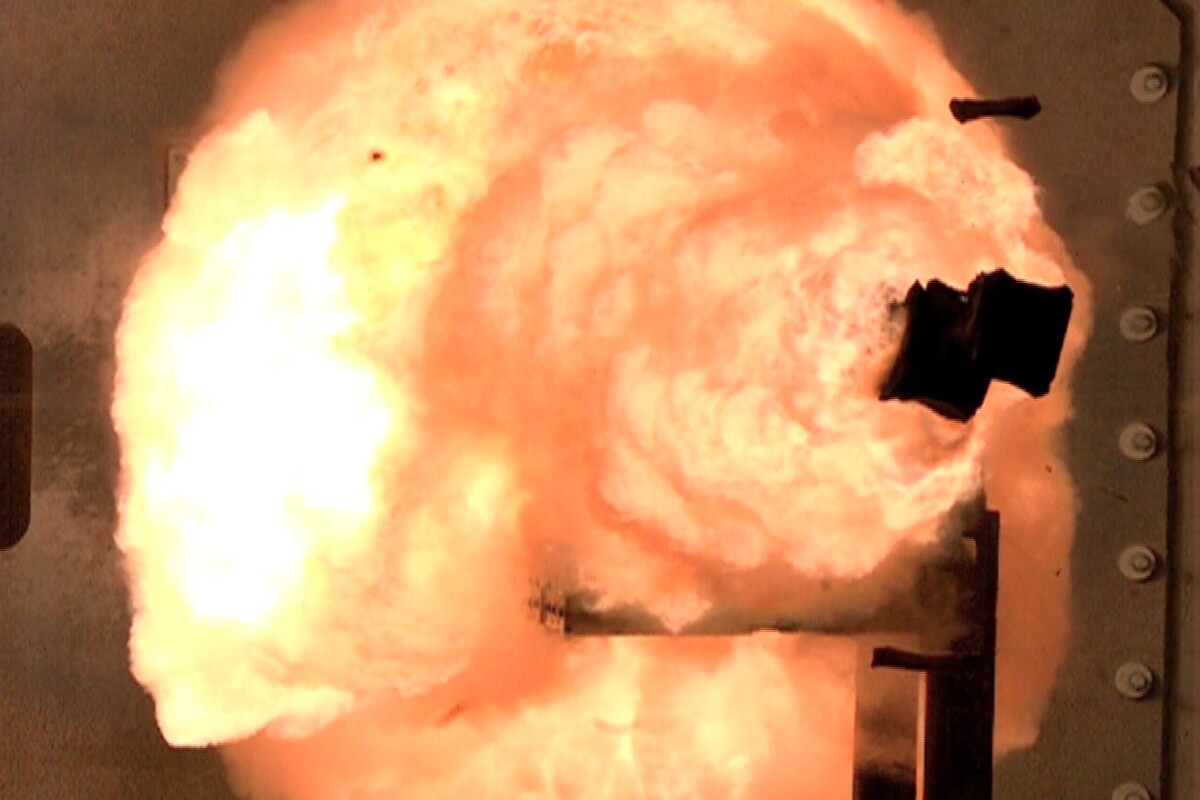
The first full-energy shots from the electromagnetic railgun prototype launcher captured from a high-speed camera (Photo: U.S. Navy)
The electromagnetic (EM) railgun prototype launcher that was recently installed at the Naval Surface Warfare Center (NSWC) in Dahlgren, Virginia, has commenced firing, kicking off a two-month-long series of full-energy tests. Predictably, the first full energy shots make for some pretty impressive video.
Following its delivery by BAE Systems on January 30, the first prototype demonstrator was installed and outfitted with a suite of sensors, high-speed cameras and measuring devices to allow for evaluation of the 32-megajoule weapon.
Following a series of low-energy test shots, evaluation of the launcher is now underway and will see tests conducted at 20 megajoules to 32 megajoules - one megajoule is equivalent to a 1-ton object being thrust at 100 mph (161 km/h). Test projectiles similar to those previously fired from NSWC Dahlgren's laboratory launcher will be fired at speeds of 4,500 to 5,600 mph (7,242 to 9,012 km/h) using electricity instead of chemical propellants.
The U.S. Navy hopes the evaluation will help it reach its near-term goal of a 20- to 32-megajoule weapon for surface ships capable of shooting a distance of 50 to 100 nautical miles (57 to 115 miles/93 to 185 km).
A second launcher being built by General Atomics is scheduled for delivery in April.
The video below shows what those high-speed cameras caught on the first full-energy test firings.
Source: U.S. Navy

YEYYYY!!!
MORE WMD's!!
If it's electrical, what's with all the fire coming out of the muzzle?
YYYEEEESSS! Awsome, i love it. But that seems like a lot chemical energy propulsion behind the projectile...
Industry first, this is a killing machine, not part of some constructive industry.
@Larry Hooten
The fire/flame is plasma from the arc, super-heated air. Needless to say, this weapon isn't the most efficient way to propel an object, but it is effective.
Awesome technology. Let's deploy this as soon as possible.
I'm guessing the flame is caused by super heated air, from huge emp it takes to propel the projectile
@ Nacho: I think the fire exists because of the friction that's created when the super speed projectile is launched. I heard a story awhile back that said, the heat inside the muzzle got so hot that past devices destroyed themselves or couldn't sustain high firing rates.
The projectile is travelling 5,000 mph. That "chemical energy" you see is pure friction coming off the front blunt edge.
I know a conventional weapon has fire shooting out if it, along with the gasses, as that is what powers the projectile (burning fuel - gun powder). But what causes the fire in this electromagnetic device? Very odd looking. I also wonder what the advantage of this is compared to rockets, guided missiles and other existing projectile weapons? (I know the projectile is a bit faster, but is it worth the investment)?
Mount that into a space-ship and we have Halo....Pillar of Dawn anyone?
The advantage of this rail gun is that the Navy won't need a magazine full of explosives in the bowels of the ship (a bit of a hazard in wartime). However, wouldn't every electronic device on the ship need to be optically based or totally EMP-hardened?
The electronics on a modern naval vessel are hardened against EMP, nuclear detonations cause significant EMP that our war fighters equipment is designed survive.
Whats with the shape of the projectile? Not very aerodynamic at all!
re; Hala Chaoui
Kudos to the minesweeper guy hopefully it will work well. The forces of fascism used mines against civilians all over the place.
............................................................................................................................
re; Nacho Lotitto
There are three kinds of Weapons of Mass Destruction. Biological, Area effect Chemical Poisons, and Nuclear don't cheapen the term by calling an artillery piece a WMD.
............................................................................................................................
re; Daniel Humphries
At these speeds the most heat resistant materials known to man will burn to a blunt leading surface.
............................................................................................................................
re; halcyon_m
Actually it is the most efficient method of accelerating solid objects to these speeds.
............................................................................................................................
re; Observer101 - February 29, 2012 @ 01:55 pm PST
Most of the flames is the sabot burning but there is some air compression heated to plasma as well.
............................................................................................................................
re; Ed
The velocity is still too low for space to space weapons against maneuvering targets.
............................................................................................................................
re; Dawar Saify
This is the first rail-gun designed to be mass produced not a one off research tool. Destroying the infrastructure and soldiers of an evil power is unfortunately all to often a constructive purpose.
"Whats with the shape of the projectile? Not very aerodynamic at all!"
LOL!!! Really! That's exactly what I thought Daniel - it's like firing a nail, flat head first.
Also, "capable of shooting a distance of 50 to 100 nautical miles (57 to 115 miles/93 to 185 km)" at that kind of range, what kind of possible accuracy can these things have?
I'm certain that firing an ingot has got to be far cheaper than launching a missile (well, at least when you average the cost of the gun over a projected lifetime), but still, the drift shell by shell must be enormous - thus I wonder what the planned utility is unless it's just a rather course area bombardment.
These days, people don't appreciate speeds of Mach ~6-8 at sea level. The fired projectile weighing only a few kg's has the energy equivalent of 32 1-ton cars going at 161 km/h. Sheer kinetic force drives the object's in a rather neat line over several km's. Couple that with a small surface on the projectile and it penetrates every armour you can pit it against.
You'd have the skin pulled from your face if you tried traveling at mach 1 outside, aerodynamic face or not. Imagine mach 6-8.
They made the test projectiles blunt on purpose so that they don't escape the range accidentally and kill someone 50 miles away:
"It's a true marvel of science, as all of this is accomplished with nothing more than kinetic energy. The projectiles do not contain any explosives. In fact, the Navy has been using non-aerodynamic rounds on purpose in tests so that a round doesn't go off-range and smash through a neighboring town or interstate.
One day, however, the Navy will be using conical projectiles for maximum penetration."
http://www.theblaze.com/stories/military-video-captures-destructive-power-of-navys-newest-rail-gun/
Did anyone notice the software used to control the firing? Another cool LabVIEW application.
A weapon is a tool for making you opponent change his mind.
re; yrag
The accuracy in artillery come down to 4 things.
1 You have to know how fast and in what direction this projectile will leave that gun tube. This includes but not limited to barrel wear and propellant temperature.
2 You have to know where the target in relationship to the gun. This includes latitude, longitude, altitude of both, curvature of the earth and motion of both.
3 The effect that the weather will have on the projectile. (incidentally the faster the projectile the less effect of weather) You have to know air temperature, humidity, wind speed and direction, barometric pressure, water droplets size and density (lightest mist to torrential downpour), and in chemically propelled artillery propellent temperature. (During the the Vietnam war the Air Force weather office regularly gave wind speed for the wrong altitude.)
4 Aiming the tube properly, because having everything else right doesn't matter if the tube is pointed in the wrong direction.
The only effect distance makes is to magnify aiming errors and to give weather more time to have effect (this is more or less meaningless because the projectiles from this gun will spend most of their flight in vacuum)
This is a reply to the people wondering about the fire coming out of the "gun", and why past devices destroyed themselves.
My teacher last year actually worked with the navy on some of these prototypes.
The object they are launching are made of aluminum. the aluminum is in contact with a rail above and beneath the round. The "bullet" is propelled forward by the magnetic field that is created by current flowing from one rail into the ammo and finally to the other rail.
Normally when you grind aluminum the exposed surface oxidizes and quickly becomes resistant to fire. However, when the projectile is fired it is going so fast that the aluminum doesn't have time to oxidize, and catches fire, thus the flames in the video coming out of the muzzle.
Because the magnetic forces are so powerful inside of the gun when firing not only is the projectile being propelled forward, but the rails are being forced apart by similiar forces. That, and when you fire the projectile you scrape the rails with the projectile and destroy the contact between rail and projectile. Those two forces have made it so rail guns have only been good for a few firings before having to replace the rails.
Or Login with Facebook:
Related Articles
Just enter your friends and your email address into the form below
For multiple addresses, separate each with a comma
Privacy is safe with us because we have a strict privacy policy.
Explore Gizmag


Charming. What a contrast with this, an Afghani inventor comes up with a mine sweeper:
http://www.greenprophet.com/2012/02/wind-powered-bamboo-mine-sweeper/?utm_source=feedburner&utm_medium=email&utm_campaign=Feed%3A+greenprophet+%28Green+Prophet%29