
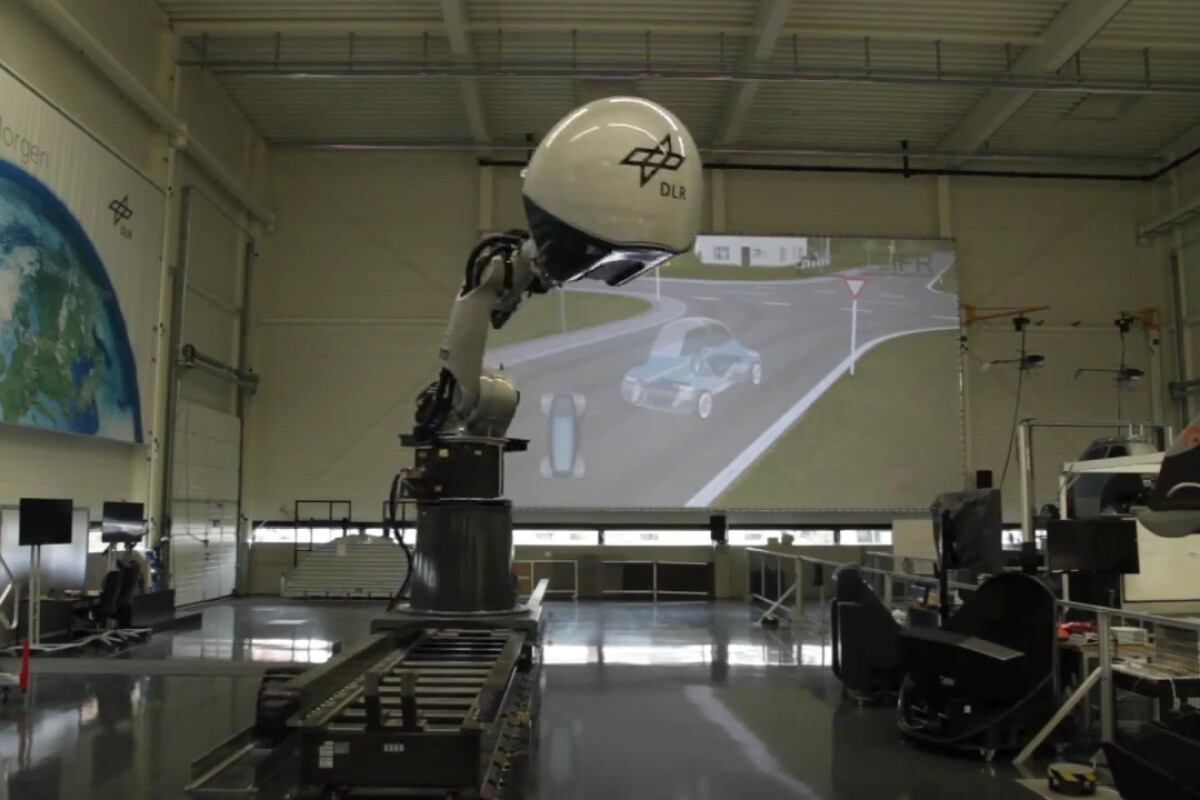



Computer simulations designed to teach people how to operate a vehicle can reproduce a reasonable facsimile of real-world conditions, but they lack one key ingredient: a realisic sense of motion. That's why companies like Toyota has spent millions developing motion simulators that typically move on six hydraulic arms to recreate the sensation of actual driving. Now, the German Aerospace Center (DLR) has built a cost-effective motion simulator powered by a single industrial robot arm that can handle extreme scenarios, such as spin maneuvers and even flight take-off and landing.
The DLR Robotic Motion Simulator uses KUKA's mass-produced industrial robot components, thus saving a great deal of the cost normally attributed to commercial motion simulators. In 2006 KUKA re-purposed its robot arm for theme parks with the RoboCoaster, followed by the RoboSim 4-D Simulator in 2009, so it was only a matter of time before the German Aerospace Center modified the arm for its own purposes.
The KUKA robot arm is strong enough to lift a car chassis, so it's perfectly suited to lifting and spinning you around inside a lightweight virtual reality cabin. Once you're strapped in, the top shell of the pod acts as a hemispherical projection screen, giving you a wide field of view. The arm provides pitch, yaw, and roll, while the entire rig moves back and forth on a track.

Developed to study human-machine interfaces, simulation environments, visualization and more, the system uses the commercially-available Modelica software. Researchers at DLR have been contributing to the Modelica software library for more than a decade, including the development of DLR SimVis. It can simulate complex physical systems including mechanical, electrical, hydraulic, and other sub-components for a variety of vehicles and scenarios.
To take advantage of this flexibility, the DLR Robotic Motion Simulator features modular components that can be switched in short order to suit a variety of situations – from driving a road vehicle to flying a helicopter or other aircraft. That means it will have plenty of training applications, but it also looks like a hell of a lot of fun. You can watch it in action in the following video.
Source: DLR via IEEE Spectrum