


March 21, 2008 It seems despite man's endless ingenuity and the incredible modeling power available to inventors through CAD systems, we keep looking to nature to find ever more effective ways of doing things. Millions of years of evolution's trial and error approach have resulted in some incredibly effective designs that are ready to be incorporated into human constructions if we can only identify, understand and replicate them. The random-looking bumps on the humpback whale's flippers have just inspired a breakthrough in aerodynamic design that seems likely to dramatically increase the efficiency and performance of wind turbines, fans, flippers and even wings and airfoils. WhalePower's tubercle technology seems like nothing less than a revolution in fluid dynamics.
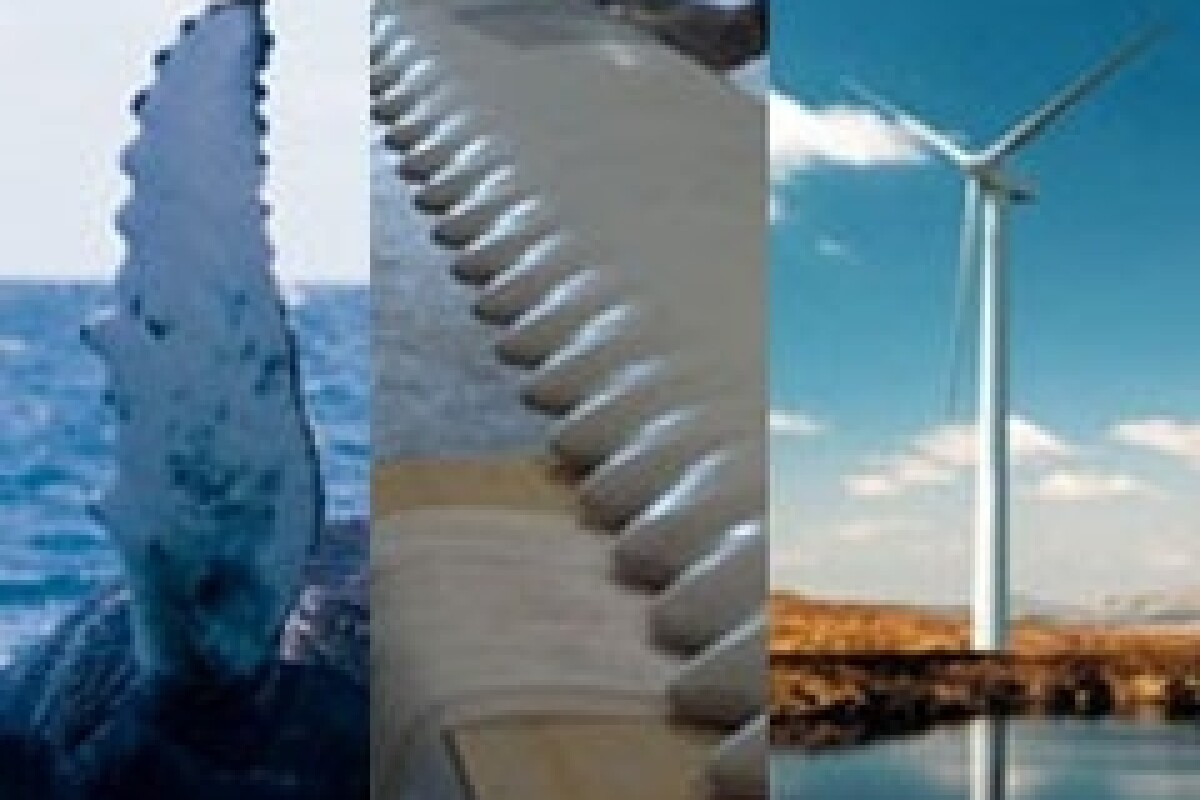
The humpback whale can weigh as much as 13 Hummer SUVs - and its unexpected levels of agility in the water have puzzled scientists for many years. Dr. Frank E. Fish (believe it or not) was browsing through a gift shop, when he noticed a group of small bumps on the leading edges of the fins of a humpback whale statue. Thinking it an error by the sculptor, he commented that the bumps seemed to be on the wrong side of the fin, starting an argument that would eventually lead him to discover an entirely new way of looking at the role of fins and wings in fluid dynamics.
Current theory would state that the leading edge of a fin, fan or turbine blade should be absolutely straight and smooth for best effect - a 'fact' that has been taken for granted for decades. But the more Fish studied the odd leading-edge bumps, or Tubercles, the more it became apparent that evolution's work on the fin was far ahead of man's best efforts. Airfoils fitted with tubercle bumps showed much higher lift efficiency and greater stall resistance than identical airfoils without them. Turbines fitted with tubercles to the leading edges of each blade are able to produce more power at low fluid speeds, are quieter, and perform much better in turbulent fluid streams.
It seems the bumps have the effect of channeling air into smaller areas of the blade, resulting in a higher wind speed through the channels and a number of rotating airflows on top of the blade which increase lift. Furthermore, the bumps eliminate the tendency of air to run down the length of the blade's edge and fly off at the tip, causing noise, instability and a loss of efficiency. In fact "bumps" is probably the wrong word as these are not small protrusions - on a utility scale (50 meter) blade for example, each tubercle would be about the size of a VW Beetle.
After discovering the Tubercle effect, Fish worked with Phil Watts to invent and patent a new type of leading edge for airfoils and hydrofoils. WhalePower was then formed in collaboration with Stephen Dewar with a view to applying these designs to all types of turbines, pumps, compressors or fans.
Wind power generation turbines stand to gain greatly from the discovery; because they can be used at a greater pitch angle with much less drag and much less tendency to stall, they allow turbines to continue generating power at wind speeds that are much too slow for traditionally shaped turbines to operate safely in. Importantly for the turbine market, tubercles can be retrofitted to the leading edge of conventional blades. Real world performance is proving very impressive, leading several major wind farm manufacturers to seek retrofit kits for their existing designs.
The technology is in the early stages of commercialization by WhalePower, which is initially focusing mainly on the wind turbine market as a means of establishing itself. Currently Tubercle Technology is being licensed to manufacturers like Canada's Envira-North who will bring out the first big fans (24 feet in diameter) in April this year. Definitive R&D testing at the Wind Energy Institute of Canada (WEICan) is also about to take place and negotiations are in progress with a number of manufacturers who make everything from hovercraft fans to the tiny fans that keep laptops cool.
While the company doesn't expect it to be easy to break into the market, WhalePower co-founder Stephen Dewar is confident that the commercial benefits of the technology will be so easily apparent that we'll soon see bumpy leading edges on a range of household and commercial goods.
"If we've got what we think we've got, then the range of applications is staggering," said Dewar in an interview with The Star, "I'm honestly scared of making claims at this point. The results are so good that we know everybody who knows anything about aerodynamics will think we're salting the goldmine."
We look forward to discovering how this nature-inspired technology stands up as a commercial product, and seeing its applications diversify as it matures.