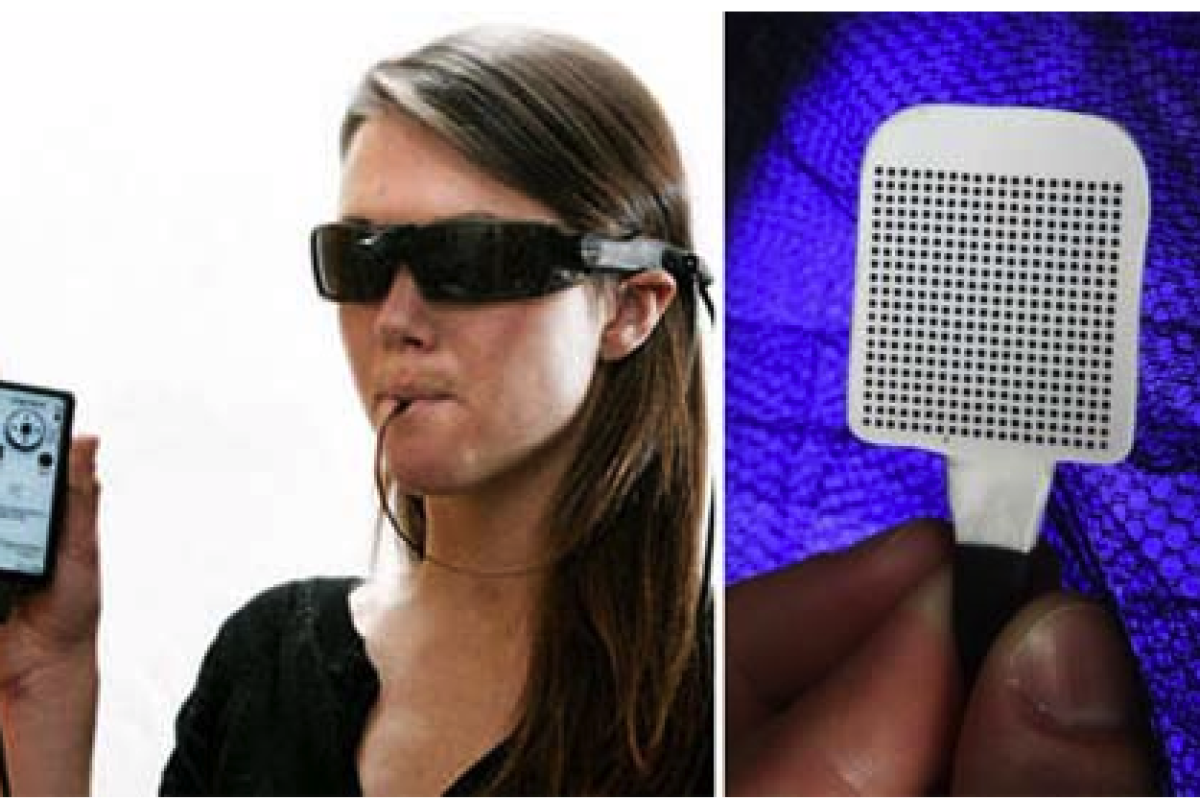


According to the National Institutes of Health, more than one million Americans over the age of 40 are legally blind - defined by U.S. law as vision that is 20/200 or worse, or have a field of view that is less than 20 degrees in diameter. It is estimated that adult vision loss costs the country about $51.4 billion per year. A new device aims to help restore the experience of vision for the blind and visually impaired by using nerves on the tongue's surface to send light signals to the brain.
Humans use around two million optic nerves to transmit visual signals from the retina — the portion of the eye where light information is decoded or translated into nerve pulses — to the brain's primary visual cortex.
BrainPort is a device being developed by neuroscientists at Middleton, Wisconsin–based Wicab, Inc. (a company co-founded by the late neuroscientist Paul Bach-y-Rita) that helps users ‘see’ without using their eyes. Bach-y-Rita hypothesized in the 1960s that "we see with our brains not our eyes."
Using the BrainPort device, visual data is collected through a small digital video camera, about 1.5cm (5/8 inch) in diameter, housed in the center of a pair of sunglasses worn by the user. From there, the data is transmitted to a handheld base unit about the size of a cell phone. The unit converts the digital signal into electrical pulses — replacing the retina’s function.
The base unit also incorporates features like zoom, light settings and shock intensity levels as well as a central processing unit (CPU).
Tasting is believing
Signals are sent from the CPU to the tongue via a ‘lollipop’, an electrode array about 9 sq cm (1.4 sq inch) that sits on top of the tongue. Each electrode corresponds to a set of pixels: white pixels, for example, deliver a strong electrical pulse whereas black pixels have no signal. Densely-packed nerves on the tongue surface receive the incoming electrical signals, which users describe as feeling a little like Pop Rocks or champagne bubbles.
At this stage, Wicab neuroscientist Aimee Arnoldussen says it remains unclear whether the information is then transferred to the brain's visual cortex, where sight information is normally sent, or to its somatosensory cortex, where touch data from the tongue is interpreted. Either way, the results are promising.
Learning curve
Presently, it only takes around 15 minutes for users to start interpreting spatial information via the BrainPort, says William Seiple, research director at the non-profit vision health care and research organization Lighthouse International.
For instance, Seiple says if the camera detects light fixtures in the middle of a dark hallway, corresponding electrical stimulations will occur along the center of the tongue.
"It becomes a task of learning, no different than learning to ride a bike," Arnoldussen says, adding that the "process is similar to how a baby learns to see. Things may be strange at first, but over time they become familiar."
Seiple has four patients who train with the BrainPort once a week, all of whom have made quick progress in undertaking what sighted people take for granted, like navigating through doorways, finding elevator buttons, reading letters and numbers, and distinguishing cups and forks at the dinner table without fumbling around.
"At first, I was amazed at what the device could do," he said. "One guy started to cry when he saw his first letter."
The price of ‘sight’
Wicab says it will submit BrainPort to the U.S. Food and Drug Administration for approval at the end of the month and hopes the device will be approved for market by the end of 2009. Robert Beckman, president and chief executive officer of the company, anticipates a cost of about $10,000 per machine.
Wicab is working with the University of Pittsburgh Medical Center's UPMC Eye Center for further testing on BrainPort, along with other artificial devices such as retinal and cortical implant chips, in order to develop criteria for monitoring the progress of artificial sight.
"We can't just throw up an eye chart,” says optometrist Amy Nau. “We have to take a step back and describe the rudimentary precepts that these people are getting. The images are in black and white, pixilated. How do you recheck vision?"
Nau likes the BrainPort because it is non-invasive, unlike implants.
The key to the success of the device lies in its utilization of the tongue, which seems to be an ideal organ for sensing electrical current, as opposed to the surfaces of fingers, for example, which are covered with a layer of dead cells called stratum corneum.
"Many people who have acquired blindness are desperate to get their vision back," Nau says, and although sensory substitution techniques can’t fully restore sight, they do help with spatial orientation and deliver more independence to the blind and visually impaired, including those suffering glaucoma.