



Glass-skinned steel-frame skyscrapers have many advantages. They're relatively quick, inexpensive and easy to build and require comparatively few materials. But they pose problems; heat not least among them. Buildings with fully glazed facades are essentially greenhouses, so when the sun comes out, they can get uncomfortably hot. The problem that is more acute in hot climates like that of the United Arab Emirates, where, despite this fact, the appetite for glassy high-rise continues to be voracious. For its design of Al Bahr Towers in Abu Dhabi, Aedas has developed a unique intelligent skin, inspired by the traditional Arabic mashrabiya, that it claims reduces interior heat gains caused by sunlight by around 50 percent.
Any hot country that has seen more than a few centuries of civilization tends to have already solved the problem of hot buildings. An old Mediterranean or Arabic house, for example, will typically be built with thick, heavy walls of adobe, clay or stone which, having cooled overnight, draw heat from the interior over the course of the day. Windows are few, small, and often shuttered to minimize and control incoming heat. It's logical, then, that Aedas has looked to the past for clues to heat management of its 145-m (475-ft) towers. They may not be built from adobe, but an intelligent outer skin has apparently been "informed" by a familiar feature of Islamic architecture: the mashrabiya.

Mashrabiyas are the wooden lattice screens, carved to some geometric design, that have filled the windows of traditional Arabic architecture (and particularly houses) since the 14th century. Often placed on the street-side of dwellings, mashrabiyas offered protection from eyes as well as the sun. In his excellent essay on mashrabiyas, freelance scribe and photographer John Feeney writes that, as well as offering privacy and shade, mashrabiyas actually encourage the flow of air, helping to cool water stored in clay pots thanks to their porous "sweating surfaces." Clever things.
The outer skins of Al Bahr Towers are actually simpler than the mashrabiyas from which they draw inspiration – at least in the sense that they serve a single purpose: shade. But whereas traditional mashrabiyas are passive, Aedas' modern interpretation adapts according to the sun's position. The skin is made up of 2,000 umbrella-like modules per tower which open and close to vary the amount of shade at that point according to the time of day. The umbrellas are automated, controlled by the building management system – something akin to a central nervous system that allows a building's various systems to work with each other rather than against.
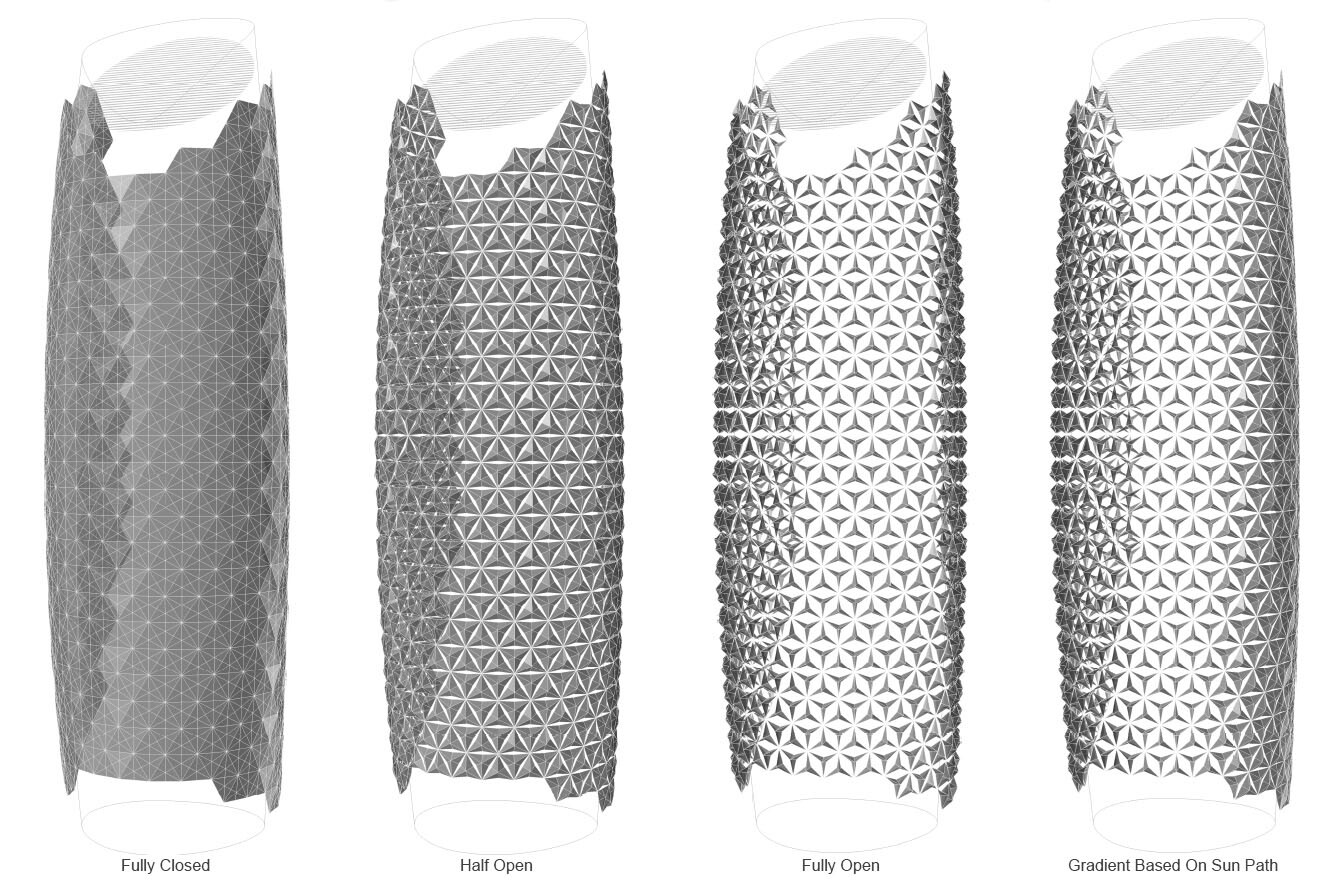
The advantage of this approach, according to Aedas, is the avoidance of dark tinted glass which inevitably restricts all incoming light all of the time, and not merely the problematic direct sunlight at certain times of day. Instead, these dynamic shades let daylight in for part of the day allowing the use of artificial lighting to the interior can be reduced. However, the energy saving from the reduced need for air conditioning is likely to be at least as significant, if Aedas' predicted reduction in solar gain is accurate.
What's rather nice about these modern mashrabiyas is that at various degrees of openness, they take on different geometric patterns from tessellating hexagons to spaced out alternately-facing three-pointed stars.
Combined, the towers will contain about 70,000 sq m (753,000 sq ft) of office space. The slightly bulging form of the towers is reminiscent of London's Gherkin, albeit with the tapering pinnacle sliced off. But the partial covering of mashrabiyas, which almost resemble barnacles, give the towers an identity of their own. Aedas tells Gizmag that Al Bahr Towers are now nearing completion.
Source: Aedas