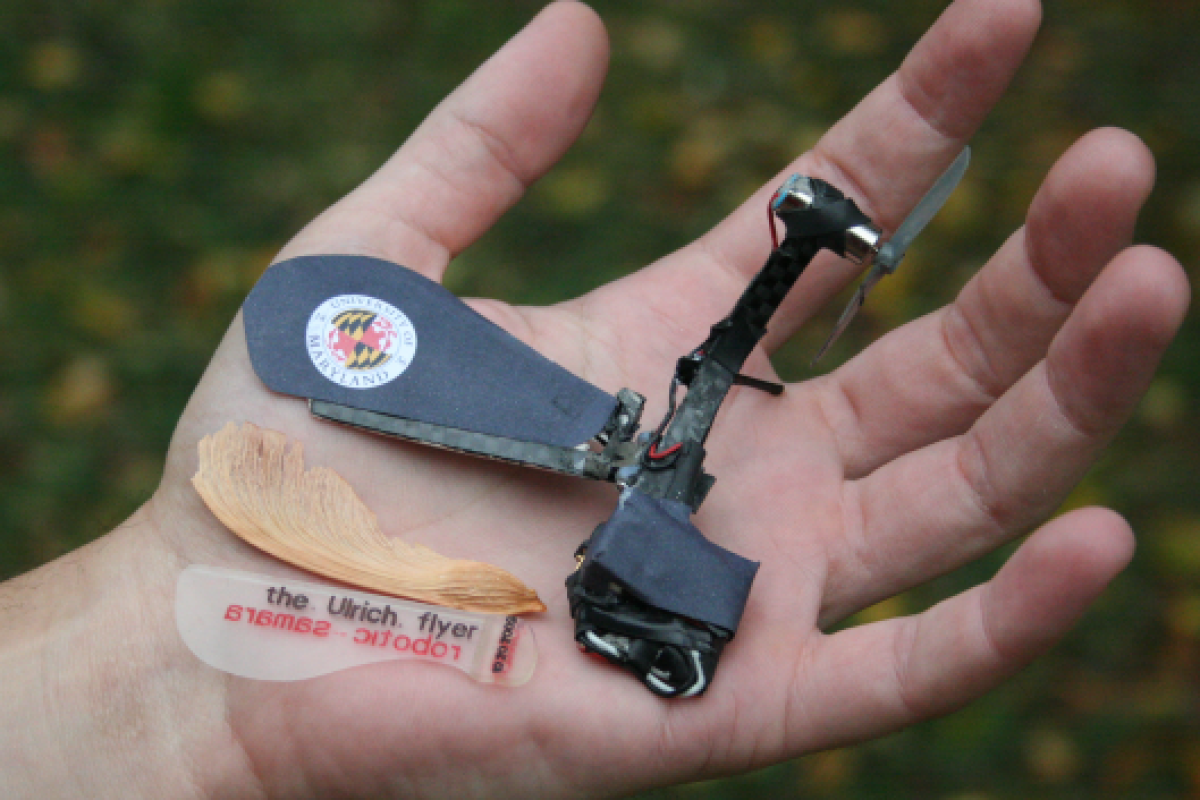



Students at the University of Maryland’s Clark School of Engineering have turned to nature to create a flying device that can hover and perform surveillance duties, and that could lead to applications for military and emergency services. The enigmatic maple tree seeds (or samara fruit) - and the unique spiraling pattern with which they glide to the ground - have intrigued children and engineers for decades. Now aerospace engineering graduate students have applied the seeds’ design to airborne devices and created what they believe to be the world's smallest controllable single-winged rotocraft.
Researchers first tried to create an unmanned aerial vehicle that could mimic a maple seed's spiraling fall in the 1950s. Foiled attempts have followed regularly ever since as these tiny vehicles (less than 1m or 3ft) have been easily knocked off course by wind.
Unfazed by recent failings, an open challenge was issued to the engineering students in June this year to design a viable craft.
Separating stability and propulsion achieves success
The Clark School students have solved the steering problem and provided a solution that allows the device to take off from the ground and hover, as well as perform controlled flight after being deployed from an aircraft. The device can also begin to hover during its initial descent, or after being launched by hand.
After studying the maple seeds, the students incorporated some natural design aspects into their new creation - the world's smallest controllable single-winged rotorcraft. The maple seed-inspired design is valuable because when dropped, unpowered, from a plane and then controlled remotely, it is hoped that it can perform surveillance maneuvers for defense, fire monitoring and search-and-rescue purposes.
"Natural maple seeds usually trade off altitude for rotation as they fall to the ground," said Evan Ulrich, one of the graduate students on the team. This altitude-rotation trade-off results in the power that the seeds need to travel – but not enough power to hover.
Ulrich and other graduate students in the research group, led by Clark School Dean Darryll Pines (Professor, Department of Aerospace Engineering), incorporated a new part to their device, a curved, comma-shaped component in the body of the device, which provides more stability and gives the device power to hover.
Success was gained by physically separating the propulsion and stability components of the craft. The wing of the vehicle is designed to function in the same way as natural samara and performs a stable autorotation during descent. The propulsive section of the vehicle functions like the tail rotor on a helicopter, though instead of preventing rotation, (as in the case of a helicopter), it maintains rotation (to allow it to hover).
The vehicle has been demonstrated at University of Maryland events, the American Helicopter Society Annual Forum, the Smithsonian Udvar-Hazy Air and Space Museum, and at the 100th anniversary of the College Park airport.