"Interstellar travel may still be in its infancy, but adulthood is fast approaching, and our descendants will someday see childhood's end." The Starflight Handbook
The first steps towards interstellar travel have been taken, but the stars are very far away. Voyager 1 is about 17 light-hours distant from Earth and is traveling with a velocity of 0.006 percent of light speed, meaning it will take about 17,000 years to travel one light-year. Fortunately, the elusive "warp drive" now appears to be evolving past difficulties with new theoretical advances and a NASA test rig under development to measure artificially generated warping of space-time.
The warp drive broke away from being a wholly fictional concept in 1994, when physicist Miguel Alcubierre suggested that faster-than-light (FTL) travel was possible if you remained still on a flat piece of spacetime inside a warp bubble that was made to move at superluminal velocity. Rather like a magic carpet. The main idea here is that, although no material objects can travel faster than light, there is no known upper speed to the ability of spacetime itself to expand and contract. The only real hint we have is that the minimum velocity of spacetime expansion during the period of cosmological inflation was about 30 million billion times the speed of light.
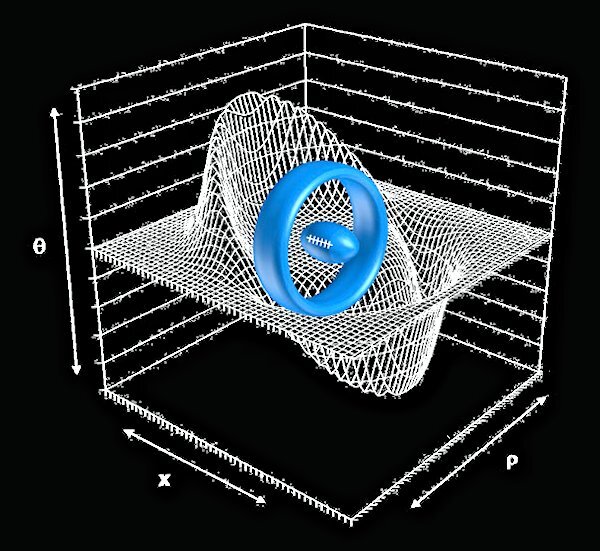
The warp effect uses gravitational effects to compress the spacetime in front of a spacecraft, then expand the spacetime behind it. The bit of spacetime within the warp bubble is flat, so that the spacecraft would float at zero-g along the wave of compressed and expanded spacetime. The net effect is rather like surfing, where you are nearly stationary with respect to the wave, but are traveling with the speed of the wave. Whereas many of the theoretical studies consider a warp bubble moving at ten times the speed of light, there is no known limit to the potential speed.
Such a warp bubble could in principle be used to enable subluminal travel (travel slower than light) as well as superluminal travel (travel faster than light). This may seem a silly choice – why travel slow rather than fast? However, it is likely to turn out far easier to achieve a subluminal warp drive for a number of fundamental reasons. Besides, space travel at 90 percent of the speed of light is far superior to anything we currently have on the books.
This sounds too easy, and in many ways, it is. Thus far, all superluminal warp drives require negative energy and pressure to form and maintain the warp bubble. Matter consistent with such properties does not exist in classical physics. While in quantum mechanics there are certain possibilities for negative energy phenomena, they generally do not seem well suited to generate the required warp bubble.
An additional problem is that a great deal of negative energy is required to initiate a warp bubble. For Alcubierre's original model, it would take more negative energy than the total mass of the Universe to equip a small spacecraft to travel at ten times light speed. Fortunately, refinements to the model have resulted in the energy requirements reducing to the mass equivalent of a few hundred kilograms of matter with negative energy. Mind you, we don't know how to get that quantity either, but it feels a more likely prospect.
Matter with negative energy and negative pressure is usually called exotic matter, and we don't know of any. However, another possibility is to use dark energy to expand spacetime – after all, that is how we know dark energy exists, through observing the accelerated expansion of the Universe. Although nearly three-quarters of the mass-energy of the Universe is dark energy, it is spread thinly, at the equivalent of about ten hydrogen atoms for every liter of space. Given this, harnessing dark energy for warp drives might seem an overwhelming task.
That doesn't mean it's impossible however. To put this into perspective, consider magnetism. The interstellar magnetic field is about a nanoTesla, or about one-fifty thousandth of the Earth's field. If this is all we knew of, harnessing magnetism for any practical purpose would seem unlikely. However, a tiny rare earth magnet exhibits magnetic fields 100 million times stronger than the interstellar field. It isn't wise to recklessly eliminate possibilities.
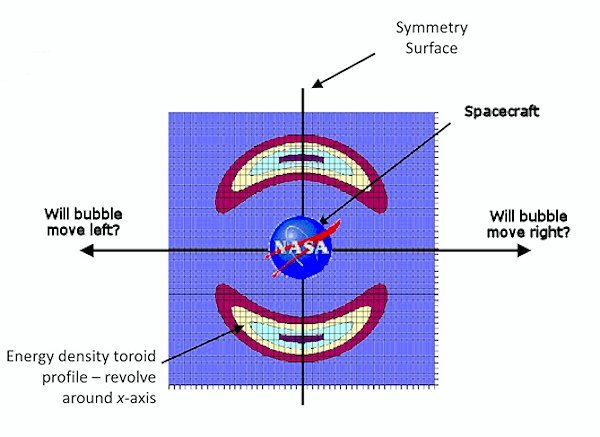
All warp bubbles have unknown difficulties concerning turning them on and off. It isn't that models for this process can't be composed – rather the models are too complex to analyze. In addition, to date warp bubbles are symmetrical, so how do they decide which direction to move? A recasting of the relativistic theory of warp bubbles suggests a solution to this dilemma, but the theoretical analysis appears to be faulty. It isn't clear if the faults can be patched without losing the result.
Other problems with superluminal warp bubble drive include the apparent need to generate the front edge of the warp field, which is moving faster than light. In some cases it becomes impossible to control a superluminal warp drive from the spacecraft within the bubble, which would be embarrassing to all concerned as the ship continued to travel forever, or at least until it hit something. Speaking of hitting something, we presently have no idea what happens if a warp bubble hits an external object.
Many models of superluminal warp bubbles also have visible event horizons which are likely to generate high levels of Hawking radiation. Some researchers believe the spacecraft would be incinerated by this radiation, some believe it would not present a problem. The jury is still out, but it seems likely that such problems can be avoided.
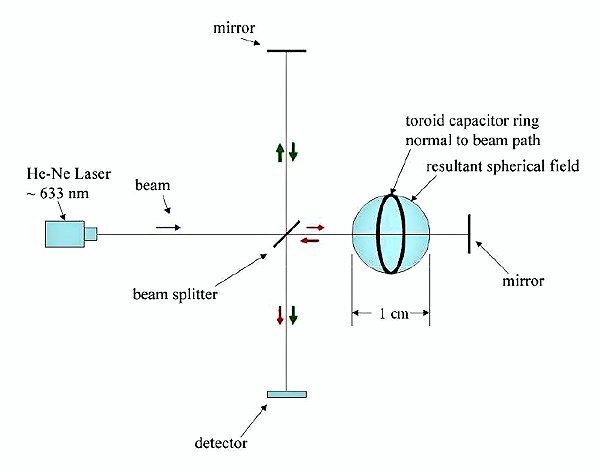
Before creating a warp bubble, it would be nice to know something about how various sorts of physical inputs can actually warp space. This is the intent of NASA's new White-Juday Warp Field Interferometer (WFI). The WFI is a conventional interferometer, capable of measuring changes in the various path lengths of as little as a nanometer. In this case, however, the path lengths are not changed by moving the mirrors, but by warping spacetime in the small experimental volume. Length changes as small as one part in ten million will be detectable.
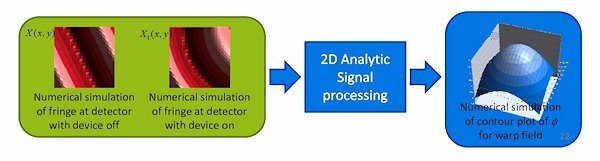
The apparatus will first be tested to see if warping due to the electric field of an extremely high voltage ring electrode can be detected. If so, an optical signal similar to that seen on the left side of the figure above will result. Once the signal is analyzed, a plot of the amount of warping as a function of position within the charged ring will be generated.
The takeaway message is that, while practical warp drive is a long way off, serious efforts to learn more about the possibility are, on a small scale, being undertaken now. In 2022, a version of this article will probably be relatively certain whether an Alcubierre-style warp drive is a reasonable possibility or not.
Source: NASA Eagleworks