Back in 2009, before the Nissan Leaf and Chevy Volt were ready for market, the world heard loud, overinflated claims of "367" and "230" mpg ratings. Talk is cheap, and actual EPA testing sent those ratings rocketing right back down to earth at 99 mpg-e and 60 mpg, respectively. Volkswagen is the latest to get in on the 200+ mpg game, claiming its XL1 will be capable of 261 mpg (European cycle). Thanks to a radical approach that slashes weight, optimizes aerodynamics and wrings every last drop of fuel, Volkswagen may actually make good on its claims – or at least get close.
Volkswagen first showed the XL1, an evolution of the 2009 L1 and original 2002 1-liter bubble, in 2011. While it looked like a fanciful green concept designed to make headlines and then disappear into the archives, Volkswagen was clear that it planned to eventually build it and set a date of 2013. Now, the time is here, and Volkswagen is readying the production version for next month's Geneva Motor Show.
Volkswagen calls the XL1 the most aerodynamic production car ever and uses a 0.19 drag coefficient to prove it. For comparison, the carefully aero-optimized, cost-is-not-an-issue McLaren P1's drag coefficient is 0.34. Aerodynamic measures include a narrowed rear-end, wheel covers over the rear wheels, and rear-view side cameras in place of mirrors. It doesn't exude conventional auto aesthetics, but if you're the type that appreciates function over form, it's an absolutely gorgeous design.
The second pillar of the XL1's lofty fuel economy is weight savings. Thanks to a build that's more than 20 percent carbon fiber-reinforced plastic (CFRP), including the monocoque structure and body panels, along with a thin-glass windshield, polycarbonate side windows, and other measures, the XL1 barely twitches the scale needle to 1,753 pounds (795 kg). It measures 153.1 inches long, 65.6 inches wide, and 45.4 inches high (3,888 x 1,665 x 1,153 mm), which is comparable to the Polo's width and length, but more than 10 inches (254 mm) shorter.

With support from that gaunt build and slippery aerodynamics, Volkswagen gets away with powering the XL1 with a meek 47-hp 800cc two-cylinder TDI engine, 27-hp electric motor and lithium-ion battery. That small, rear-wheel-drive powertrain, in turn, contributes to the low weight. The entire drive unit, including the battery, weighs 500 pounds (227 kg), less than the Nissan Leaf's 660-pound (300-kg) battery and only 100 pounds (45 kg) more than the Chevy Volt's battery.
Armed with a seven-speed dual-clutch gearbox (DSG), the plug-in hybrid powertrain provides up to 32 miles (50 km) of all-electric driving. In electric mode, the engine is decoupled from the drivetrain, allowing the electric motor to act alone. Volkswagen says that the restarting of the engine is a smooth, joltless process, whereby the e-motor's rotor speeds up, couples with the engine's clutch and brings it up to speed. Unlike in other plug-in hybrids, where a comparatively large four-cylinder is tasked with taking over, the XL1's tiny two-cylinder turbodiesel continues to provide ultra-frugal commuting when handed the reigns.
The XL1 is cushioned by double wishbone suspension in the front and a semi-trailing link suspension in the rear. Lightweight running gear materials include aluminum suspension components, magnesium wheels and ceramic brake discs. The XL1 also rolls on Michelin low rolling resistance tires.
Along with the impressive 0.9 liter/100 km (261 mpg) fuel efficiency figures – which make it the "1 liter car" it was aiming for – Volkswagen says the car can maintain a constant cruising speed of 62 mph (100 km/h) using just 8.4 hp/6.2 kW and, in all-electric mode, can travel 1 kilometer (0.62 mile) on just 0.1 kWh of electricity. The company says the vehicle can accelerate from 0-62 mph (100 km/h) in 12.7 seconds, on the way to a top speed of 99 mph (160 km/h). When needed for acceleration, the electric motor can kick in to assist the diesel engine.
The XL1 puffs out just 21 g/km of C02 with exhaust gas recirculation, an oxidation catalytic converter and a diesel particulate filter used to keep exhaust emissions down. VW has also worked to optimize the efficiency of the cooling system.

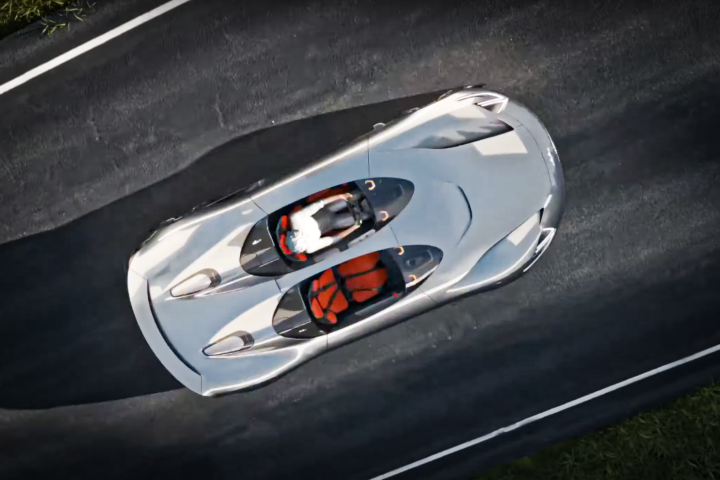
The driver takes the wheel of the XL1 by entering through one of two winged, double-hinged doors that swing up and slightly forward. Inside, Volkswagen replaced the 1+1 layout of the L1 prototype with slightly offset side-by-side seating.
Volkswagen plans to build each XL1 with a new "handcrafting-like" process at its Osnabrück, Germany, facility. Many of the major components will be sourced from other VW plants and external manufacturers and put together using a very specific nine-stage process. With that in mind, not to mention the composites and technologically advanced design, we expect that the XL1 will be the toy of trendy celebrities and business executives for the foreseeable future. Volkswagen has yet to confirm pricing but more details should be forthcoming from Geneva.
Source: Volkswagen