Urban Transport
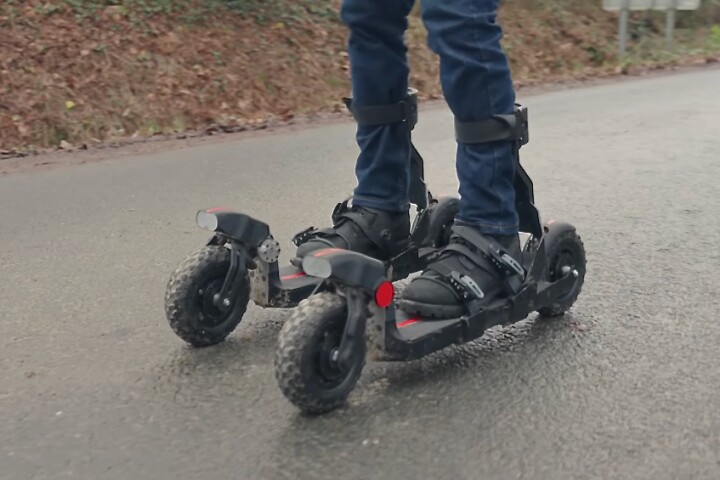
LandRollers take skaters to new places and surfaces
By Mike Hanlon

April 18, 2006 Yet another variation on the skating theme has come to light. With the first production run still warm, LandRollers are one of many new innovations in the field of human-powered urban transport we have seen over recent years. The significant benefit of the design is its ability to take skaters to places - and surfaces - never before imaginable.
Based on the fundamental premise that the greater the size of a wheel, the less prone it is to deflection and the larger the objects it will roll over, LandRoller are an unlikely looking variation on the in-line skating model that uses two oversized wheels on each skate that are angled inward. The resulting wheel configuration improves stability, manoeuvrability, safety, ride smoothness and braking. Read More
The Electroscoot – 50 miles for 50 cents
By Mike Hanlon

April 14, 2006 Personal mobility options and how we tackle the daily commute greatly influences the lives of each of us. The ecological footprint each of us has on the planet influences everyone. With this in mind, the ElectroScoot was conceived and built. Somewhat reminiscent of the Segway in many aspects, the ElectroScoot is a functional, low cost objet d’art. It runs 50 miles for about 50 cents, does 30 km/h and recharges fully in six hours. No parking costs and no helmet required (please check your local laws). A red hot price point of 1500 Euro makes this a likely winner in our minds and the entire design process is well documented on the Electroscoot web site. Designers GRO are seeking manufacturing partners for the project. Read More
The first carbon racing bike from Mercedes-Benz
By Mike Hanlon

April 6, 2006 Carbon fibre has some extraordinary properties in that it is very light and very strong. It is also very expensive, so it only gets used where the amount of money spent is immaterial compared to the performance of the product. Mercedes Benz currently uses carbon fibre in just one of its products – the Mercedes-Benz SLR McLaren, the world’s first production car with a bodyshell made entirely of carbon fibre. Carbon fibre is also used extensively in the McLaren Mercedes F1 cars of Kimi Raikkonen and Juan Pablo Montoya. And later this month a second Mercedes-Benz product will be available that is constructed mainly of carbon fibre – the Carbon Bike, the new flagship human-powered Merc. Thanks to its ultra-lightweight carbon-fibre frame, this US$3665 thoroughbred weighs in at a mere 8.3 kilograms. Read More
World’s largest quarter pipe
By Mike Hanlon

April 4, 2006 After jumping over the Great Wall Of China on his skateboard, Danny Way will continue to push the boundaries of what’s possible on a skateboard when he attempts to break the world 'Bomb Drop' record in Las Vegas tomorrow. The current World Record is held by Norway’s Adil Dyani who dropped 12 ft 3.6 inches into an 18 ft ramp for a total drop of 30 ft 4 inches. Danny's attempt will more than double the previous record with a freefall of between 20 ft and 30 ft into a 46 ft high ramp that is 24 ft wide. He will then ride at a speed of up to 45mph across 64' of flat bottom into the world's largest quarterpipe (27 ft high x 48 ft wide). The Guinness Book of World Records will attend to certify the structure and the drop and the event, which will be held from 6-8 PM at the Hard Rock Hotel & Casino on Wednesday, April 5, is free to the public. The event kicks off the CTIA trade show and was created to launch Ignition’s mobile phone action-sports content service. Read More
The SUB G1 - 135hp 1000cc V-twin three-wheeler
By Mike Hanlon

March 18, 2006 ADDITIONAL IMAGES For those who have looked enviously at three wheeled prototypes such as the Volkswagen’s GX3, Heikki Naulapaa's Aprilia Magnet, Tommy Forsgren's Hermes, Elisha Wetherhorn's Rider, Mercedes-Benz Life-Jet , Peugeot’s 20CUP, Toyota’s I-Swing, Dimitrios Scoutas' Skipee and the Phiaro Eternity, here’s one you can buy and use on the road. Powered by 1000cc of liquid-cooled DOHC, eight-valve, V-twin Suzuki motorcycle engine producing 135hp (98.6 kW) and 105 Nm of torque driving through a six-speed sequential gearbox, the SUB G1 three-wheeler weighs just 330kg, giving it Formula car power-to-weight, handling and aerodynamics. Set up by ex-GM automotive designers Niki Smart, Jay Brett and Nick Mynott, SUB is a small company in southern California that caters to clients who want individual specialised vehicles. Initial production preparations for the SUB G1 are underway and will be limited to a maximum of 25 units, with a minimum of 15 to start production. Cost of each vehicle will be US$80,000 with a US$25,000 security deposit. Read More
Freeline Skates – one two-wheeled skateboard for each foot
By Mike Hanlon

March 12, 2006 Since man invented the wheel, the promise of personal transport has been within reach for anyone with a vivid imagination and a healthy dose of engenuity. Ice skaters wishing to skate all year round made the first recorded wheeled shoes around 300 years ago, and the first patent for a roller skate was issued in France in 1819. The roller skate achieved mass popularity across Europe and the United States a century ago, with hundreds of skating rinks attracting the young-at-heart. But the availability of advanced plastics in the sixties really opened up the realms of personal transport as successive waves of roller skating, inline skating (the invention of the RollerBlade) and skateboarding captured the imagination of the youth of the day, creating sub-cultures, efficient personal transport and extreme athletes capable of performing tricks that seemingly defy Newtonian physics. With advanced materials now readily available for the fabrication of even the wildest ideas, new concepts for skating on tarmac keep coming and the latest such promising technology is Freeline Skates – one tiny, aluminium body, two-wheeled skateboard for each foot, ridden with a sideways stance like a skateboard and capable of being powered on the flat or even uphill by a body twisting motion. Very fast, very unique, very cool! Read More
Mercedes-Benz presents the Automatic Bike 2006
By Mike Hanlon

March 1, 2006 The name Mercedes Benz is synonymous with automobiles but it should be noted that the marque is also at the forefront of bicycle development. Twelve months ago Mercedes launched an automatic pushbike, and yesterday updated the 2006 Automatic Bike with a wealth of technical modifications and a much-enhanced sporty design. With a choice of two equipment lines, it brings a whole new dimension to muscle-powered movement at the same time as reducing the weight by a full four kilograms. Read More
The world’s first full size dual suspension folding bike
By Mike Hanlon

February 27, 2006 Innovative bicycle company Onyerbike has released a four bike range of foldable, full-size, dual-suspension bikes that finally offer high spec bikes you can tuck comfortably out of the way for ease of transportation or if you live in limited space or dorm/barracks accommodation. The top-of-the-range Hawk comes with adjustable suspension at both ends (lock out front suspension and air shock rear), magnesium wheels, a lightweight aircraft grade 7005 aluminium frame and Tektro disc brakes. The onyerbike range is unique in that it is the first to offer 26 inch wheels instead of the 20, 16 or 14 inch wheels which generally are used in folding bike solutions, so offering a genuine go-anywhere (on- or off-road) at-a-reasonable-clip bike. The company is seeking international dealers and distributors. Read More
Two-wheeled skateboard offers surfing on tarmac experience
By Mike Hanlon

January 1, 2006 The EssBoard is a skateboard with a twist – quite literally. Its two castor type wheels enable a motion that is very difficult to descibe, but enables the board to be propelled up-hill, and without needing to touch the ground, while at the same time enabling a motion that more closely captures the feel of surfing or snowboarding than any previous asphalt skateboard. Emanating from Korea, the EssBoard appears identical to “the Wave” board which comes from California, and the Exboard which comes from the UK, though we’ve been unable to ascertain which was the original or whether the designs originated independently. Putting originality aside, the Essboard (and presumably the Wave and exboard) offers some compelling functionality, as it works the torso and legs at the same time as offering captivating entertainment value. If you can’t quite comprehend what the Essboard, Exboard or Wave board can do, or how they work, check these videos at the Streetsurfing site, or these vidz at the Exboard site, or these at the Essboard site for beginners and expert riders. Read More
StreetSurfer offers a new two-wheeled experience
By Mike Hanlon

December 8, 2005 “The bicycle has effectively been the same since the safety bicycle evolved from the Penny farthing more than a century ago”, says Mark Palmer, chief evangelist of the StreetSurfer, “and we figured it was about time to take the next step.” Interestingly, those who have ridden the StreetSurfer tend to agree that it is not just very different to the bicycle, but significantly better in several key aspects – steering, cornering, front wheel tracking and the general feel which is more akin to surfing or snowboarding than a BMX or mountain bike – and more than capable of creating its own following and a dedicated street culture. The four-wheeled front foot of the StreetSurfer offers significantly more traction than a bike tyre and the dynamics of the bike are flowing like surfing. Suspension is equally unconventional, being comprised of polymers which activate on impact. Limited supplies will be available of the StreetSurfer prior to Christmas. Read More
The rear-view helmet
By Mike Hanlon

November 22, 2005 NEW IMAGES Seeing behind you on a motorcycle has always been a problem. Sometimes the mirrors vibrate, and sometimes they offer a terrific view of your elbows, and most of the time they offer a distinctly inferior view of the rear compared to that you get in a car because you can’t see the parts directly behind you. As a soldier in combat will tell you, when your situational awareness is down in a hostile environment, the risk of injury multiplies enormously. And hence when a helmet with an integrated rear view mirror system was launched last week in Munich we think it’s worth a look. Manufacturers Reevu spent ten years developing the helmet, which has a built-in 180 degree unbreakable rear-view mirror system in the hope it will save lives on the roads by improving situational awareness and hence preventing accidents. The innovative technology allows the wearer to see the road behind, using a system of unbreakable mirrors constructed out of ABS, which are contained inside the helmet shell and provide a window in the top of the helmet opening – a robust, low cost heads-up display. Read More
Toyota's i-swing personal mobility concept
By Mike Hanlon

October 25, 2005 Toyota debuted its i-swing mobility concept at the Tokyo Show today, arousing massive public interest. Toyota's i-swing is a new personal mobility vehicle in the same vein as the personal mobility models (such as the PM , i-unit and I-foot ) Toyota has exhibited previously but one that takes the concept several steps further, with the capability of operating in a similar manner to the Segway in two wheeled mode at walking pace on a footpath so it takes up little space, or transform to a three-wheeled mode for road speeds. In addition to the joystick control, the i-swing can be controlled by body weight movements with a feeling reportedly like turning as if on snow skis. The i-swing concept proposes using Artificial Intelligence to enable it to learn the habits and preferences of users. Read More
Yamaha unveils hybrid electric motorcycle and limousine scooter
By Mike Hanlon

October 28, 2005 UPDATED IMAGES Yamaha revealed a hybrid motorcycle concept at the Tokyo Show which is quite unlike any form of two wheeler seen to date. The motorcycle, to be known as the Gen-Ryu, uses the high output lightweight compact YZF-R6 600cc motor and an electric motor to deliver the type of performance normally associated with a much larger capacity engine, and is packaged as a futuristic cruiser with advanced aerodynamics and some form of noise cancelling in the cockpit area to enable voice activation of the navigation system, mobile telephone, intercom communications with the pillion and other similarly equipped riders plus a dazzling array of advanced technologies such as headlights which turn to the inside of the corner and rear cameras playing through LCD screens in the dashboard. The Gen-Ryu will be joined on the Yamaha stand by the previously reported and equally radical stretching and shrinking DEINONYCHUS and the limousine-styled Maxam scooter. With massive overhangs, plush white leather upholstery and long, feet-first styling, the Maxam is the most distinctive two wheeler we’ve ever seen. Read More
Honda E4-01 900cc scooter
By Mike Hanlon

October 24, 2005 Honda’s media information for the Tokyo Motor Show exhibits was sparse this year and kept everyone guessing as to exactly what was behind the exterior of the motorcycle stand’s central focus – a concept motorcycle with a stylish superscooter exterior dubbed the E4-01. Accompanying the image of the bike was the simple sentence, “Honda's vision of the future begins with the E4-01 concept vehicle which offers customers a new take on motorcycling lifestyles.” The E4-01 has some strong visual similarities to the centrepiece of the 2003 Tokyo Show motorcycle exhibition which was dubbed the Griffon, and the Griffon was an evolution of the 2001 centrepiece, the full-roofed Elysium, both powered by 750cc horizontally opposed motors. Our initial suspicion that it was an electric motorcycle was also wrong. It's a 900cc motorcycle with "sports automatic" transmission, and claims of supersport performance and handling, all wrapped up in scooter styling. Read More
Yamaha's radical adjustable electric motorcycle
By Mike Hanlon

October 28, 2005 UPDATED IMAGES For the last 125 years, motorcycles have been made up of two wheels and a motor, and they have all been arranged as a wheel, a motor and another wheel – in that order – all of them. But the freedom afforded to designers by the in-wheel electric motors which technology has recently spawned will make for some interesting changes over the coming years and Yamaha is the first of the motorcycle manufacturers to seriously look at alternatives available in the next generation of motorcycles. The Deinonychus prototype takes full advantage of the greater chassis design freedom afforded by an in-wheel motor, and offers a completely new type of two-wheel-drive (2WD) EV (electric vehicle) with "Stretch & Shrink" functions in the vertical and horizontal directions. Yamaha’s exhibition at the Tokyo Motor Show features a number of futuristic commuter vehicles other than the Deinonychus including a fuel cell prototype, a hybrid prototype and a production electric scooter. For the record, a Deinonychus is a lightly built, fast-moving, agile, bipedal, killer dinosaur. This article includes a full rundown of Yamaha's other electric, methanol and hybrid scooters shown at Tokyo Read More
The trioBike: ingenious triple play inner urban transport
By Mike Hanlon

September 6, 2005 Designed in Denmark, the trioBike is an affordable and flexible inner urban transport solution for a business, family or individual. The trioBike has three basic configurations – as a standard pushbike, as a human-powered transport vehicle with space for an 80 kilogram cache of goods or two children plus support system, or as a lightweight shopping trolley/pushchair. trioBike is designed to transform without the need for tools, has zero running costs (including free parking) and is obviously a pollution-free transport solution. Read More
The Moovie: they built it
By Mike Hanlon

August 29, 2005 The Peugeot Design Contest was the first major design contest to be held on the internet and it fuelled the imagination of designers all over the globe when it first hit in 2000. Here was an opportunity for a young designer with vision to bypass everything on the way to global acclaim – the winner received significant prizes and the ultimate reward was to have their concept produced as a working vehicle and featured on the Peugeot stand at the world’s premier motor show – this year the Frankfurt Show. This year the third Peugeot Design Contest saw Andre Costa carry off the first prize for his outrageous two-seater electric concept car, the Moovie. With the Frankfurt Show just weeks away, Peugeot has now released images of the actual working model that was built from Costa’s original concept. It’s one concept worth examining, particularly now that the small electric-powered two-seater city car has gone from drawing board to reality. Read More
IKOO Electric bike
By Mike Hanlon

August 22, 2005 The IKOO is without doubt the coolest looking electric scooter we’ve seen yet – so cool that it featured on all the technology blogs over the last month, most notably the Red Ferret Journal, Gizmodo, TreeHugger and a new blog on largely retro gadgets, retrothing. Based solely on looks and specifications, the IKOO looks like a winner, with a “surgical stainless steel” frame and disk brakes. We haven’t ridden the IKOO which the manufacturers claim is zippy with its powerful 600W EQuake S6 electric motor, a range of 18 miles and a top speed of 18 mph. They also claim it provides optimal balance between speed and range though it’s our opinion that if you’re going for a scooter in the 400-600W range, having a pedal option so you can assist the motor is a massive boon to the range and usability of the machine. Read More
Motorcycle and pushbike helmet heads-up Display
By Mike Hanlon

August 15, 2005 The creators of the world’s first personal Heads Up displays have just created a powerful new feature – radar detection display. The SportVue MC2 alerts motorcycle riders of the presence of radar in a personal helmet-mounted display. Using radar detectors on a motorcycle is difficult because of increased road, traffic and wind noise. And it’s hard to mount a detector so the rider can see the display. The MC2 offers this plus MUCH more, particularly when hooked to a datalogger such as the compatible Veypor unit. Indeed, it's hard to argue against the MC2 not offering a degree of safety for motorcycle racing too - and it'd be handy to know your laps times as you're doing them so you know what's working on the stopwatch. It'd be more than handy to know how close the guy behind is and who it is too. For road riders, we've been mightily impressed with this idea since we first wrote about it. The addition of radar is an absolute no brainer for the sports motorcyclist and the addition of the datalogger is a godsend for the thinking sports motorcyclist. Read More
The wheelchair that stands-up, balances and can climb stairs
By Mike Hanlon

August 5, 2005 Dean Kamen is best known for Project ginger and the Segway but to many people on the planet his most significant contribution has been the iBOT Mobility System which was introduced in 2003 – using a unique combination of electronics, sensors and software, the iBOT allows users to raise themselves to eye level, climb stairs and gives people with disabilities a greater sense of independence and freedom to go where they want to go. This week Independence Technology, the company that manufactures and markets the iBot, introduced the next generation of the revolutionary mobility system - the iBOT 4000 offers a number of significant enhancements over the original iBOT 3000 model. Read More
NARO Tilting Car Concept Progressing
By Mike Hanlon

UPDATED August 13, 2005 8 NEW IMAGES The NARO vehicle concept we featured in January is progressing and the company is currently undertaking extensive market research prior to the construction of prototypes at the same time as testing public reaction to several new styling themes for the executive commuter, taxi, and light van trade market segments. The NARO vehicle concept is a "free leaning" vehicle that improves the mobility of the commuter and addresses the key issues of congestion, pollution and parking scarcity in urban areas. Read More
The RIDER: an electric commuter trike
By Mike Hanlon

July 13, 2005 We’ve seen more than a few three wheelers that tilt and carve at Gizmag: machines such as Finnish designer Heikki Naulapaa's Magnet, Swedish designer Tommy Forsgren's Hermes, Australian designer Dimitrios Scoutas' Skipee and the Mercedes-Benz F 300 Life-Jet all exude motorcycle-like sports appeal. But Isreali designer Elisha Wetherhorn's carving machine is more akin to an electric bicycle. The Rider is an electric commuter concept trike that “carves” around corners, can run for four hours at 15 km/h and folds up so it can be used to go the “final mile” when used as an adjunct to traditional automotive or commuter transport. The Rider weighs just 14 kilograms, incorporates regenerative braking and a front-wheel electric motor and the 24 volt battery can be removed for ease-of-charging. Read More
The world's most radical quad bike?
By Mike Hanlon

June 18, 2005 It’s got to be close to the most radical quad on the planet, built around a Subaru STi rally car motor – weighing just 530 kilograms and producing 228 brake horsepower, the fire-breathing, four-wheel drive STi-ATV is the result of thousands of hours of work by New Zealand Motorsport enthusiast Ken Brough. Why did he build it? “Why not?”, says Ken, who will make the vehicle available for demonstrations and auto shows. Ken conceived the STi a few years ago while watching television coverage of New Zealand’s famous Race to the Sky – a hillclimb where some of the most radical quads ever assembled get unleashed. Having built a number of speedway cars over the years plus the odd track car or two, Ken’s idea was to build an over-the-top, super quad with the hope of running it in Race to the Sky, doing demonstrations and the auto show circuit and having a wickedly quick road-registered toy. Read More
Electric Superbike is on the way
By Mike Hanlon

June 20, 2005 Our recent story on the inevitability of the electric motorcycle brought a number of reader emails pointing out projects we’d missed. One stood out head and shoulders above the rest. The rMOTO electric superbike concept was developed by ROBRADY design to showcase the technologies and expertise of several of its clients but when the first design sketches were released on the company web site in April, so great was the interest that the project has been given the green light and a prototype is to be constructed for unveiling in January 2006. In terms of design pedigree, no studio could be more appropriate than ROBRADY which has worked on an array of relevant notable projects such as the Vectrix electric and fuel cell scooters, a number of Segway scooters, Parker Hannifin’s Fuel Cells, regenerative braking systems and on a number of motorcycle designs for various companies. See inside for an exclusive interview with ROBRADY principal, Rob Brady. Read More
The scooter - the short history of a cultural icon
By Mike Hanlon

The scooter was invented in 1947 as a low cost alternative to the automobile in war-ravaged Europe – it was designed as transport for the masses and it caught on so quickly that it became one of the great transport phenomena to sweep the world in the 20th century.
The Vespa (which means “wasp” in Italian) was the result of Enrico Piaggio’s determination to create a viable alternative to the automobile for the masses. As the war drew to a close, Enrico studied every possible solution to get production in his plants going again. Read More


Freedom Glen
- November 25, 2009 @ 02:47 UTC