
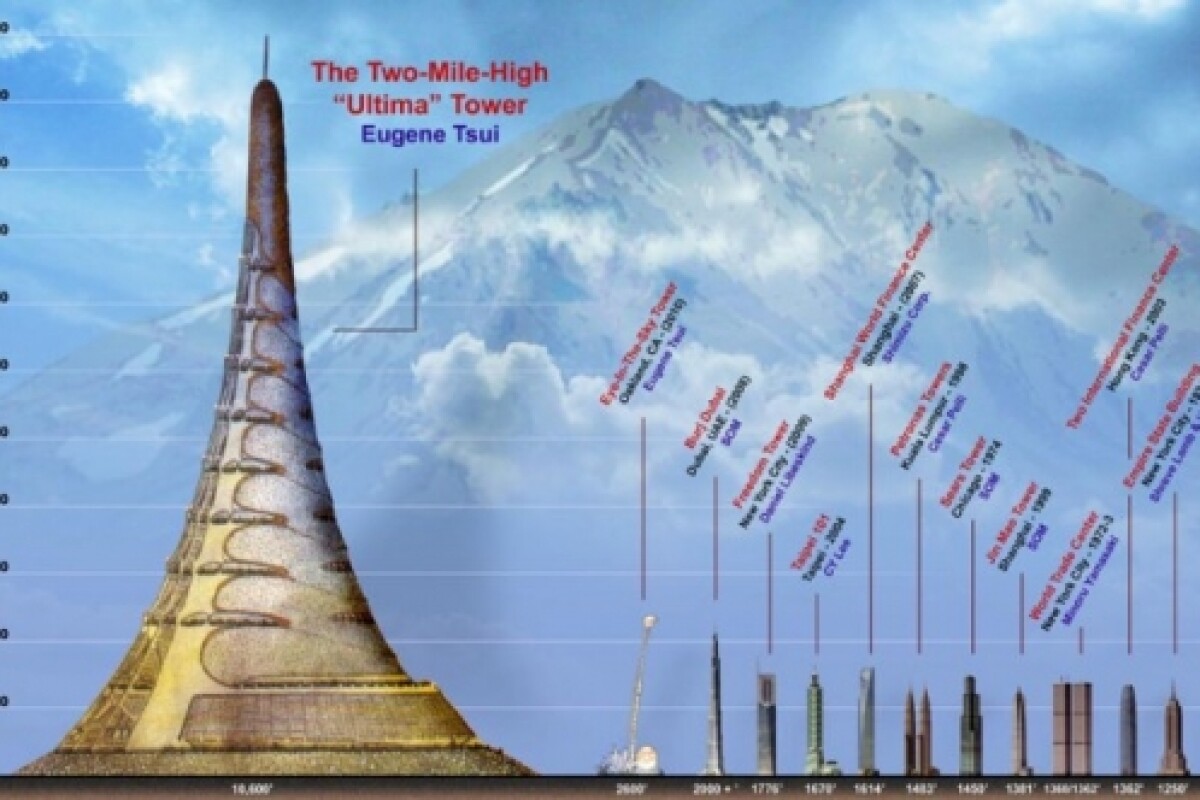



May 5, 2008 Forward-thinking architects are looking upwards in an effort to control a global population that is growing by around 2.2 per cent every year and becoming ever more concentrated in crowded cities. Eugene Tsui is taking nature as the inspiration for his 2-mile high, one-mile wide Ultima Tower, capable of housing up to a million people. Designed to be virtually impervious to wind, water and earthquakes, the massive tower is conceived less as an architecture project but as a series of mini-ecosystems within which other architectural projects can be developed. And it offers some ingenious ideas on energy production, water use and intra-colony transport. At US$150 billion a pop, you wouldn't expect to see the Ultima being built any time soon, but as population pressure increases, it's pioneering ideas like these that will form the inspiration for real-world solutions.
Often through history there's been a fine line between genius and madness - and truly revolutionary ideas that are ahead of their time can sound like the latter. So perhaps it's worth suspending present-day disbelief when you're looking at an idea like the Ultima Tower.
The Earth's population is exploding to unprecedented numbers, bringing with it massive demands on energy, food production and public infrastructure. The percentage of humanity that's living in concentrated city areas has just tipped over 50%, and will continue to increase, meaning that areas that are already overcrowded will need to accommodate millions upon millions more people in the coming decades - and at the same time, more and more land will be needed to grow food for them.
This sort of mass challenge seems to galvanize architects; we've seen a few lately offer massive vertical solutions to the population challenge. The Ultima Tower takes a very interesting and organic approach, inspired by various forms of nature.
Its developer Eugene Tsui isn't thinking in terms of architecture, but of ecosystem creation - because at 2 miles high and with a base with a 1-mile diameter, the Ultima Tower is more like a framework within which smaller architecture can take place. Tsui sees the main challenges as working out how to service the structural, energy, safety, water and transport needs of the estimated 1 million inhabitants such a tower could accommodate.
The shape of the building draws inspiration from the nests of termites, a 1-mile wide funnel shape with gently curved sides. A criss-crossing network of double-helix cables distributes tension across the outer covering in such a way as to allow the entire building to absorb stresses instead of single areas. The design is extremely aerodynamically efficient, and resistant to earthquake shock waves. The structure is cooled in a similar way to a termite nest - the lower levels are cooled by water flow (in this case, a series of ground-floor waterfalls) and the cool air rises through the building, taking heat energy with it, and exits at the upper floors into the atmosphere.
The entire 150 million square foot surface of the building is covered with photovoltaic cells and wind turbine energy generators - and the extreme height of the structure allows a new form of energy generation to occur, using the differential in air pressure between the ground floor and the 10,500-foot high tip to generate further electricity for the project.
Tsui has looked carefully at how trees move water around their considerable vertical lengths and created a similar system for the Ultima Tower. Based on the principles of transpiration and cohesion, water pressure is created at the lower levels and a kind of capillary action moves the water upward through the structure. The entire building is originally situated in a large lake to provide a reserve from which to draw the large volumes of water needed. Large bodies of water are planned at 12 separate levels, to act as fire barriers, sprinkler reservoirs and recycled water basins, as well as for ecological and recreational purposes.
The individual floor environments are looked at as mini-ecosystems in which a range of bird, plant and animal life can coexist with the human habitants. Each of the 120 levels is treated as an entire landscaped neighborhood with a "sky" 30 to 50 meters high and inbuilt lakes, streams, rivers, hills and ravines give a natural setting to the flatter soil on which residential, public and commercial structures can then be built. Natural air is maintained through the building with a policy of using windows and vegetation rather than air conditioning to maintain cooling. As such, the upper floors have thinner air than the lower floors; a choice of altitudes for residents to make.
Ecological efficiency is encouraged through composting toilets, natural water cleaning systems and large amounts of forest and water-based life forms. Every residence is mandated to be a minimum of 100 feet by 100 feet, of which 50% must be covered by natural vegetation. Sunlight is directed through the floors by a system of external mirrors, in order to keep plant life a focus.
Elevators will be powered by compressed air, and a ride from the ground level to the top floors will take more than ten minutes at a constant speed. Getting around the floors themselves will be assisted by a vertically stacked train system, servicing as many as 30 floors at once. Here's hoping it doesn't break down!
Tsui's love of nature-inspired design is obvious in the construction of his astounding house in Berkeley, California, which is modeled after the segmented Tardigrade, one of nature's most indestructible creatures. He has built several other unique structures, with dozens more in planning and development phases, but nothing (obviously) of the scale of the Ultima Tower.
At an estimated cost of $150 billion to build, it's unlikely that we'll see the Ultima ever come to fruit. But as our numbers continue to increase and our physical space actively declines with increased food production, cities across the world are going to be forced to look at vertical solutions, and the range of ideas Tsui has packed into this one is quite outstanding.
Loz Blain
Images courtesy of Eugene Tsui / tsui design and research, inc.
See also - tsui design, Inhabitat.