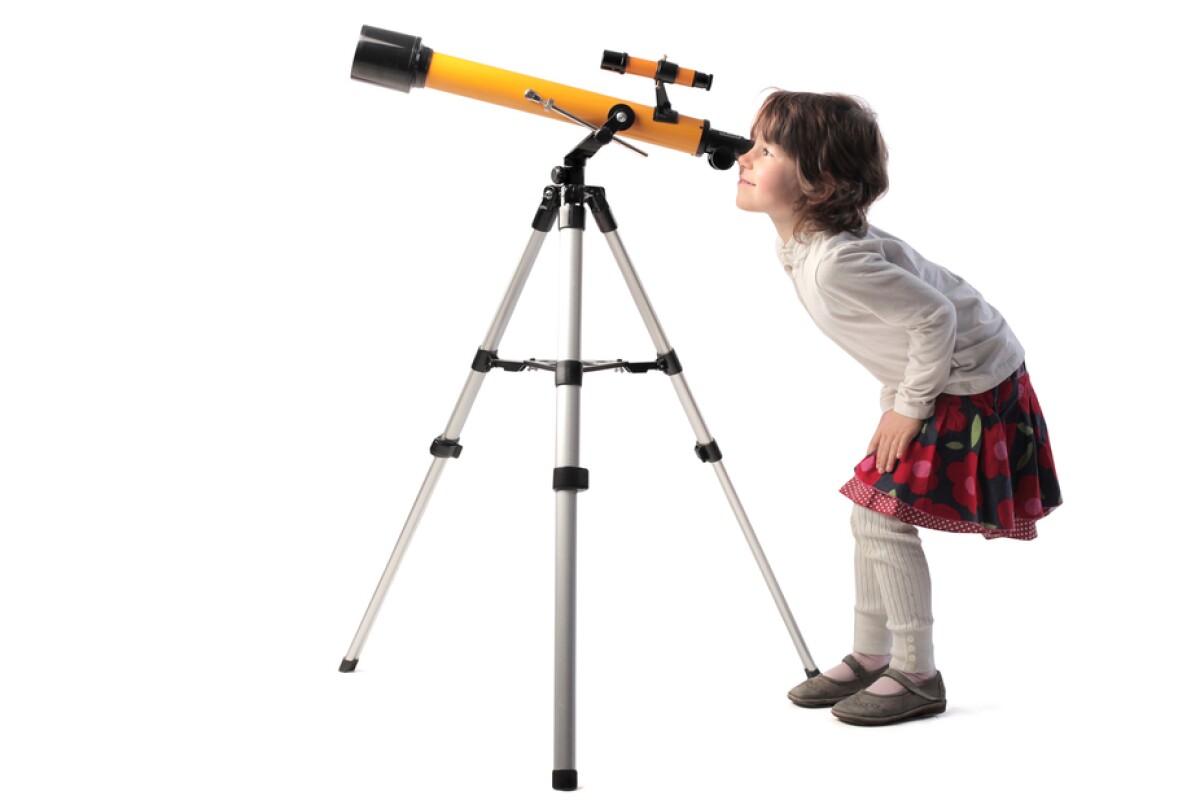



If you received a telescope for Christmas, or bought one for your kids, your adventures in amateur astronomy are just beginning. Astronomy is the art and science of actually looking at the heavens and even a small telescope will let you find a host of celestial wonders. So where do you begin? Here are our suggestions for five of the most rewarding and spectacular objects with which to start your adventure in amateur astronomy ... plus some important tips on using a telescope.
What is a "small" telescope? Roughly speaking, small "beginner" telescopes have an objective (main optic) diameter between about 2.4 and 4.5 inches (60 and 115 mm). These are the scopes for which the sights of our list are intended. If you have a larger scope, your views will be that much better.
Before getting to our list of objects, here's a few tips on how to use your new telescope.
- The single most important tip is to go easy on magnification. Some small "department store" scopes come with eyepiece combinations that will give 500X magnification or more. Using such magnification on a small scope will result in a dim, blurry, and very narrow view. This is too much magnification for the scope, for your scope's mount (vibrations), and for the atmosphere through which you are viewing (turbulence). A rule of thumb is to use magnification between about four and twenty-five times the diameter in inches (between 1 and 0.16 times the diameter in mm) of your scope's objective lens. On rare occasion you can use twice this magnification IF your mount is steady enough.
- If you have an GOTO mount, don't expect too much of it. These mounts automatically point your scope at a selected object, but while computer pointing is a useful tool, GOTO accuracy on inexpensive scopes is not always the best. Pointing accuracy depends on the setup (usually aiming the scope at three bright stars) and the quality of the gears, which are usually plastic in inexpensive GOTO mounts. As a result, if using the GOTO capabilities of your scope, always use an eyepiece that gives your scope its lowest magnification. This gives you a large field of view, and greatly increases the chance of finding your target.
- When observing faint objects, give your eyes a chance to adjust to the dark. After 20-30 minutes in the dark, your eyes will be thousands of times more sensitive than when you first go outside. Also, when observing very faint objects, you will see more if you look a bit to the side (averted vision). In this way the light of the object hits the more sensitive rods of the retina.
- Another factor to keep in mind is light pollution. In crowded cities it is often difficult to see even the brightest stars owing to streetlights and car headlights. There are two main ways to combat this. The best is to take your telescope to a location that has darker skies, typically to rural areas outside of town, although suburban parks may be dark enough to observe many objects. The other approach is to at least set up your telescope in a dark area, say, in the shadow of trees or a building. The lack of direct light will allow your eyes to become dark adapted, and more able to examine the objects you want to see. If neither of these is possible, remember that the Moon and planets can be seen in almost any situation.
- If you have trouble finding any of the objects listed below, examine the area of the sky using a pair of binoculars. All of them show up clearly in binoculars, and this gives you a quick way to get your bearings.
Now let's get down to observing! First, a safety note – NEVER point your telescope at the Sun! While watching the Sun can be done safely with a telescope, you need dedicated equipment to do so.
1. The Moon
The best object for examination with a small scope, bar none, is Earth's Moon. The Moon will fill your field of view at about 60 power, and even the smallest telescope will reveal the craters, rills, shadows, ejecta plumes, and other details on the Moon's surface.

An excellent beginner's guide for learning the Moon's surface features is the Lunar 100, a list of features in order of increasing difficulty. When you work through this list with a high-quality Lunar map, you will never again look at the Moon in the same way. My favorite Lunar feature is the dual crater Messier/Messier A, #25 on the list, the result of a glancing impact by a pair of small asteroids.
2. Jupiter
Right after darkness falls, the brightest object high in the eastern sky is Jupiter, the largest planet in the solar system.

Even though Jupiter is currently about 630 million km (390 million miles) away from Earth, 40X magnification will make it appear the size of the Moon in the night sky. You should easily be able to see the bands of clouds which circle Jupiter, and Jupiter's four largest moons are easy targets that change position from night to night. The Great Red Spot has been a bit dim in recent years, so the smaller scopes will probably not show it. As a bonus, Jupiter is currently surrounded by the Hyades star cluster, a loose assortment of dozens of stars you will be able to see best using your lowest magnification.
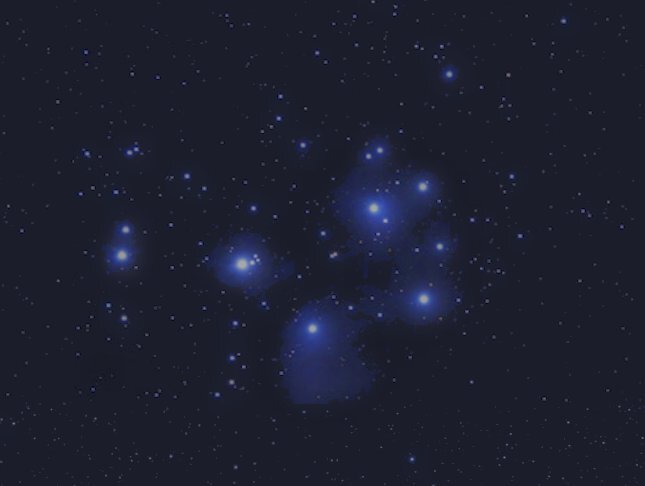
Also, about 10 degrees north and slightly west of Jupiter lies the Pleiades star cluster, visible as a tiny "Big Dipper" without your telescope. (Your fist at the end of your outstretched arm is about 10 degrees wide.) Viewed through a telescope, dozens of stars appear in a smaller area than that covered by the Hyades. These are two of the closest star clusters to Earth, at about 150 and 300 light years, respectively.
3. Orion Nebula
Next is the sword of Orion. The Orion Nebula (also known as M42) hangs like a sword below the belt of Orion, which is high in the southern sky after dark.

Easily visible to the unaided eye, the Orion Nebula is a stellar nursery where stars are being born at a rapid pace, the nearest such region to Earth at a distance of about 1340 light years. The light of the Orion Nebula comes from an assortment of very hot stars within it. These stars excite some of the gas in the nebula to emit their characteristic spectral lines, while the dust in the nebula reflects their light. Even in a small scope, M42 is a delightful sight.
There is a quadruple star called the Trapezium within M42 that can be seen at a magnification of 40 or 50X. This is actually an asterism, an accidental alignment of unrelated stars, but they are unusually close together, with a spread about the same size as Jupiter. It has been suggested that an intermediate mass black hole may reside in the general vicinity of the Trapezium.
4. Andromeda and Triangulum galaxies
All of the objects above can be observed from either the northern or southern hemispheres. Now we're going to split our attention to look at a pair of galaxies for each hemisphere.Northern Hemisphere: A little over 10 degrees southwest of the "W" shaped Cassiopeia lies an easily visible white patch in the sky. This is M31, the Andromeda galaxy.

M31 is very nearly the same size as is our galaxy, and is about 2.5 million light years distant, making it the closest large galaxy to ours. In fact it will collide with our galaxy in a mere four billion years or so. Use your lowest magnification and averted vision to trace out the fringes of the galaxy – in a larger scope and a dark sky it can be traced out to nearly three degrees across. On a good night you may see M31's satellite galaxies M32 and M110 to either side of the flat disk.

The other Northern Hemisphere galaxy is found about 10 degrees southeast of M31, near the tiny arrow-like asterism of Triangulum. This is M33, the third largest member of the Local Group of galaxies that includes M31 and our galaxy. At a distance of about three million light years, M33 can be glimpsed in a very dark sky without optical aid, but from most observing sites binoculars allow it to be easily located. M33 is about double the size of the full moon, and again calls for low magnification and averted vision to make the most of the object. It is a spiral galaxy viewed nearly from atop the spiral, leading to interesting patterns of dark lanes in larger telescopes.
5. Large and Small Magellenic Clouds
Southern Hemisphere: At this time of year, southern viewers are fortunate to have the Milky Way's companion galaxies, the Large and Small Magellenic Clouds (LMC and SMC, respectively), in prime position for an early night's observation.

The LMC is visible as a faint "cloud" in the night sky of the southern hemisphere straddling the border between the constellations of Dorado and Mensa. In total it is nearly as bright as is Alpha Centauri, but is spread over a region of the sky the size of your fist, so appears far fainter. Once again this is a subject for your smallest magnification, but even so the entire LMC will not fit in your field of view. Fortunately there is a great deal of smaller structure to be seen, including the Tarantula Nebula.
The SMC is about 20 degrees to the west of the LMC. It is dimmer than the LMC, but also is smaller in extent. As a result, the surface brightness (total brightness/area) is about the same for the SMC and LMC. The SMC has several open clusters and areas of nebulosity, the brightest of which might be glimpsed using a small telescope. Examining the SMC brings an additional award in the form of the second brightest globular cluster, NGC104. NGC104 contains roughly a million stars within a 120 light year sphere. In a small telescope it appears about half the size of the Moon, and with larger magnifications (perhaps 20-25 X) some of the stars will be resolved around the edges of the cluster.
Wherever on Earth you live, your adventures in amateur astronomy are just beginning. Even your small telescope will let you find a host of celestial wonders.
Source: Astronomical League