


December 21, 2007 The Personal Watercraft (PWC) market is in the grip of a horsepower “arms race” with a rash of new machinery announcements including a 342 bhp 2.2 litre V6-engined PWC from Austrian company HSR-Benelli and a 308 bhp 2.2 litre V8-engined PWC from the famous Italian MV Agusta motorcycle company. It all appears to have been catalyzed late last year when Kawasaki announced its 250 bhp Ultra 250X into a market where Seadoo’s 215 bhp RXP was previously the fastest of the bunch. Subsequently, SeaDoo has announced 255 bhp RXP-X and RXT-X models, Honda has announced a turbocharged 1500cc Aquatrax and Yamaha has announced a new lightweight purpose-built, turbocharged and intercooled 1812cc Super High Output (SHO) motor in its 2008 range. Given the radical upsurge in power outputs, one wonders what might be available a year or two from now.
Until Kawasaki announced its Ultra 250X last year, the most powerful standard PWC available was Seadoo’s 215 bhp RXP and a gentleman’s agreement with the US Coast Guard by all manufacturers meant that no stock PWC could exceed 65mph.
It all sounds like a remake of the motorcycle horsepower wars of the seventies and eighties which were catalyzed by Kawasaki with the release of the 82 bhp 900cc Z1 in 1973 – a landmark motorcycle with significantly more power than anything that had existed before.
The massive success of the Z1 saw the other manufacturers follow suit, and like bidders at an auction, Honda, Yamaha, Suzuki and Kawasaki continuously leapfrog each other with ever-more-powerful models, boosting top-of-the-line power to more than 100 bhp before the turn of the decade, 130 bhp by the mid eighties and 150 bhp by 1990. In 17 years, the horsepower of the leading mass-produced flagship models more than doubled. By comparison, in the subsequent 17 years, horsepower of the leading sports machinery has risen only 30%.
The parallels with the motorcycle industry are many – three of the four leading PWC manufacturers (Japanese makers Honda, Yamaha and Kawasaki) produce motorcycles also, and the engines used in PWC are often derived from motorcycle engines with Kawasaki’s Ultra 250X based on the ZX1400 bike engine and Yamaha getting great value in PWC from its R1 sports bike motor. The links grew stronger in the last few months with the news that the revered Italian motorcycle names of MV Agusta and Benelli are set to grace two new ranges of extreme performance PWCs.
Europe’s only PWC manufacturer, Austrian-based Hydrospace, acquired Benelli Motori (the engine arm of Benelli Motorcycles), changed its name to HSR-Benelli in October and announced an entirely new series of PWC at Salon Nautique de Paris earlier this month, all powered by derivatives of the Benelli Tre motorcycle engine.
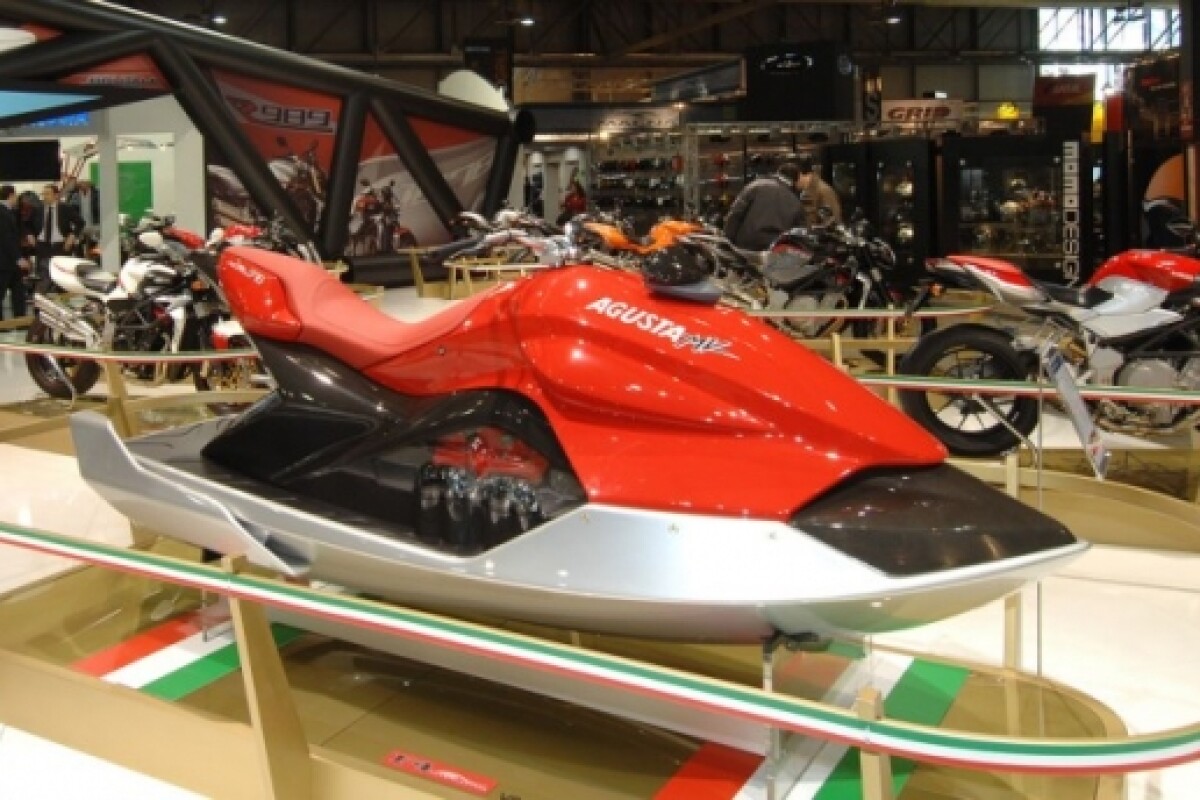
Then MV Agusta unexpectedly unveiled the F4 Interceptor - a carbon fiber hulled V8-engined PWC - at the Milan Motorcycle Show in Italy a few weeks ago.
Interestingly both of the new European PWC manufacturers have opted to use large-capacity normally-aspirated powerplants borrowed from motorcycles, rather than the turbo/supercharged route of the Japanese manufacturers. Indeed, for their flagship models, both of the Europeans have taken motorcycle engines and created new engines by fusing two motorcycle engines together
MV Agusta has taken two of its high performance 1078cc four cylinder engines and created a Swiss-watch-like 2156cc V8 powerplant which will power a limited-edition 308 bhp, carbon-fiber–hulled, two-seater called the F4 Interceptor.
Information on the Italian machine is scarce though you don't need to be a Rhodes Scholar to recognize it is likely to become the world’s fastest and most expensive PWC and the ideal accessory for all those EUR100 million yachts moored in the Mediterranean.
The only information apart from the raw numbers available on the craft at this stage is that it has a CDI ignition, electronic fuel injection, a 3-blade stainless steel impeller, uses a 160mm high pressure axial flow pump and is claimed to weigh in at an astounding 238 kg dry.
Indeed, the specifications of the MV Agusta appear to hold the key to the machine’s performance aspirations. The light weight is not just a function of exotic materials such as the carbon fiber hull and frightfully expensive titanium and magnesium which is spread liberally around their motorcycles – it is also much smaller than any of the current crop. At 2.946 metres long, it is 36 cm shorter than the SeaDoo, which is shorter than any of the Japanese models – for those who can’t think in metric, that’s more than a foot shorter than any of the others.
As with any other form of performance motorsport, fundamental physics still applies - modest dimensions means less mass to accelerate, stop and change direction.
Compare the dimensions and power of the MV Agusta and HSR-Benelli to the recently announced offerings of the existing manufacturers and you’ll see a significant gap in the power-to-weight ratios – see this table – and why we think the European PWC will naturally fall into an elite class of PWC similar perhaps to the difference between luxury class cars such as BMW and Mercedes, and their exotic automotive counterparts such as Ferrari, Lamborghini et al.
One of the most successful motorcycle racing marques in history, MV Agusta produces a range of exquisite performance motorcycles including the world’s fastest production motorcycle (the F4 R312) and the world’s most expensive (the 100,000 Euro F4CC).
Limited numbers of the new F4 Interceptor will be produced in 2008 and no price has yet been announced but given its impeccable heritage and positioning as a luxury brand, it is expected to quite comfortably become the most expensive production PWC yet sold.
The new HSC-Benelli Series-R range will have four models, two using the three cylinder Benelli motorcycle engine (a EUR 11,250 Naked Edition tuned to 142 bhp and a EUR 13,500 172 bhp Pro Edition) and two using the V6 engine created by fusing two three cylinder engines together. The V6-engined machines will be a 278 bhp, 328 kg EUR 17,900 Prestige model and a 342 bhp EUR 19,900 race edition.
Given the conversion rates to US dollars, the HCS-Benelli Series-R range is likely to be very expensive in comparison to its contemporaries in the United States, though given the level of specification, many consider that the race machinery is indeed still a bargain.
There’s one other issue still to be resolved before the Series-R range makes an appearance in the lucrative U.S. market and that’s that the machinery has yet to gain U.S. Coast Guard approval – something which might be problematic given that the V6-engined machinery is likely to easily contravene the agreement between the manufacturers and the Coast Guard that no standard PWC will exceed 65 mph.
Where it all goes from here will be interesting. The aftermarket accessory market for PWCs is booming and an unlimited budget for go-fast goodies can build you a 90 mph PWC from the current crop of machinery.
Both the Benelli 1100 and MV Agusta F4 bike engines are capable of producing incredible performance with off-the-shelf parts. For example, the more expensive motorcycle variants of the MV Agusta F4 1078cc engine (such as the 2008 “312” model) produce in excess of 200 bhp. Benelli is rumored to be close to announcing a turbocharged version of its TRE with more than 200 bhp on tap.
Accordingly, 400 bhp is achievable from both the Italian V8 and Austrian/Italian V6 using readily available parts. 400 horses in a jet ski is a tantalizing prospect to be sure … and this is just the start.