
University of Warwick
-
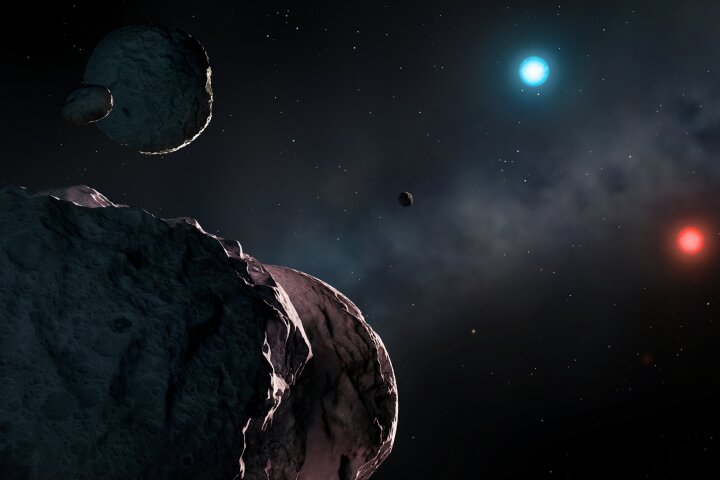 Planets have been born, lived and died long before Earth even existed. Now astronomers have detected the ruins of ancient planets around two unusual white dwarf stars, including an Earth-like world that existed almost 10 billion years ago.
 -
 In what's described as a key advancement for the future of systems that could help propel humans into deep space, scientists have demonstrated a method of extracting oxygen from water in microgravity using magnetism.
 -
 Some cells can turn cancerous when they divide, due to chromosomes getting “lost” in the process. Researchers have now uncovered what happens to these lost chromosomes and how to recover them, potentially leading to ways to prevent certain cancers.
 -
 It's safe to say that any task which involves going up high is at least somewhat dangerous. The HB1 robot was designed with this fact in mind, as it climbs walls and even scuttles across ceilings so people don't have to.
 -
 Supernovae usually appear suddenly in the sky, but now astronomers have spotted one in advance. The telltale sign is a star with a “teardrop” shape, as it gets stretched out by the gravitational pull of a companion.
 -
 Although an increasing number of countries are switching to sturdier, harder-to-copy polymer banknotes, the things still are being counterfeited. A new technology could help weed those fakes out, by taking their fingerprints.
 -
 The common perception is that that it can be harder to shed excess pounds as we grow older, but a new study has contradicted this school of thought, indicating lifestyle changes can help tackle obesity regardless of age.
 -
 Debris orbiting in high Earth orbit is not being tracked closely enough, according to the results of a new survey, and could pose an unexpected threat to important satellites that provide communication, weather observation and navigation services.
 -
 Whether it occurs in a car, plane, boat or VR environment, motion sickness is no fun. According to new research, though, it's possible for people to "train their brain" out of the condition, potentially reducing the symptoms by more than half.
 -
 For the first time, astronomers have used a machine learning algorithm – a form of self-teaching AI – to confirm the existence of 50 new exoplanets in data collected by the now retired Kepler space telescope.
 -
 A Medieval medical book hold the key to new ways to combat antibiotic-resistant bacteria. Scientists have found that a medical recipe from the ancient Bald's Leechbook is effective against five strains of bacteria that cause biofilm infections.
 -
 It goes without saying that as a chemist stirs a solution in their lab, they need to check how its characteristics change. A new "Smart Stirrer" has been designed with that in mind, as it automatically detects and reports transformations.
Load More