
UAS
-
 In a sky-high, 24-hour test flight, BAE System successfully sent its High Altitude Pseudo Satellite (HAPS) Uncrewed Aerial System (UAS) PHASA-35 solar-powered drone into the stratosphere, reaching an altitude of over 66,000 ft (20,000 m).
 -
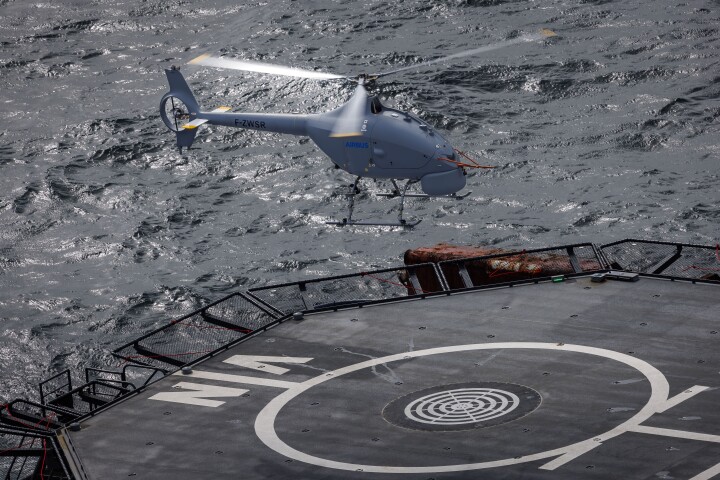 The Airbus'VSR700 robotic helicopter has successfully completed sea tests under operational conditions, including fully autonomous take-offs and landings in strong gale force wind conditions, from a civilian ship's helicopter deck.
 -
 BAE Systems has brought down drones using standard rockets equipped with its Advanced Precision Kill Weapon System and an advanced proximity fuse – an approach the company says costs much less than conventional drone countermeasures.
 -
 Boeing's Loyal Wingman combat drone has taxied under its own power for the first time, carrying out several ground maneuvers at speeds of up to 14 knots (16 mph, 26 km/h) and stopping on command.
 -
 AeroVironment has unveiled its latest loitering missile unmanned aircraft system. Based on the Switchblade 300, which was deployed with US forces in Iraq and Afghanistan in 2011, the Switchblade 600 is larger with increased capabilities.
 -
 Germany's Elektra Solar has announced that its Elektra Two Solar OPS high altitude, long endurance aircraft has successfully taken off, flown around a bit and landed all by itself, in a demonstration of a new autopilot system.
 -
 Lockheed Martin's Fury drone had previously demonstrated the ability to stay in the air for more than 12 hours at a time over a series of flight tests. Now the Fury has been fitted with a new engine that Lockheed says will increase its flight endurance to 15 hours.
 -
 As part of its plan to turn undersea drones from remote controlled tools to proper members of the fleet, the US Navy has awarded a US$43.2 million contract to Lockheed Martin to design an autonomous submarine capable of carrying out multiple missions without a human crew.
 -
 Urban aerial surveillance is already seen as a crucial element in the information mosaic required by any smart city, and last week's TM Forum Smart City In Focus Conference in Yinchuan (China) saw the first showing of an Unmanned Aerial System that has been purpose-built for the task.
 -
 Defense company Kratos has announced that it will show two low-cost combat drones at the Paris Air Show next week, offering an insight as to what military conflicts might look like in the foreseeable future – a manned combat jet leading dozens of 1,000 km/h lethally-armed unmanned companions.
 -
 DARPA’s unmanned aerial systems (UAS) can be fitted for a wide range of missions, but compact UAS can usually only carry one such instrument at a time, and need to land fr a swap over. Now, DARPA and BAE Systems are collaborating on a program to enable smaller UAS to multitask.
 -
 Wirth Research has unveiled the design of its tilt-rotor, vertical take off and landing (VTOL) drone. The company claims its UAS will be the first in the world to use lightweight hydrogen fuel cells as its primary energy source, for a combination of long range and zero local emissions.
Load More